
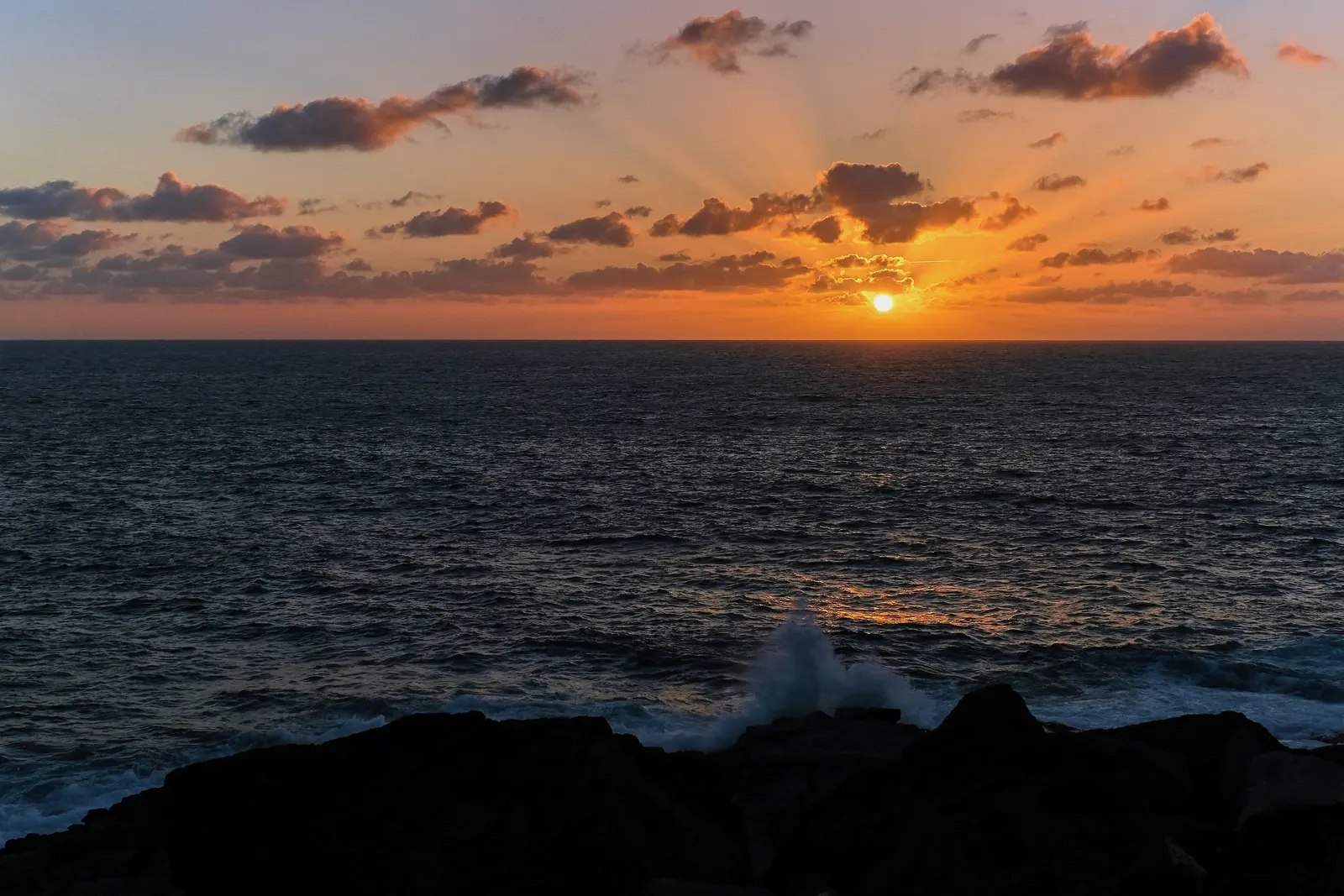
Vines grow in black ash here, each one cupped in its own hollow behind a crescent of volcanic stone. La Geria's vineyards look like land art, and in a sense they are. Lanzarote was remade by the eruptions of the 1730s, then remade again by César Manrique, who treated the island itself as his medium.
Lanzarote is made for unwinding. It's ready to explore in the Nuvoha app: set your budget and see complete Lanzarote trips.
Why visit Lanzarote
The eruptions that buried a quarter of the island left behind Timanfaya's rust-and-charcoal Fire Mountains, where geothermal heat still scorches brushwood a few metres below the surface. Manrique's interventions (the lava-tube auditorium at Jameos del Agua, the cliff-face lookout of Mirador del Río, his own house built inside volcanic bubbles) give that landscape a human answer. Add the white villages his low-rise campaign preserved, wines pressed from Malvasía volcánica grapes and the sheltered coves of Papagayo, and the whole island reads as one composed work. UNESCO declared it a Biosphere Reserve in 1993.
What Lanzarote feels like
Lanzarote is pared back: whitewashed cubes with green-painted woodwork, black fields, few buildings above two storeys and almost no advertising hoardings. The trade winds keep the air clear and the kitesurfers busy at Famara, while inland villages like Haría sit in palm-filled valleys that feel closer to an oasis than to Europe. It is a quiet island that rewards slow driving and long views.
Fire, caves and land art
- Timanfaya National Park: The Fire Mountains of the 1730s eruptions, toured by coach along the Ruta de los Volcanes with geothermal demonstrations at the top.
- Jameos del Agua: Manrique's transformation of a collapsed lava tube into gardens, a pool and an auditorium, home to blind albino cave crabs.
- Cueva de los Verdes: A walkable stretch of the same lava tunnel system, running for kilometres from volcano to sea.
- Mirador del Río: A Manrique-designed viewpoint built into a cliff some 400 metres above the strait facing La Graciosa.
- La Geria: The ash-black wine region where thousands of stone half-moons shelter individual vines from the wind.
- Playas de Papagayo: A cluster of sheltered golden coves at the island's southern tip, lying inside a protected natural area.
Villages and shorelines
- Arrecife: The low-key capital, arranged around the seawater lagoon of El Charco de San Ginés.
- Teguise: The island's former capital, a dignified inland town of whitewashed mansions and cobbled squares.
- Puerto del Carmen: The main resort strip along the south-east coast, spread behind a long run of beaches.
- Haría: A northern village in the so-called Valley of a Thousand Palms, where Manrique spent his final years.
- Playa Blanca: The southernmost town, a ferry port facing Fuerteventura with the Papagayo coves at its edge.
Ash-grown food and wine
Food here tastes of the Atlantic and the ash. Day boats land cherne and vieja for the grill; lapas (limpets) are seared and doused in green mojo; gofio, the archipelago's toasted grain, thickens broths and desserts alike. The revelation is the wine: Malvasía volcánica grown in La Geria's black hollows, mineral and faintly saline.
- Lapas con mojo verde
- Cherne a la plancha
- Gofio escaldado
- Caldo de pescado
Empty roads, short drives
IntercityBus Lanzarote runs the public network from Arrecife out to the resorts and larger villages, but timetables thin beyond the main corridors. Most visitors hire a car: distances are short, the roads are excellent and empty, and the Manrique sites are scattered. Inside Timanfaya there is no self-driving: the Ruta de los Volcanes is covered by the park's own coaches. César Manrique-Lanzarote Airport lies just outside Arrecife on the island's east coast. Transfers are short: Puerto del Carmen is a few minutes away, Playa Blanca around half an hour.
Know before you land
- Leaving small change or rounding up after a meal is appreciated; nobody expects more.
- Stay on marked paths across the lava fields: the crusts are fragile and the flora slow-growing.
- Greetings are unhurried; a buenos días opens every exchange in shops and villages.
- Manrique's legacy is a point of local pride: visitors who know his work are warmly received.
- The trade winds blow for much of the year: the east and south coasts have the calmest water, while Famara's surf belongs to experienced board riders.
- A combined entry covering several of the CACT Manrique sites is worthwhile if you plan to see more than two.
- Caldera Blanca, just outside the national park boundary, is the volcano you can actually climb on foot.
- La Geria's bodegas welcome visitors for tastings: the Malvasía is hard to find off the island.
- Swimming at Famara is dangerous in most conditions; admire it, surf it with a school, but swim elsewhere.
Best for
- Beach time
- Unwinding
Key facts
| Country | Spain |
|---|---|
| Region | Europe |
| Airports | ACE |
| Trip length fit | Short-trip friendly |
| Editorial | Featured destination |
Lanzarote essentials
| Currency | Euro (EUR) |
|---|---|
| Language | Spanish (Castilian), with Catalan, Basque and Galician co-official regionally; English is common in tourist areas |
| Time zone | Mainland: Central European Time (UTC+1, UTC+2 in summer); the Canaries are one hour behind the mainland |
| Emergency number | 112 (general emergency) |
| Driving side | Right |
| Tap water | Safe to drink across the country; the taste varies by region |
Climate & seasons
| Month | Typical range | Season |
|---|---|---|
| January | 14°C to 21°C | Mild dry winter |
| April | 16°C to 23°C | Warm spring |
| July | 20°C to 28°C | Warm windy summer |
| October | 20°C to 27°C | Warm autumn |
Lanzarote is one of Nuvoha's winter-sun picks.
Typical stay
- Weekend-friendly
- Short break (2–5 days)
Lanzarote works as a weekend break just as well as a longer stay.
Getting there
Lanzarote is served via ACE.
- ACE
Is it your kind of trip?
Ideal if…
- time on the coast is the point of the trip
- you want to slow down and reset
- you want one of our featured destinations
Maybe not if…
- you want big-city energy around the clock
Pairs well with
Compare with
| Lanzarote | Gran Canaria | Tenerife | |
|---|---|---|---|
| Country | Spain | Spain | Spain |
| Region | Europe | Europe | Europe |
| Styles | Beach | Beach | Beach |
| Trip length fit | Weekend-friendly | Weekend-friendly | Weekend-friendly |
| Airports | 1 | 1 | 1 |
More in Europe
Near Lanzarote
Travel style
- Winter sun
- Short-trip friendly
- Beach
Frequently asked questions
Which airports serve Lanzarote?
Lanzarote is served via ACE.
Is Lanzarote good for a weekend trip?
Yes, Lanzarote works for a weekend as well as a longer stay.
What kind of trip is Lanzarote best for?
Lanzarote is best for beach trips, popular for unwinding.
Which destinations pair well with Lanzarote?
Within multi-city range: Gran Canaria (207 km), Tenerife (307 km), Agadir (423 km).
Can you walk on the volcanoes at Timanfaya?
Not freely: the national park protects its fragile lava, so access is by the park's coach route and a couple of guided walks. For volcano hiking under your own steam, climb Caldera Blanca or the Montaña Roja crater near Playa Blanca instead.
Is Lanzarote too windy to enjoy?
The trade winds are constant company but rarely spoil things; they keep summer temperatures pleasant. Beaches on the south and east, such as Papagayo and Playa Grande, are well sheltered, while the windward north-west is best left to surfers and dramatic photographs.
Do you need cash on Lanzarote?
Cards are accepted almost everywhere, including small village bars. Keep a little cash for market stalls in Teguise, rural honesty boxes and the occasional taxi. Cash machines are easy to find in Arrecife and the resort towns.