
A rolling field of Saharan-style dunes slides into the sea at Maspalomas; an hour's drive north, the same island turns green with pine forest and cliff-hung villages. Gran Canaria is carved by deep ravines (barrancos) radiating from a mountainous core, which is why locals call it a continent in miniature.
Gran Canaria is made for unwinding. It's ready to explore in the Nuvoha app: set your budget and see complete Gran Canaria trips.
Why visit Gran Canaria
Gran Canaria packs remarkable variety into fifty kilometres: the protected dune reserve at Maspalomas, the sacred monolith of Roque Nublo standing near 1,800 metres, whitewashed Tejeda in its volcanic amphitheatre, and Las Palmas, a proper working city with one of the world's finest urban beaches in Las Canteras. History runs deep too, from pre-Hispanic cave dwellings in Barranco de Guayadeque to the Vegueta quarter where Columbus paused en route to the Americas. Few islands offer city, mountain and desert within a single day.
What Gran Canaria feels like
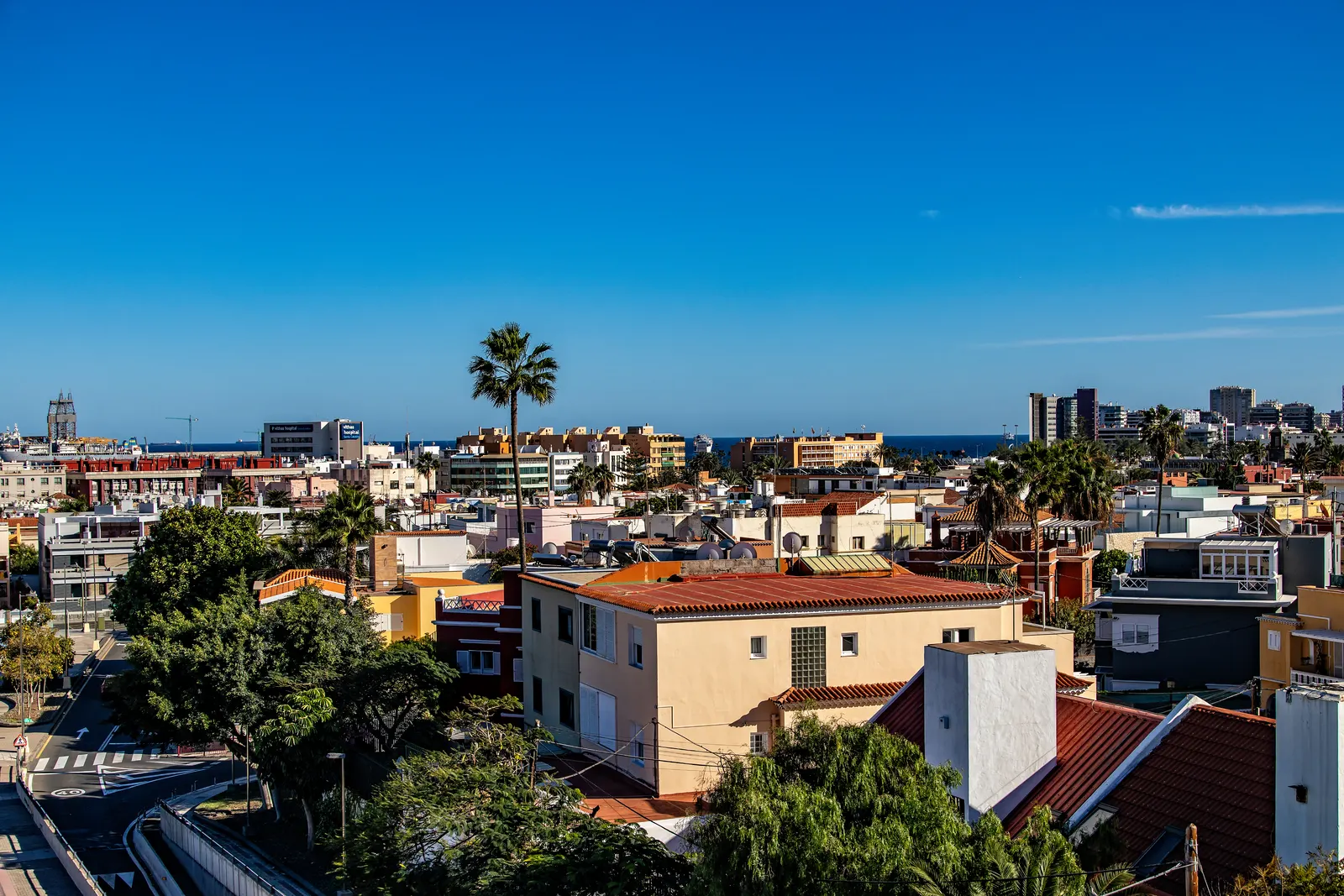
The south is holiday territory, sun-sure and unhurried along its promenades. Las Palmas feels entirely different: surfers wax boards beside office workers on Las Canteras, and the old town's plazas fill for the evening paseo. Inland, silence takes over: terraced ravines, almond trees, hamlets where the bar doubles as the shop. Weather shifts with altitude, so mist and sunshine often share the island at once.
Dunes, ravines and summits
- Dunas de Maspalomas: A protected reserve of shifting golden dunes framed by a palm oasis, the La Charca lagoon and the ocean.
- Roque Nublo: An 80-metre volcanic monolith sacred to the island's pre-Hispanic inhabitants, reached by a short summit path.
- Vegueta: Las Palmas's foundation quarter of cobbled lanes, the Casa de Colón and the cathedral of Santa Ana.
- Playa de Las Canteras: A three-kilometre city beach sheltered by a natural offshore reef known as La Barra.
- Puerto de Mogán: A canal-threaded fishing port on the south-west coast, its houses draped in bougainvillea.
- Barranco de Guayadeque: A deep ravine dotted with cave houses and cave chapels, parts of it still inhabited.
From capital to cave village
- Las Palmas de Gran Canaria: The island capital, splitting its life between the historic Vegueta-Triana axis and the beachside Santa Catalina end.
- Maspalomas and Playa del Inglés: The sun-facing south, a long run of beaches, dunes and resort promenades.
- Tejeda and the highlands: The island's centre of pine forest, almond blossom and viewpoints over the great volcanic basin.
- Agaete: A north-western town of white houses beneath tall cliffs, with natural seawater pools at its port.
- Teror: A pilgrimage town of carved wooden balconies, home to the basilica of the island's patron saint.
Hearty island cooking
Canarian cooking here leans hearty: sancocho, the salted-fish and sweet-potato dish eaten across the island, slow-braised ropa vieja, and watercress stew from the highlands. The north-west produces queso de flor de Guía, a cheese curdled with thistle flowers, while Tejeda's almonds become bienmesabe, a dense honeyed dessert spooned over ice cream.
- Sancocho canario
- Ropa vieja canaria
- Potaje de berros
- Queso de flor de Guía
- Bienmesabe
Guaguas and mountain roads
Buses (always called guaguas here) do the heavy lifting: Global coaches run the island-wide routes while the yellow Guaguas Municipales cover Las Palmas itself. Services along the east and south coasts are fast and frequent; mountain routes are scenic but sparse, so most visitors hire a car for the interior's hairpins and viewpoints. Gran Canaria Airport sits on the east coast, roughly midway between Las Palmas and the southern resorts. Global bus lines run directly to both, and the transfer in either direction takes around half an hour.
Travel notes
- A small tip (rounding up, or a coin or two left on the saucer) is welcome but never assumed.
- The paseo matters: evenings are for strolling, greeting and taking a terrace seat, not rushing.
- Say buenos días when entering small shops and bars; leaving without a goodbye reads as cold.
- Topless sunbathing is accepted on beaches, but cover up before stepping into shops or cafés.
- Pack a warm layer for the highlands: Tejeda can be ten degrees cooler than the coast.
- Walk the Maspalomas dunes at first light, when the sand is cool and the ridges unmarked.
- Swim at Las Canteras along its reef-sheltered stretches if the Atlantic is lively.
- The GC-60 and GC-210 mountain roads are spectacular but slow: double any journey time the map suggests.
- Agaete's natural pools, Las Salinas, make a fine alternative to the beaches on windy days.
Best for
- Beach time
- Unwinding
Key facts
| Country | Spain |
|---|---|
| Region | Europe |
| Airports | LPA |
| Trip length fit | Short-trip friendly |
| Editorial | Featured destination |
Gran Canaria essentials
| Currency | Euro (EUR) |
|---|---|
| Language | Spanish (Castilian), with Catalan, Basque and Galician co-official regionally; English is common in tourist areas |
| Time zone | Mainland: Central European Time (UTC+1, UTC+2 in summer); the Canaries are one hour behind the mainland |
| Emergency number | 112 (general emergency) |
| Driving side | Right |
| Tap water | Safe to drink across the country; the taste varies by region |
Climate & seasons
| Month | Typical range | Season |
|---|---|---|
| January | 16°C to 22°C | Mild dry winter |
| April | 17°C to 23°C | Warm spring |
| July | 21°C to 27°C | Warm dry summer |
| October | 21°C to 26°C | Warm autumn |
Gran Canaria is one of Nuvoha's winter-sun picks.
Typical stay
- Weekend-friendly
- Short break (2–5 days)
Gran Canaria works as a weekend break just as well as a longer stay.
Getting there
Gran Canaria is served via LPA.
- LPA
Is it your kind of trip?
Ideal if…
- time on the coast is the point of the trip
- you want to slow down and reset
- you want one of our featured destinations
Maybe not if…
- you want big-city energy around the clock
Pairs well with
Compare with
More in Europe
Near Gran Canaria
Travel style
- Winter sun
- Short-trip friendly
- Beach
Frequently asked questions
Which airports serve Gran Canaria?
Gran Canaria is served via LPA.
Is Gran Canaria good for a weekend trip?
Yes, Gran Canaria works for a weekend as well as a longer stay.
What kind of trip is Gran Canaria best for?
Gran Canaria is best for beach trips, popular for unwinding.
Which destinations pair well with Gran Canaria?
Within multi-city range: Tenerife (117 km), Lanzarote (207 km), Agadir (629 km).
Do you need a car on Gran Canaria?
Not for the coast: guaguas link the airport, Las Palmas and the southern resorts efficiently. The interior is another story: buses do reach Tejeda and Teror, but sparse timetables make a hire car the practical choice for covering the ravines and viewpoints in one day.
Can you swim year-round on Gran Canaria?
Yes; the Atlantic stays between roughly 19°C and 23°C. Las Canteras and the southern beaches are calmest, while the natural pools at Agaete suit rougher days. Winter sunshine is exactly why the island fills from November to March.
What is the best trip into the mountains?
Head for Tejeda via the GC-15: the route stacks up Teror's balconied old town, the high viewpoints and the Roque Nublo trail. Clear mornings often give views across to Mount Teide on Tenerife before the cloud builds after midday.