
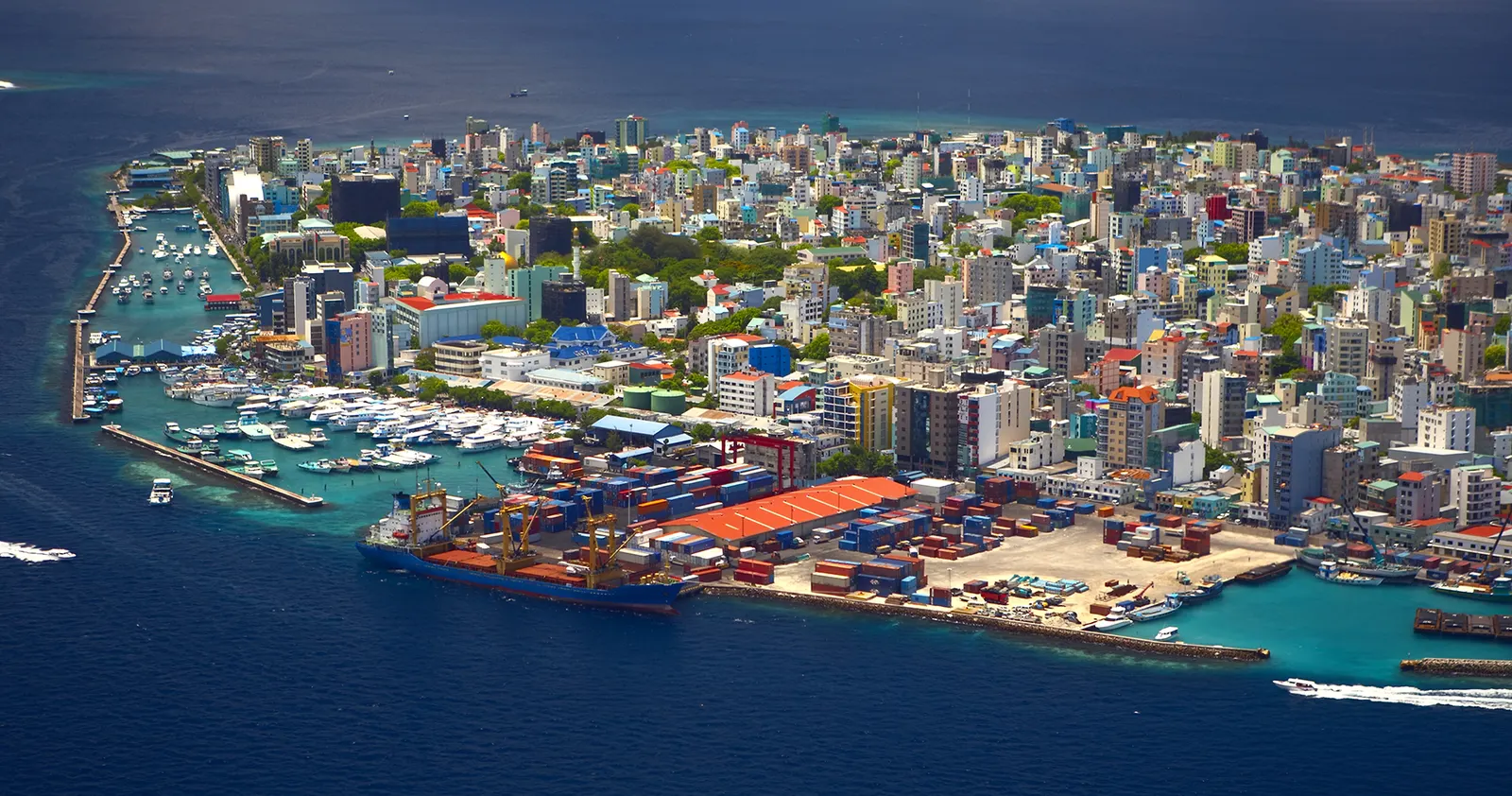
No country on Earth sits lower in the water: the Maldives averages about 1.5 metres above sea level, a chain of 26 atolls strung across 870 kilometres of Indian Ocean south-west of Sri Lanka. Of its roughly 1,190 islands, around 200 are inhabited and well over 150 operate as single-island resorts, the one-island-one-resort model the country made famous. The capital, Malé, packs colourful high-rises onto an island you can walk across in half an hour. Beyond it, the draw is the water itself: house reefs a few fin-kicks from shore, manta rays gathering at Hanifaru Bay in Baa Atoll, whale sharks cruising Ari Atoll, and sandbanks that vanish at high tide. Local-island guesthouses now offer a second way in, closer to Maldivian daily life.
Malé is the Maldives destination on Nuvoha today. Set your budget and Nuvoha builds the complete trip: flights and hotels together.
Why visit Maldives
- Coastline worth building a trip around
Best known for
- Overwater villas
- House-reef snorkelling
- Manta rays at Hanifaru Bay
- Whale sharks in Ari Atoll
- Seaplane transfers over the atolls
Atoll by atoll
- North Malé Atoll: The atoll surrounding the capital, with the international airport and the greatest concentration of resorts reachable by speedboat rather than seaplane.
- South Malé Atoll: A quieter counterpart just across the Vaadhoo Channel, known for consistent surf breaks and reliable channel diving.
- Baa Atoll: A UNESCO Biosphere Reserve. Between roughly May and November, plankton blooms draw large gatherings of manta rays into Hanifaru Bay.
- Ari Atoll: One of the largest atolls and a long-standing favourite for divers, with year-round whale shark sightings along its southern rim.
- Addu Atoll: The southernmost atoll, just below the equator, where a causeway links several inhabited islands (a rarity in the Maldives), and Gan hosts a regional airport.
Where to go
Maldives essentials
| Currency | Maldivian Rufiyaa (MVR); US dollars widely accepted at resorts |
|---|---|
| Language | Dhivehi; English is spoken throughout the tourism industry and in Malé |
| Time zone | Maldives Time, UTC+5, no daylight saving; some resorts run their clocks one hour ahead |
| Emergency number | 119 (police) |
| Driving side | Left |
| Tap water | Not drunk from the tap; resorts and guesthouses supply desalinated or bottled water |
Seasons at a glance in Malé
| Month | Typical range | Season |
|---|---|---|
| January | 26°C to 31°C | Drier season |
| April | 27°C to 32°C | Hot transition |
| July | 26°C to 31°C | Southwest monsoon |
| October | 26°C to 31°C | Humid wet season |
Seasons vary across Maldives. Each destination page has its own climate table.
More in Asia
More Asia country guides
Frequently asked questions
Which Maldives destinations can I book with Nuvoha?
Malé, with complete flight and hotel trips built around your budget.
What kind of trips suit Maldives?
Maldives works for beach holidays.
How do you reach your island from Malé airport?
It depends on distance: speedboats serve islands near Malé, seaplanes reach mid-range atolls in daylight hours, and far-flung atolls combine a domestic flight with a boat. Resorts arrange transfers when you book.
Do I need Maldivian rufiyaa?
Rarely on resort islands, where bills are settled in US dollars or by card. On local islands and in Malé, rufiyaa is useful for cafés, shops and ferries.
What plug type is used in the Maldives?
Mostly the British three-pin Type G, though older buildings may have Type D sockets. Resorts frequently fit universal outlets, but a Type G adapter is the safe bet.