
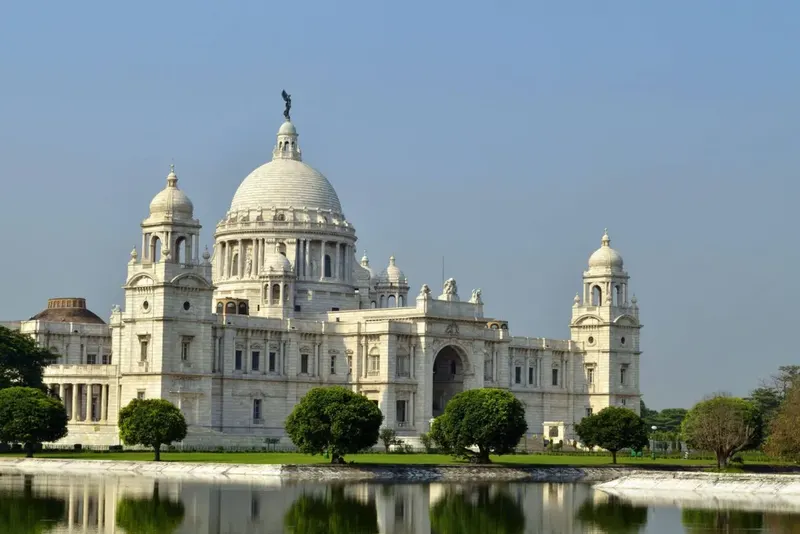
Kolkata was the capital of British India until 1911, and the grandeur of that era still lines the Hooghly: colonnaded mansions, the marble sweep of the Victoria Memorial, and the great steel span of the Howrah Bridge. Yet the former Calcutta is less a museum than a living argument, a city that treats literature, cinema, football and politics as blood sports over endless cups of tea. Bengali culture runs deep here, and few Indian cities are so devoted to conversation, or to sweets.
Kolkata is a quieter alternative. It's ready to explore in the Nuvoha app: set your budget and see complete Kolkata trips.
Why visit Kolkata
Kolkata is India's cultural conscience, the birthplace of a nineteenth-century renaissance whose writers, reformers and artists remade the country's imagination. This is the city of Rabindranath Tagore and Satyajit Ray, of College Street's mile of bookstalls and the coffee-house debates beside them. Its museums and galleries are among the oldest in Asia, its Victoria Memorial and colonial quarter unmatched for Raj-era architecture. Every autumn, Durga Puja transforms whole neighbourhoods into open-air galleries of sculpture and light, a festival now recognised by UNESCO. Add clattering trams, yellow taxis and a street-food culture without rival, and Kolkata rewards the curious.
Highlights
- Victoria Memorial: The white-marble monument to the Raj set in gardens on the Maidan, now a museum of paintings, sculpture and colonial-era history.
- Howrah Bridge: The mighty riveted cantilever bridge over the Hooghly, carrying a ceaseless river of people and traffic between Kolkata and Howrah.
- College Street: A mile of bookstalls known as Boi Para, backed by the university and the venerable Indian Coffee House, long a haunt of students and intellectuals.
- Indian Museum: Founded in 1814, the oldest and largest museum in India, its galleries ranging from Egyptian mummies to Gandharan sculpture and fossils.
- Kumartuli: The riverside potters' quarter in the north, where artisans shape the clay idols of Durga and other deities from straw and mud.
- Dakshineswar and Belur Math: A pair of riverside spiritual landmarks north of the centre, the Kali temple where Ramakrishna served and the Ramakrishna Mission's headquarters facing it across the water.
Areas to know
- BBD Bagh (Dalhousie Square): The colonial administrative core, ringed by Raj-era landmarks like the Writers' Building and the General Post Office around a central tank.
- Park Street and Chowringhee: The city's dining and entertainment spine of old restaurants and Christmas lights, edging the Maidan, the Indian Museum and New Market.
- North Kolkata: The oldest quarter, a dense weave of narrow lanes, faded rajbari mansions, Kumartuli and the Tagore family house at Jorasanko.
- Kalighat: A southern temple district built around the Kali temple, one of the holiest Shakti shrines and the source of the Kalighat style of painting.
- Salt Lake and New Town: Planned townships to the east, home to the IT sector, stadiums and newer housing, a marked contrast to the old city's density.
Food & drink
Bengali food is subtle and fish-forward, built on rice, mustard and the catch of river and pond. A home-style meal moves through courses to macher jhol, a light fish curry, or shorshe ilish, prized hilsa in mustard sauce during the monsoon. The street food is a cuisine of its own: egg-and-kebab kathi rolls, said to have been invented here, spicy phuchka and jhalmuri. Then come the sweets, the city's true obsession, from spongy rosogolla to sandesh and earthen pots of mishti doi.
- Shorshe ilish
- Kosha mangsho
- Kolkata kathi roll
- Phuchka
- Rosogolla
- Mishti doi
What Kolkata feels like
Kolkata is intense, crowded and improbably warm-hearted. Its pavements are a continuous stage of tea stalls, bookmongers, hand-pulled carts and impromptu debate, or adda, the Bengali art of the long unhurried conversation. Grand colonial buildings crumble beautifully beside street shrines and century-old coffee houses; trams still rattle down a few central routes. The city runs on intellect and appetite in equal measure, fiercely proud of its poets and its rosogolla alike. It peaks each autumn with Durga Puja, when the streets fill through the night. The heat and monsoon downpours are real, but the human warmth is the abiding memory.
Getting around
Kolkata runs the oldest metro in India, a fast north-south spine now joined by an east-west line tunnelling under the Hooghly. Above ground, the city's yellow Ambassador taxis, app cabs and auto-rickshaws share the streets with a handful of surviving tram routes and, in places, hand-pulled rickshaws. Buses are plentiful if bewildering. Ferries cross the river to Howrah, and much of the old centre is walkable, if crowded. Netaji Subhas Chandra Bose International Airport lies at Dum Dum, in the north-east of the city, around 45 minutes to an hour from the centre depending on traffic. App cabs and prepaid taxis are the usual way in.
Good to know
- Remove your shoes and dress modestly at temples such as Kalighat and Dakshineswar, where the inner sanctums can be intensely busy.
- During Durga Puja, join the crowds moving between pandals with patience and good humour, and ask before photographing the rituals.
- Use your right hand for eating and passing food, particularly at a traditional shared meal.
- Remove your shoes and leather items before entering temples, and dress modestly at shrines and mosques.
- The cooler, drier months from November to February are the most comfortable for exploring on foot.
- For the full spectacle of Durga Puja, come in autumn, though the city is packed and rooms fill far ahead.
- Ride a surviving tram or the under-river metro for a sense of the city's layered transport history.
- College Street, the coffee house and the Kumartuli workshops reward an unhurried, wandering morning.
- Save room for the sweet shops; rosogolla, sandesh and mishti doi are best from a long-established mishti shop.
Best for
- City breaks
- Quieter travel
Key facts
| Country | India |
|---|---|
| Region | Asia |
| Airports | CCU |
| Trip length fit | Short-trip friendly |
Kolkata essentials
| Currency | Indian rupee (INR) |
|---|---|
| Language | Hindi and English are the union-level official languages, alongside twenty-two scheduled languages and hundreds of others; English is widely used in cities, business and tourism. |
| Time zone | IST (UTC+5:30), a single time zone across the whole country |
| Emergency number | 112 |
| Driving side | Left |
| Tap water | Not reliably safe to drink; choose sealed bottled water, or water that has been filtered or boiled. |
Climate & seasons
| Month | Typical range | Season |
|---|---|---|
| January | 13°C to 26°C | Dry mild winter |
| April | 24°C to 36°C | Hot pre-monsoon |
| July | 26°C to 33°C | Humid monsoon season |
| October | 24°C to 32°C | Warm post-monsoon |
Typical stay
- Weekend-friendly
- Short break (2–5 days)
Kolkata works as a weekend break just as well as a longer stay.
Getting there
Kolkata is served via CCU.
- CCU
Is it your kind of trip?
Ideal if…
- you like walkable city energy
- you like places before everyone else finds them
Maybe not if…
- a beach-first holiday is the priority
Pairs well with
Compare with
More in Asia
Near Kolkata
Travel style
- Short-trip friendly
- City
Frequently asked questions
Which airports serve Kolkata?
Kolkata is served via CCU.
Is Kolkata good for a weekend trip?
Yes, Kolkata works for a weekend as well as a longer stay.
What kind of trip is Kolkata best for?
Kolkata is best for city trips.
Which destinations pair well with Kolkata?
Within multi-city range: Hyderabad (1,207 km), Chiang Rai (1,222 km), Delhi (1,312 km).
What is the best time to visit Kolkata?
The winter months from November to February are the most pleasant, with warm days and cool evenings. Autumn, around September and October, brings Durga Puja and the city at its most vivid, though also its most crowded.
Are Kolkata's trams still running?
Yes, though the network has shrunk to a few routes. Kolkata remains the only Indian city with a working tram system, running since 1902, and a ride is a nostalgic way to cross the centre.
What is Durga Puja and when does it happen?
It is Bengal's greatest festival, honouring the goddess Durga over several days in autumn. Neighbourhoods raise elaborate themed pandals housing clay idols, culminating in immersion in the Hooghly; UNESCO added it to its heritage list in 2021.
Is Kolkata the same as Calcutta?
Yes. Calcutta was the anglicised name used until the city was officially renamed Kolkata in 2001, reflecting the Bengali pronunciation. Both refer to the same city on the Hooghly.