
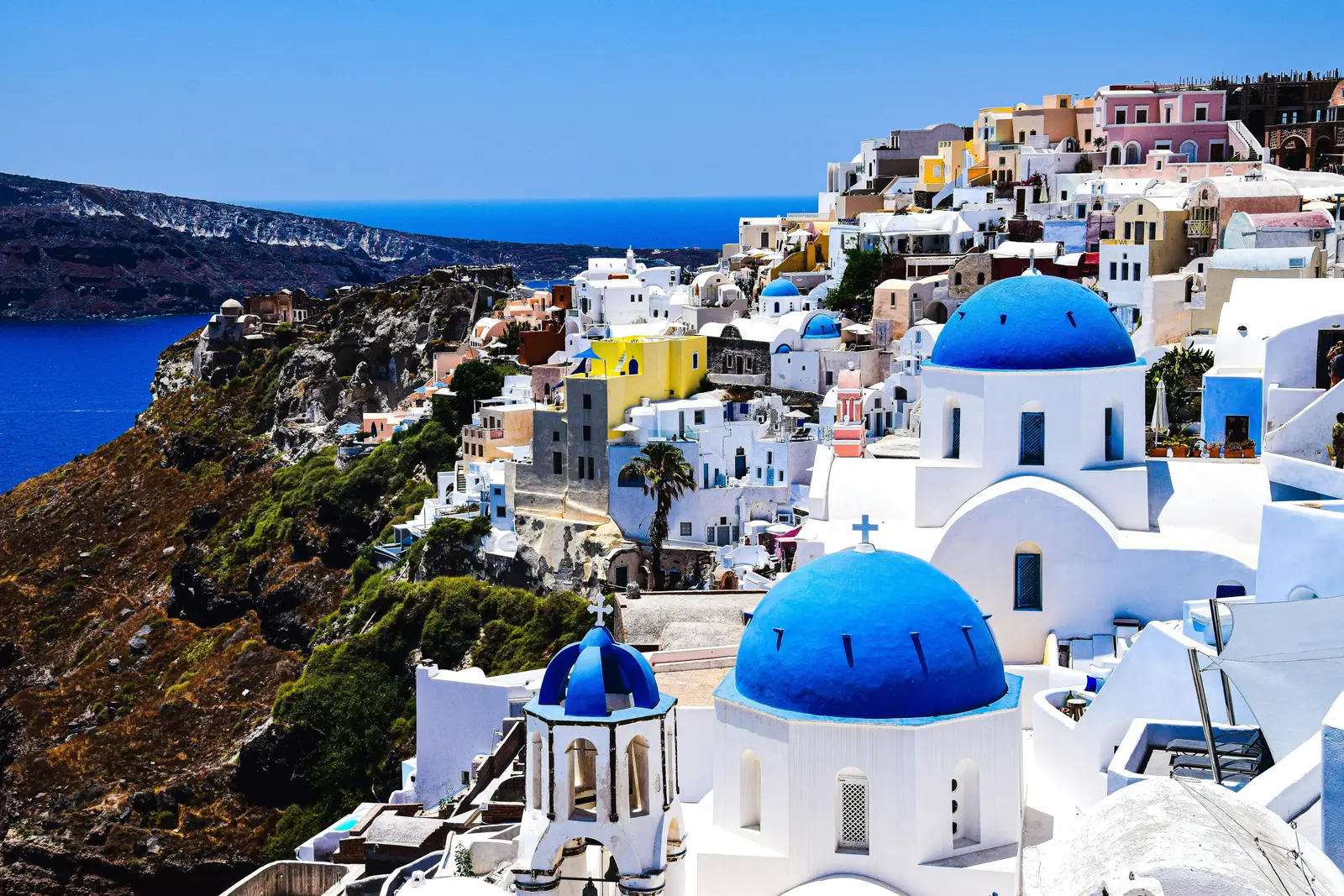
From the deck of the arriving ferry, Santorini looks improbable: a crescent of dark lava cliffs rising sheer from a flooded volcanic crater, with whitewashed villages spilling along the rim like snow. The island is what remains of a Bronze Age eruption, and everything here (the beaches, the wine, the views) traces back to that geology.
Santorini is a favourite for couples. It's ready to explore in the Nuvoha app: set your budget and see complete Santorini trips.
Why visit Santorini
Nowhere else in the Aegean puts you on the lip of a volcanic caldera. Oia, Fira and Imerovigli hang hundreds of metres above the sea-filled crater, while Akrotiri preserves a Minoan town buried by the eruption that shaped the island around 1600 BC. Below the cliffs, beaches come in black and red volcanic sand, and inland vineyards grow Assyrtiko vines coiled into basket shapes to shield the grapes from wind. It is a small island with an outsized sense of drama, best taken slowly.
What Santorini feels like
Mornings on the caldera are quiet and glassy; by late afternoon the rim path fills with walkers timing their arrival in Oia for sunset. Cruise days bring surges of visitors to Fira, then the crowds drain away by evening. Inland, villages like Pyrgos and Megalochori keep a slower rhythm of bell towers, cats and wine barrels, and the black-sand strips of Kamari and Perissa feel like a different island altogether.
What to see on the caldera rim
- Oia: The island's most photographed village, its blue-domed churches and old windmill stacked down the northern tip of the caldera.
- Akrotiri Archaeological Site: A Minoan Bronze Age town preserved under volcanic ash, with multi-storey buildings and frescoed walls excavated beneath a protective roof.
- Fira to Oia rim walk: A roughly ten-kilometre cliff-top path linking the caldera villages, with the volcano islets in view the whole way.
- Perissa and Perivolos beaches: Long stretches of black volcanic sand on the south-east coast, backed by tavernas and the great rock of Mesa Vouno.
- Assyrtiko vineyards: Santorini's vines are trained into low woven baskets against the wind, producing crisp mineral whites and the sweet Vinsanto.
- Nea Kameni: The dark lava islet in the middle of the caldera, reached by excursion boat, with a walk up to its still-steaming crater.
Villages around the island
- Fira: The island capital on the caldera rim, holding the cable car down to the old port, the Museum of Prehistoric Thera and the main bus station.
- Oia: A former sea captains' village at the northern tip, known for cave houses carved into the cliff and the ruined Byzantine castle viewpoint.
- Imerovigli: The highest point of the caldera rim, facing the rock of Skaros where a medieval fortress town once stood.
- Pyrgos: A hilltop village of Venetian-era lanes inland, wrapped around a Kasteli castle and ringed by vineyards.
- Emporio: The island's largest inland village, with a fortified medieval core of narrow passages built against pirate raids.
Eating and drinking on volcanic soil
Volcanic soil makes Santorini's larder distinctive: intensely sweet cherry tomatoes, white aubergines, capers and fava split peas that have been grown here for centuries. Tavernas serve tomatokeftedes (fried tomato fritters) alongside grilled fish at the beach strips and down at Ammoudi Bay. The island's wineries pour Assyrtiko, a bone-dry white from wind-battered basket vines, and Vinsanto, a sun-dried dessert wine with real history behind it.
- Fava (yellow split-pea puree with capers)
- Tomatokeftedes (tomato fritters)
- White aubergine, grilled or baked
- Grilled fresh fish at Ammoudi Bay
- Vinsanto dessert wine
Moving between the villages
KTEL buses radiate from Fira's central station to Oia, the airport, Akrotiri and the beach villages, frequent in summer, thinner in the shoulder seasons. Taxis are few for the island's size, so plan ahead for early ferries. Many visitors hire a small car or quad for a day to reach the vineyards and the south coast; the caldera villages themselves are pedestrian, all stairs and marble lanes. A cable car links Fira to the old port below. Santorini (Thira) Airport sits on the flat eastern side of the island near Kamari, about fifteen minutes' drive from Fira. It is small and gets very busy on summer mornings, so allow extra time for departures.
Good to know before you go
- Tipping is not obligatory in Greece; rounding up the bill or leaving a little for good taverna service is the usual gesture.
- Cover shoulders and knees when visiting churches and monasteries, including Profitis Ilias at the island's summit.
- The caldera path passes close to homes and terraces: keep to the marked route and keep noise down in the early morning.
- Climbing onto church domes for photographs is considered deeply disrespectful, however often the shot appears online.
- Watch the sunset from Imerovigli or the Akrotiri lighthouse rather than Oia's castle, which becomes uncomfortably crowded in high season.
- Wear proper shoes for the Fira to Oia walk and carry water: shade is scarce and the path is uneven in stretches.
- Black volcanic sand gets scorching by midday, so keep sandals on for the walk to the water.
- The meltemi wind picks up hard on summer afternoons; the caldera side can be surprisingly gusty.
- Reserve Akrotiri and winery visits ahead in July and August, when slots go quickly.
- Carry some cash for buses and smaller tavernas, though cards are widely accepted.
Best for
- Beach time
- Couples
Key facts
| Country | Greece |
|---|---|
| Region | Europe |
| Airports | JTR |
| Trip length fit | Short-trip friendly |
Santorini essentials
| Currency | Euro (EUR) |
|---|---|
| Language | Greek; English is widely spoken in tourism |
| Time zone | Eastern European Time (UTC+2, UTC+3 in summer) |
| Emergency number | 112 (general emergency) |
| Driving side | Right |
| Tap water | Safe in Athens and most of the mainland; on many islands locals prefer bottled water |
Climate & seasons
| Month | Typical range | Season |
|---|---|---|
| January | 10°C to 15°C | Mild windy winter |
| April | 13°C to 20°C | Warm spring |
| July | 23°C to 29°C | Hot dry summer |
| October | 18°C to 24°C | Warm autumn |
Typical stay
- Weekend-friendly
- Short break (2–5 days)
Santorini works as a weekend break just as well as a longer stay.
Getting there
Santorini is served via JTR.
- JTR
Is it your kind of trip?
Ideal if…
- time on the coast is the point of the trip
- you're planning a trip for two
Maybe not if…
- you want big-city energy around the clock
Pairs well with
Compare with
More in Europe
Near Santorini
Travel style
- Short-trip friendly
- Beach
Frequently asked questions
Which airports serve Santorini?
Santorini is served via JTR.
Is Santorini good for a weekend trip?
Yes, Santorini works for a weekend as well as a longer stay.
What kind of trip is Santorini best for?
Santorini is best for beach trips, popular for trips for two.
Which destinations pair well with Santorini?
Within multi-city range: Mykonos (116 km), Athens (218 km), Bodrum (218 km).
Can you swim in the caldera itself?
Only really from boat trips: the caldera shore is cliff, not beach. Most swimming happens on the black sand at Kamari, Perissa and Perivolos, or the red-cliffed cove near Akrotiri, roughly from May to October.
Do I need a car on Santorini?
Not necessarily. Buses link Fira to every major village and beach, and the caldera settlements are walkable. A car or quad helps for vineyards, Akrotiri and quieter southern coves, but parking in Oia and Fira is scarce.
Is Santorini very hilly to walk around?
Yes. The caldera villages are built into a cliff face, so expect long flights of steps, including nearly six hundred between Fira and the old port. Comfortable shoes make a real difference.