
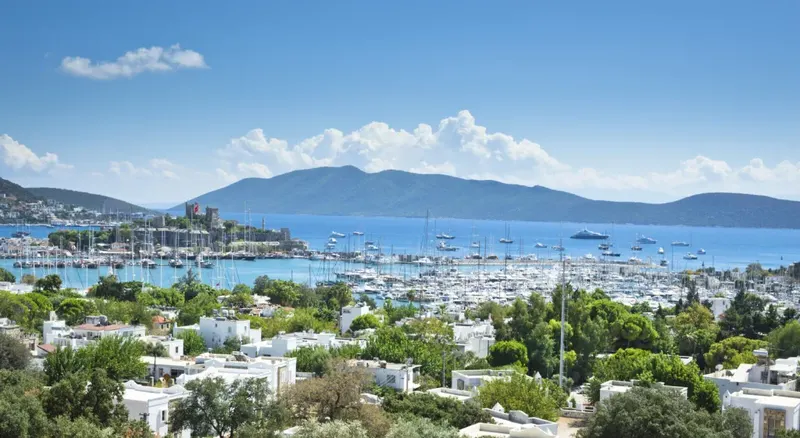
Bodrum wraps two bays around a stone castle on the Aegean coast of south-west Turkey. The town is a rule of low white houses with blue shutters and bougainvillea, kept deliberately plain so that the Castle of St Peter dominates the waterfront. This was ancient Halicarnassus, birthplace of the historian Herodotus and once home to a tomb so grand it gave its name to a type of monument. Beyond the town, a peninsula of coves and villages runs west into the sea.
Bodrum is a quieter alternative. It's ready to explore in the Nuvoha app: set your budget and see complete Bodrum trips.
Why visit Bodrum
Bodrum works on two levels. The town itself is history and harbour: the crusader castle guards the entrance to the bay and holds a museum of underwater archaeology built around ancient shipwrecks, while a hillside theatre and the remains of the Mausoleum recall the classical city. Around it, the peninsula is a run of distinct villages, from lively Gumbet to the seafood quays of Gumusluk and the marinas of Yalikavak and Turgutreis. Wooden gulet yachts line the harbour for day cruises to quieter coves, and in summer ferries cross to the Greek island of Kos.
What Bodrum feels like
Bodrum keeps a lighter, more Aegean feel than the Mediterranean resorts to the east. Whitewash, blue sea and windmills on the ridge set the tone, and the summer afternoons bring the meltemi wind down off the hills. The town has long been the social centre of the coast, with a marina, harbour bars and a night-time energy that peaks in July and August. The peninsula villages each keep their own pace: some busy and musical, others little more than a jetty, a fish restaurant and a sunset. Spring and autumn are calm, warm and given over to sailing.
Landmarks and coves worth your time
- Castle of St Peter: A fifteenth-century crusader fortress on the promontory between the bays, now the Bodrum Museum of Underwater Archaeology with finds from Bronze Age shipwrecks.
- The Mausoleum at Halicarnassus: The site of the monumental tomb of King Mausolus, counted among the Seven Wonders of the ancient world, of which the foundations and fragments remain.
- The ancient theatre: A Greek and Roman theatre cut into the hillside above the town, still looking out over the bay.
- The windmills: A line of old stone grain windmills on the ridge between Bodrum and Gumbet, a viewpoint over both coasts.
- Gumusluk and ancient Myndos: A fishing village at the western tip where part of the old harbour lies just under the water and fish restaurants line the shore.
- The harbour and gulet cruises: The town marina, departure point for day trips aboard traditional wooden gulets to the peninsula's coves and islands.
Around the peninsula
- Bodrum Town: The castle, marina, bazaar and nightlife at the head of the two bays, the hub of the whole peninsula.
- Gumbet: A sandy bay just west of town, close and busy, known for watersports by day and bars by night.
- Bitez: A quieter bay of citrus groves and shallow water, long favoured by windsurfers.
- Turgutreis: A town and marina at the western end, facing open water and known for its sunsets.
- Yalikavak: An upmarket village on the north-west coast built around a large modern marina.
- Gumusluk: A low-key fishing village on the west tip, protected from development, with seafood tables set almost in the sea.
The Aegean table
The peninsula eats in the Aegean manner, lighter and greener than inland Turkey, with olive oil, herbs and the day's catch to the fore. Meze tables carry wild greens gathered from the hills, samphire dressed with lemon and garlic, and stuffed courgette flowers. The local kebab, cokertme, layers thin beef over crisp shoestring potatoes with yoghurt and tomato. Fish and octopus come grilled and simple at the harbour and in Gumusluk. The hills behind produce a dark pine honey, spooned over clotted cream at breakfast.
- Cokertme kebab (beef over crisp potato with yoghurt)
- Samphire (deniz borulcesi) in olive oil
- Grilled octopus
- Wild Aegean greens
- Mugla pine honey with clotted cream
Getting around the peninsula
Frequent dolmus minibuses are the backbone of the peninsula, running between Bodrum's bus station and every village, often until late in summer. The town centre is walkable, with a pedestrian bazaar between the two bays. Water taxis and boats link the harbours in season, and a hire car or scooter helps for reaching the more remote coves over the hills. Ferries from the town harbour cross to the Greek island of Kos in the sailing season. Milas-Bodrum Airport sits inland, around thirty-five kilometres north-east of the town, and serves the whole peninsula. Transfers run along a single main road that branches out to the coastal villages, so journey times lengthen the further west you are staying.
Practical pointers
- Bodrum is easy-going, but cover up away from the beach and dress modestly if you visit a mosque.
- Haggling is normal in the bazaar and good-humoured, so agree a price only if you mean to buy.
- On gulet day trips, follow the crew's lead on swimming stops and take your litter back ashore.
- Tipping is appreciated in restaurants and for boat crews, usually a small percentage or rounding up.
- Gumusluk is the place for seafood by the water at sunset, so park at the entrance and walk in.
- The meltemi wind rises in the afternoons, so face west at Turgutreis for sunsets and pick sheltered bays for calm swimming.
- Gulet cruises from the harbour take in coves and islands such as Orak, so bring shade for the deck.
- Ferries to Kos run in the sailing season and need a passport, making a Greek island day out simple.
- Each village has a character of its own, so it pays to match where you stay to the pace you want.
- Bitez and Gumbet suit windsurfing and watersports when the wind is up.
Best for
- Beach time
- Quieter travel
Key facts
| Country | Turkey |
|---|---|
| Region | Europe |
| Airports | BJV |
| Trip length fit | Short-trip friendly |
Bodrum essentials
| Currency | Turkish Lira (TRY) |
|---|---|
| Language | Turkish; English is common in Istanbul and the coastal resorts |
| Time zone | Turkey Time (UTC+3), no daylight saving |
| Emergency number | 112 (all emergencies) |
| Driving side | Right |
| Tap water | Officially treated, but most locals and visitors drink bottled water |
Climate & seasons
| Month | Typical range | Season |
|---|---|---|
| January | 7°C to 15°C | Mild wet winter |
| April | 12°C to 22°C | Mild spring |
| July | 24°C to 35°C | Hot dry summer |
| October | 17°C to 26°C | Warm autumn |
Typical stay
- Weekend-friendly
- Short break (2–5 days)
Bodrum works as a weekend break just as well as a longer stay.
Getting there
Bodrum is served via BJV.
- BJV
Is it your kind of trip?
Ideal if…
- time on the coast is the point of the trip
- you like places before everyone else finds them
Maybe not if…
- you want big-city energy around the clock
Pairs well with
Compare with
More in Europe
Near Bodrum
Travel style
- Short-trip friendly
- Beach
Frequently asked questions
Which airports serve Bodrum?
Bodrum is served via BJV.
Is Bodrum good for a weekend trip?
Yes, Bodrum works for a weekend as well as a longer stay.
What kind of trip is Bodrum best for?
Bodrum is best for beach trips.
Which destinations pair well with Bodrum?
Within multi-city range: Dalaman (117 km), Mykonos (206 km), Santorini (218 km).
What is Bodrum known for?
A whitewashed Aegean town below a crusader castle, the ancient city of Halicarnassus, a lively marina and nightlife, and a peninsula of coves and villages reaching west into the sea.
Which part of the peninsula should I choose?
Bodrum town and Gumbet are the liveliest. Bitez, Gumusluk and Turgutreis are calmer and more traditional, while Yalikavak and the northern villages are more upmarket around their marinas.
Can I visit a Greek island from Bodrum?
Yes. Ferries cross to Kos in the sailing season, a short trip that makes an easy day out. Bring your passport, as it is an international crossing.
When is the best time to go?
Summers are hot and dry with the meltemi wind, and the sea is warm from June to October. Spring and autumn are milder and better for sailing and walking.