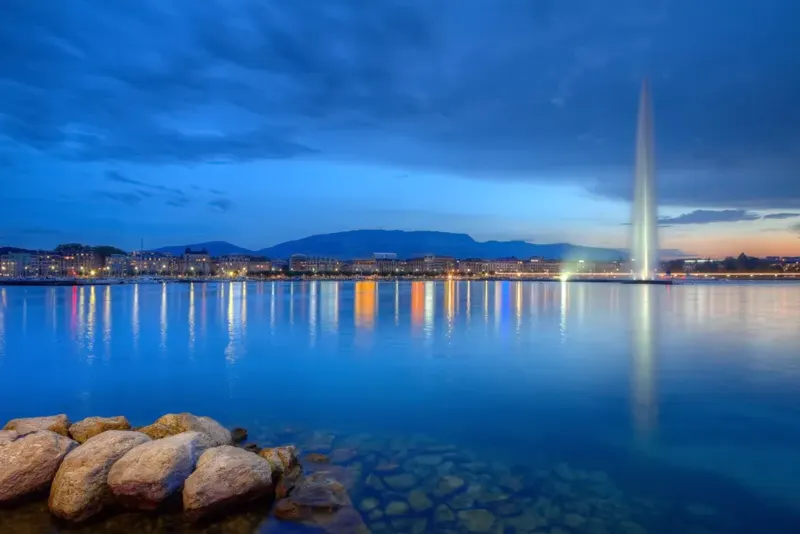
Switzerland fits four national languages and some of Europe's highest mountains into a country smaller than the Netherlands, and it runs the whole thing with famous precision. The Alps define it: the Matterhorn's near-perfect pyramid above car-free Zermatt, the Eiger and Jungfrau over the Bernese Oberland, glaciers, and trains that climb to icy passes on the dot. The German-speaking north holds Zurich, Lucerne and the Rhine Falls; French flavours Geneva, Lausanne and the vineyard terraces above Lake Geneva; Italian warms Ticino's palm-lined lakes; and Romansh survives in the valleys of Graubunden. Winter is for skiing, summer for hiking and lake swimming, and the scenic railways run all year. Even the tap water, straight from the mountains, is a point of national pride.
Switzerland on Nuvoha spans 2 destinations: Geneva, Zurich. Set your budget and Nuvoha builds the complete trip: flights and hotels together.
Why visit Switzerland
- Cities you can explore on foot, from headline sights to quiet neighbourhoods
- Quieter alternatives beyond the obvious stops
- Easy to combine two cities in a single trip
Best known for
- The Matterhorn and Zermatt
- Scenic trains like the Glacier Express
- Alpine skiing
- Lakes Geneva, Lucerne and Lugano
- Swiss chocolate and cheese
- The Jungfraujoch and the high Alps
Across the cantons
- The Bernese Oberland: The classic Alpine core above Interlaken, where the Eiger, Monch and Jungfrau tower over Grindelwald and the waterfall valley of Lauterbrunnen, and a railway climbs to the Jungfraujoch.
- Zurich and the north-east: The German-speaking heartland: Zurich on its lake, the thundering Rhine Falls, and the rolling green hills and painted houses of Appenzell towards Lake Constance.
- Lake Geneva and the west: French-speaking Suisse Romande, from cosmopolitan Geneva and Olympic Lausanne to lakeside Montreux, the Lavaux vineyard terraces and the moated Chillon Castle.
- Valais: The high, sunny south of the Rhone valley, home to the Matterhorn above car-free Zermatt, the resort of Saas-Fee and the great Aletsch Glacier.
- Graubunden: The largest and wildest canton, where Romansh still survives: St Moritz and Davos, the Swiss National Park, and the Glacier and Bernina Express lines.
- Ticino: The Italian-speaking south beyond the Alps, with palm-lined promenades, grotto restaurants and the lakeside towns of Lugano and Locarno on Lakes Lugano and Maggiore.
Where to go
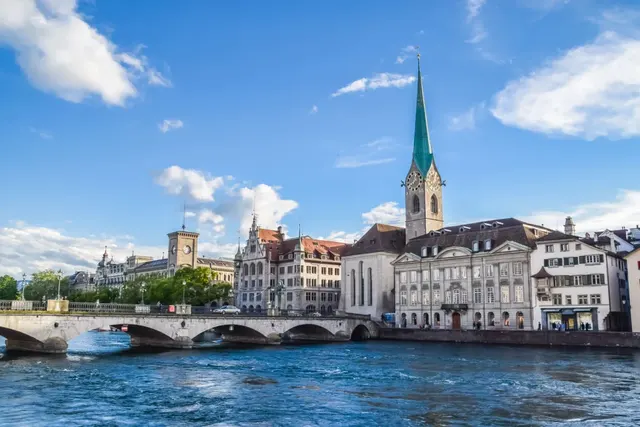
Switzerland essentials
| Currency | Swiss Franc (CHF) |
|---|---|
| Language | German, French, Italian and Romansh are all official; the language shifts by region, and English is widely spoken |
| Time zone | Central European Time (UTC+1, UTC+2 in summer) |
| Emergency number | 112 (general emergency); 1414 for Rega mountain air rescue |
| Driving side | Right |
| Tap water | Safe to drink; public fountains often run with drinkable spring water |
Seasons at a glance in Geneva
| Month | Typical range | Season |
|---|---|---|
| January | -1°C to 6°C | Cold winter |
| April | 6°C to 16°C | Mild spring |
| July | 15°C to 27°C | Warm summer |
| October | 8°C to 16°C | Cool autumn |
Seasons vary across Switzerland. Each destination page has its own climate table.
How travellers explore Switzerland
Geneva and Zurich sit about 230 km apart, an easy pairing in one trip.
More in Europe
More Europe country guides
Frequently asked questions
Which Switzerland destinations can I book with Nuvoha?
Geneva, Zurich, each with complete flight and hotel trips built around your budget.
What kind of trips suit Switzerland?
Switzerland works for city breaks, and its cities pair well for multi-stop itineraries.
How do you get around Switzerland?
By train, and superbly so: the rail network is dense, punctual and integrated with buses and lake boats, reaching almost every valley. Panoramic routes like the Glacier Express and Bernina Express turn the journey itself into the attraction, and a range of rail passes covers visitors.
Which language will I need in Switzerland?
It depends where you are: German around Zurich and Bern, French around Geneva and Lausanne, Italian in Ticino, and Romansh in a few Graubunden valleys. English is very widely spoken, so most visitors manage easily wherever they go.
Is Switzerland in the EU, and what currency does it use?
Switzerland is not in the EU, though it is part of the Schengen area, so there are no routine border checks with its neighbours. The currency is the Swiss franc; some places accept euros but give change in francs, and cards are accepted almost everywhere.
What plug type does Switzerland use?
Switzerland uses its own Type J three-pin socket at 230 volts. Slim European two-pin (Type C) plugs fit, but many other European and all UK and North American plugs need an adapter.