
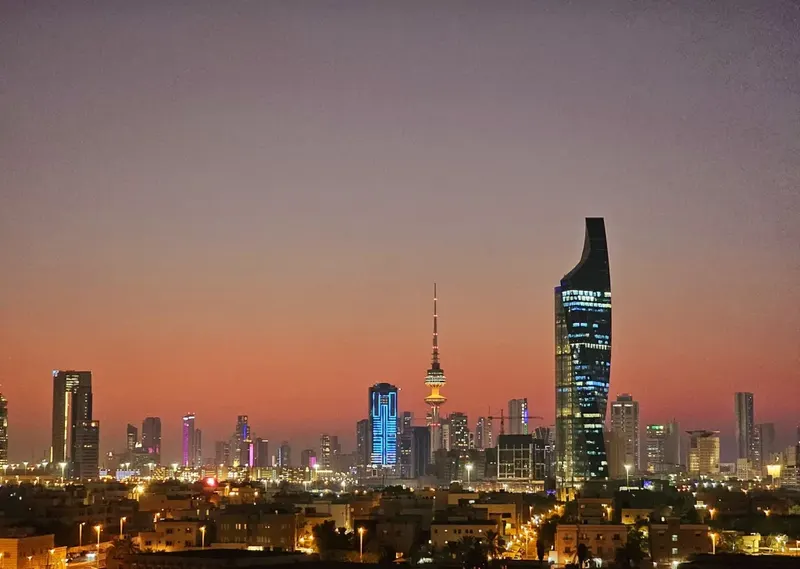
Kuwait City fronts the Arabian Gulf with a skyline all its own, crowned by the three tapering Kuwait Towers and the sculpted Al Hamra Tower. The capital of a small, oil-rich state, it pairs gleaming waterfront districts with the low-rise bustle of Souq Al-Mubarakiya, where traders have dealt for generations. It is one of the hottest cities on earth in summer, a place of malls, seafood and sea breezes, and a proud, tightly knit society.
Kuwait City is a quieter alternative. It's ready to explore in the Nuvoha app: set your budget and see complete Kuwait City trips.
Why visit Kuwait City
Kuwait wears its history and ambition side by side. The Kuwait Towers remain the national emblem, their blue-green spheres holding a viewing deck and a revolving cafe above the Gulf, while the Grand Mosque and the tilework of Seif Palace speak to older traditions. Souq Al-Mubarakiya is the heart of the old city, a maze of spice, gold and food stalls, and the Scientific Center on the Salmiya waterfront keeps a large aquarium and a traditional dhow harbour. The Arabian Gulf Street corniche runs for kilometres past marinas and Green Island, and museums such as Tareq Rajab and Al Shaheed Park chart Islamic art and the country's resilient recent history.
Towers, souqs and sea
- Kuwait Towers: The country's emblem on the Gulf: three tapering towers with a viewing sphere and a revolving cafe high above the sea.
- Grand Mosque: Kuwait's largest mosque, its vast prayer hall and courtyards open to respectful visitors on guided tours.
- Souq Al-Mubarakiya: The historic covered market at the city's heart, trading spices, gold, oud and street food for generations.
- The Scientific Center: A Salmiya waterfront complex with one of the region's largest aquariums and a traditional dhow harbour.
- Al Shaheed Park: The city's largest urban park, blending gardens and museums with a memorial to the country's history.
- Seif Palace: The historic seat of government on the waterfront, known for its Islamic tilework and clock tower, viewed from outside.
Around the capital
- Sharq: The historic waterfront and business quarter, close to the souq, Seif Palace and the marinas.
- Qibla (city centre): The downtown core of ministries, banks and the old inner-city souqs behind the corniche.
- Salmiya: A busy shopping and seaside district on the peninsula, with malls, the Scientific Center and the Marina waterfront.
- Hawally: A dense, diverse residential and commercial area inland from Salmiya.
- Jabriya: A leafy residential suburb of villas, schools and quiet streets south of the centre.
- Bneid Al Qar: A coastal district along Arabian Gulf Street towards the Kuwait Towers.
The Kuwaiti table
Kuwaiti cooking is Gulf food with a strong maritime streak. The national dish, machboos, layers spiced basmati with meat or fish, while murabyan brings prawns to the rice pot and mutabbaq samak tops it with fried fish. The Gulf's prized zubaidi, a silver pomfret, is a point of pride, and meals often finish with sticky luqaimat dumplings or saffron-scented halwa. Alongside the local table, the city's international restaurants and old souq stalls span the world.
- Machboos
- Murabyan (prawn rice)
- Mutabbaq samak
- Grilled zubaidi
- Harees
- Luqaimat
What Kuwait City feels like
Kuwait is less flashy than some of its Gulf neighbours and more quietly traditional. Summer heat is genuinely extreme, regularly among the highest recorded anywhere, so daily life retreats into air conditioning and only spills back outdoors once the sun drops. Then the corniche and the malls fill, families gather for late seafood dinners, and diwaniya gatherings, the male social salons that are a pillar of Kuwaiti life, run deep into the night. It is a conservative Muslim society: alcohol is banned, dress is modest, and the rhythms of prayer and, in season, Ramadan set the pace. Warmth towards guests runs beneath the reserve.
Getting around
Kuwait City runs entirely on cars and wide highways, with no metro or train. Ride-hailing apps are the easiest option for visitors and avoid haggling over fares, while metered taxis and car hire are also common. Distances sprawl and the heat is severe for much of the year, so walking is limited to the corniche and the malls. Traffic thickens sharply at the start and end of the working day. Kuwait International Airport (KWI) lies south of the city and is the base of the national carrier. The drive into the centre is short outside peak hours, usually by taxi or ride-hailing app.
Good to know
- Dress modestly in public: cover shoulders and knees, and keep beachwear to private beaches and pools.
- Kuwait is alcohol-free, with none sold or permitted anywhere; do not attempt to bring any in.
- During Ramadan, eating, drinking or smoking in public by day is prohibited and can carry penalties.
- Ask before photographing people, and avoid photographing government or military buildings.
- Visit between November and March; the summer is among the hottest anywhere on earth.
- Use ride-hailing apps rather than flagging taxis to keep fares clear and simple.
- Souq Al-Mubarakiya is at its best in the evening, when the food stalls and cafes come alive.
- The Kuwait Towers and the Scientific Center both reward a visit; check current opening days ahead.
- Fridays start quietly until after midday prayers, then the corniche and souqs fill up.
- Carry a light layer for the fierce indoor air conditioning in malls and restaurants.
Best for
- City breaks
- Quieter travel
Key facts
| Country | Kuwait |
|---|---|
| Region | Middle East & North Africa |
| Airports | KWI |
| Trip length fit | Short-trip friendly |
Kuwait City essentials
| Currency | Kuwaiti Dinar (KWD) |
|---|---|
| Language | Arabic; English is widely spoken and used in business and on signage |
| Time zone | Arabia Standard Time (UTC+3), no daylight saving |
| Emergency number | 112 (all emergencies) |
| Driving side | Right |
| Tap water | A desalinated supply that is safe to drink; bottled water is the common choice |
Climate & seasons
| Month | Typical range | Season |
|---|---|---|
| January | 8°C to 19°C | Cool dry winter |
| April | 20°C to 32°C | Hot spring |
| July | 31°C to 45°C | Extreme dry summer |
| October | 22°C to 36°C | Hot autumn |
Typical stay
- Weekend-friendly
- Short break (2–5 days)
Kuwait City works as a weekend break just as well as a longer stay.
Getting there
Kuwait City is served via KWI.
- KWI
Is it your kind of trip?
Ideal if…
- you like walkable city energy
- you like places before everyone else finds them
Maybe not if…
- a beach-first holiday is the priority
Pairs well with
Compare with
More in Middle East & North Africa
Near Kuwait City
Travel style
- Short-trip friendly
- City
Frequently asked questions
Which airports serve Kuwait City?
Kuwait City is served via KWI.
Is Kuwait City good for a weekend trip?
Yes, Kuwait City works for a weekend as well as a longer stay.
What kind of trip is Kuwait City best for?
Kuwait City is best for city trips.
Which destinations pair well with Kuwait City?
Within multi-city range: Dammam (355 km), Riyadh (491 km), Doha (566 km).
Is Kuwait City worth visiting?
Yes, for travellers drawn to Gulf culture rather than resorts. The Kuwait Towers, Souq Al-Mubarakiya, the corniche and strong museums fill a couple of days, and the food scene is a highlight, though nightlife is limited by the alcohol ban.
How hot does Kuwait get?
Very. Summer temperatures are among the highest recorded on the planet, regularly pushing well past 45 degrees Celsius. Life moves indoors by day, so visit in the cooler months from November to March for any sightseeing on foot.
Is alcohol available in Kuwait?
No. Kuwait is entirely alcohol-free, with none sold in shops, hotels or restaurants, and importing it is illegal. Social life centres on food, family gatherings and the traditional diwaniya rather than bars.
How do I get around Kuwait City?
By road. There is no metro, so most visitors rely on ride-hailing apps or taxis, and some hire cars. Distances are large and summers are hot, so plan to drive between sights rather than walk.