
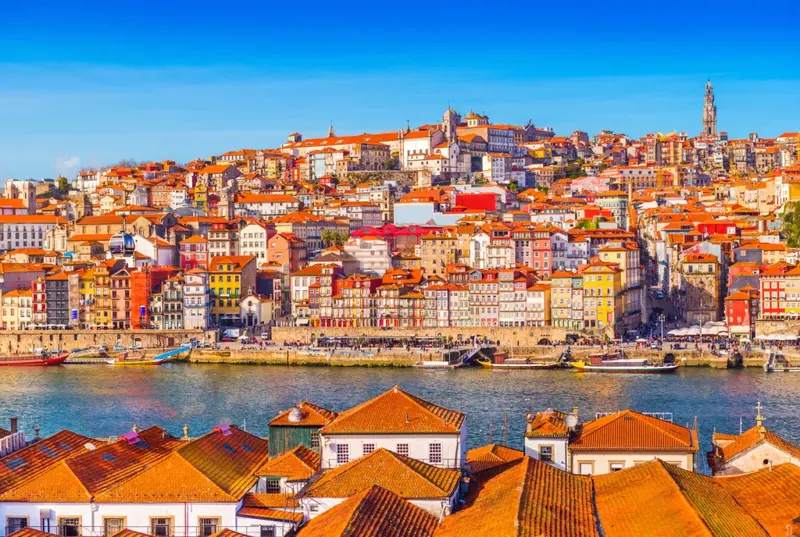
Porto tumbles down granite hills to the north bank of the Douro, right where the river empties into the Atlantic. Portugal's second city is a place of tiled facades, baroque churches and steep lanes, its historic Ribeira quarter listed by UNESCO and its riverside lined with terraces. Across the water in Vila Nova de Gaia, the port-wine lodges age their barrels in the cool. Weathered, hard-working and quietly grand, Porto wears its history without fuss.
Porto is a quieter alternative. It's ready to explore in the Nuvoha app: set your budget and see complete Porto trips.
Why visit Porto
Porto packs an outsized amount into a walkable centre. The Ribeira's medieval lanes spill down to the Douro, crossed by the double-deck iron Dom Luis I Bridge to the port lodges of Gaia, where tastings explain how the fortified wine is made and aged. Blue-and-white azulejo tiles cover everything from Sao Bento station to the Chapel of Souls, while the Clerigos Tower and the ornate Livraria Lello reward the climb and the queue. The Douro itself invites a cruise upriver toward the terraced vineyards, and the food, from francesinha to fresh Atlantic seafood, is generous and unpretentious. It is a city built for wandering.
Experiences to plan around
- Ribeira and the Douro riverfront: The UNESCO-listed old quarter of stacked houses and arcaded lanes tumbling to the river, best seen from the water or the bridge above.
- Dom Luis I Bridge: A double-deck iron arch spanning the Douro, its upper level carrying the metro and walkers high above the gorge with sweeping views.
- Vila Nova de Gaia port lodges: The cellars across the river where port is aged and poured; many open their doors for tastings and tours of the barrel halls.
- Livraria Lello: One of the world's most ornate bookshops, a small neo-gothic space of carved wood and a sinuous red staircase, entered by timed ticket.
- Sao Bento Station: A working railway station whose entrance hall is lined with some twenty thousand azulejo tiles depicting scenes from Portuguese history.
- Clerigos Tower: Nicolau Nasoni's slender baroque bell tower, climbed by a tight spiral stair to one of the finest views over the rooftops.
Neighbourhood by neighbourhood
- Ribeira: The riverside heart on the Douro's north bank, a warren of medieval lanes, squares and terraces beneath the cathedral hill.
- Baixa and Aliados: The commercial centre around the grand Avenida dos Aliados, taking in Sao Bento station, the Bolhao market and the main shopping streets.
- Vila Nova de Gaia: The south bank, given over to the port-wine lodges, a cable car and a broad waterfront looking back at the old city.
- Foz do Douro: Where the river meets the Atlantic, an affluent seaside district of promenades, lighthouses and ocean-facing cafes reached by the historic tram.
- Miragaia and Massarelos: Quieter riverside neighbourhoods west of the centre, mixing old warehouses, gardens and museums along the tram line to Foz.
- Bonfim and Cedofeita: Workaday inland quarters east and north of the centre, home to studios, independent shops and a growing cafe and gallery scene.
The Porto table
Porto eats heartily. Its people are nicknamed tripeiros, tripe-eaters, after the tripe stew that legend ties to the city's seafaring past, and the local kitchen runs to salt cod, grilled fish and slow-cooked meats. The city's own invention is the francesinha, a formidable layered sandwich under melted cheese and a rich sauce. Just downriver, Matosinhos grills the day's Atlantic catch. To drink, there is port from the Gaia lodges and the increasingly admired table wines of the Douro Valley.
- Francesinha
- Tripas a moda do Porto
- Bacalhau
- Bifana
- Pastel de nata
What Porto feels like
Porto feels lived-in and characterful rather than polished. Laundry hangs from tiled balconies above the Ribeira, funicular cars and rattling trams climb the slopes, and the light off the river shifts from grey to gold as the Atlantic weather rolls through. The city has an industrious, slightly gruff pride, softened by an easy warmth in its cafes, markets and riverside bars. Evenings gather along both banks of the Douro, where the bridge lights come on and the port lodges glow across the water. There is a strong student presence and a lively arts scene, yet the pace stays human and the old rhythms hold.
Getting from A to B
The historic core is walkable, if steep, and the granite lanes reward stout shoes. A modern metro links the airport, the centre and Gaia across the upper deck of the Dom Luis I Bridge, while historic trams trundle along the river to Foz. Funiculars and a Gaia cable car ease the climbs beside the Douro. For the wine country, boats and trains follow the river upstream into the Douro Valley. Francisco Sa Carneiro Airport sits north of the city and connects directly to the centre by metro line E in around half an hour, with taxis and ride-hailing also on hand. It is one of the simpler airport transfers in the region.
Practical pointers
- A friendly bom dia or boa tarde goes a long way; Porto is polite and appreciates the effort at Portuguese.
- Meals run late by some standards, with dinner from around eight; lunch is the main event of the day for many.
- Tipping is modest and not obligatory; rounding up or leaving a little for good service is customary.
- Port and Douro wines are a point of local pride, so it is worth asking staff for a recommendation rather than ordering by habit.
- Take care on the steep, worn granite lanes and tram tracks, which turn slippery in the rain.
- Late spring to early autumn brings the warmest, driest weather; the Atlantic makes autumn and winter notably wet.
- Reserve Livraria Lello and the busier port lodges ahead, as both draw queues, particularly at weekends.
- The upper deck of the Dom Luis I Bridge gives the finest open view over the river and is an easy walk from Ribeira to Gaia.
- A river cruise, even a short one under the bridges, is the classic way to grasp the city's layout.
- If you are here around the 23rd of June, the Sao Joao festival takes over the streets through the night.
- The historic tram to Foz do Douro is a pleasant way to reach the ocean and its seafood.
Best for
- City breaks
- Quieter travel
Key facts
| Country | Portugal |
|---|---|
| Region | Europe |
| Airports | OPO |
| Trip length fit | Short-trip friendly |
Porto essentials
| Currency | Euro (EUR) |
|---|---|
| Language | Portuguese; English is widely spoken, especially among younger people |
| Time zone | Western European Time (UTC+0, UTC+1 in summer), the same as the UK; the Azores are one hour behind |
| Emergency number | 112 (general emergency) |
| Driving side | Right |
| Tap water | Safe to drink on the mainland and the islands |
Climate & seasons
| Month | Typical range | Season |
|---|---|---|
| January | 6°C to 14°C | Mild wet winter |
| April | 10°C to 19°C | Fresh spring |
| July | 16°C to 26°C | Warm dry summer |
| October | 13°C to 21°C | Mild autumn |
Typical stay
- Weekend-friendly
- Short break (2–5 days)
Porto works as a weekend break just as well as a longer stay.
Getting there
Porto is served via OPO.
- OPO
Is it your kind of trip?
Ideal if…
- you like walkable city energy
- you like places before everyone else finds them
Maybe not if…
- a beach-first holiday is the priority
Pairs well with
Compare with
More in Europe
Near Porto
Travel style
- Short-trip friendly
- City
Frequently asked questions
Which airports serve Porto?
Porto is served via OPO.
Is Porto good for a weekend trip?
Yes, Porto works for a weekend as well as a longer stay.
What kind of trip is Porto best for?
Porto is best for city trips.
Which destinations pair well with Porto?
Within multi-city range: Lisbon (276 km), Madrid (438 km), Casablanca (881 km).
Is Porto worth visiting for the port wine?
The port lodges of Vila Nova de Gaia are one of Porto's defining experiences, offering tastings and tours that explain how the fortified wine is aged. Many also pour the dry table wines of the Douro Valley upstream.
How many days do you need in Porto?
A couple of days covers the Ribeira, the Gaia lodges and the main sights at a comfortable pace. Add more if you want to cruise or drive into the Douro Valley, or spend time out at the coast in Foz and Matosinhos.
When is the best time to visit Porto?
Late spring through early autumn offers the warmest and driest weather. Porto sits on the Atlantic and is wetter than southern Portugal, so spring and autumn can be showery, while summer stays pleasant rather than scorching.
Does Porto have beaches?
Porto is a river city at heart, but the Atlantic coast is close. The historic tram runs out to Foz do Douro, and nearby Matosinhos has a broad city beach and renowned seafood grills, both an easy trip from the centre.