
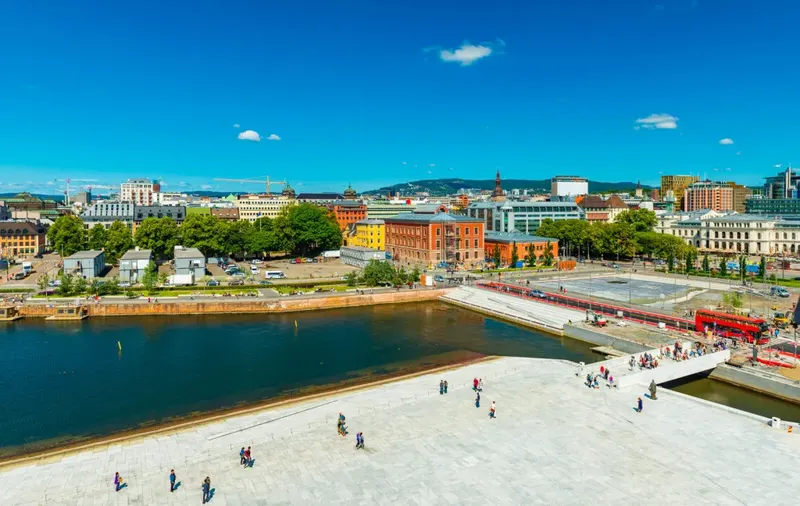
Norway is a country shaped by water and rock: a long, narrow strip of Scandinavia crimped into hundreds of fjords, where cliffs plunge straight into the sea and ferries and tunnels do the work roads cannot. The classic images all belong here, from the Sognefjord and Geirangerfjord to the granite ledge of Preikestolen and the drying racks of Lofoten. Bergen makes a handsome gateway to the fjord country, Oslo pairs harbourside museums with easy forest and ski trails, and far to the north Tromso and the Lofoten Islands chase the northern lights in winter and the midnight sun in summer. It is not a place to hurry: the scenery, and the scenic railways that thread through it, reward slow travel.
Oslo is the Norway destination on Nuvoha today. Set your budget and Nuvoha builds the complete trip: flights and hotels together.
Why visit Norway
- Cities you can explore on foot, from headline sights to quiet neighbourhoods
- Quieter alternatives beyond the obvious stops
Best known for
- The western fjords
- The northern lights
- The midnight sun
- Scenic rail journeys
- Lofoten's peaks and beaches
- Viking heritage
Coast, fjords and Arctic
- Oslo and the east: The capital sits at the head of the Oslofjord, pairing waterfront museums and the Vigeland sculptures with forest, lakes and ski trails right on its doorstep.
- Fjord Norway and Bergen: The classic western fjords, from the Sognefjord and Geirangerfjord to the Preikestolen ledge above the Lysefjord, with handsome, wooden-quayed Bergen as their gateway.
- Trondelag and Trondheim: Central Norway, where the historic city of Trondheim and its Nidaros Cathedral sit amid farmland, coastline and the old pilgrim route of St Olav.
- Northern Norway: Above the Arctic Circle lie the sculpted peaks of the Lofoten Islands, the lively town of Tromso and the North Cape, prime ground for the northern lights and midnight sun.
- The south coast: The Sorlandet shore of white-painted wooden towns, smooth skerries and sheltered inlets, a summer sailing and holiday coast for Norwegians.
- Svalbard: A remote Arctic archipelago far north of the mainland, where Longyearbyen serves polar-bear country, glaciers and a frozen wilderness of tundra and ice.
Where to go
Norway essentials
| Currency | Norwegian Krone (NOK) |
|---|---|
| Language | Norwegian; Sami languages are also recognised, and English is very widely spoken |
| Time zone | Central European Time (UTC+1, UTC+2 in summer) |
| Emergency number | 112 (police), 110 (fire), 113 (ambulance) |
| Driving side | Right |
| Tap water | Safe to drink; among the best tap water anywhere |
Seasons at a glance in Oslo
| Month | Typical range | Season |
|---|---|---|
| January | -6°C to 0°C | Cold snowy winter |
| April | 1°C to 10°C | Fresh spring thaw |
| July | 12°C to 22°C | Mild bright summer |
| October | 4°C to 10°C | Cool autumn |
Seasons vary across Norway. Each destination page has its own climate table.
More in Europe
More Europe country guides
Frequently asked questions
Which Norway destinations can I book with Nuvoha?
Oslo, with complete flight and hotel trips built around your budget.
What kind of trips suit Norway?
Norway works for city breaks.
How do you get around Norway?
The scenery makes the journey: fjord crossings by car ferry and express boat, the Bergen and Flam railways for the mountains, and the coastal ships that trace the shoreline. Domestic flights bridge the long gaps north to Tromso and beyond.
Do I need cash in Norway?
Very little. Norway is one of the most cashless countries anywhere, with cards and contactless accepted almost universally, including on ferries and in rural shops.
What plug type does Norway use?
Types C and F, the round two-pin European sockets, at 230 volts. Visitors from the UK and North America need an adapter.
Is Norway in the EU or the Schengen Area?
Norway is not a member of the European Union, but it is part of the Schengen Area, so overland travel from neighbouring countries is straightforward. Its currency is the Norwegian krone, not the euro.