
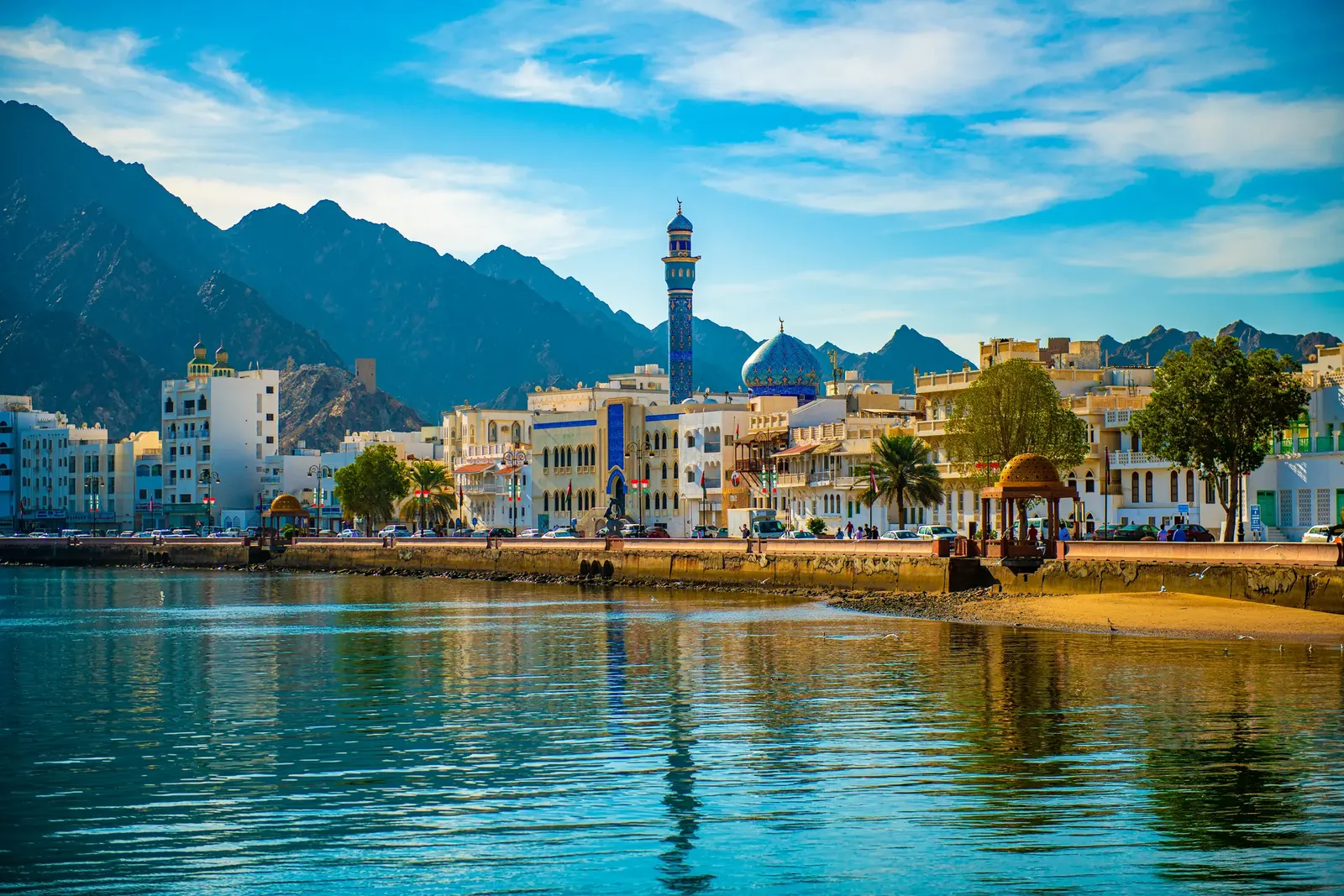
Bare rock mountains crowd Muscat against the Gulf of Oman, breaking the capital into a string of low white districts along some forty kilometres of coast. Building rules keep the skyline traditional: no glass towers, just minarets, Portuguese-era forts and the long curve of the Mutrah Corniche.
Muscat is a quieter alternative. It's ready to explore in the Nuvoha app: set your budget and see complete Muscat trips.
Why visit Muscat
Muscat offers the Arabian Peninsula without the high-rise theatre. Frankincense smoke drifts through Mutrah Souq's lamp-lit lanes; dhows still work a harbour guarded by twin sixteenth-century forts; and the Sultan Qaboos Grand Mosque welcomes visitors beneath one of the world's largest hand-woven carpets. Omani hospitality is famously unforced: expect dates and cardamom coffee. Beyond the city wait the wadis, the Bimmah Sinkhole and Nizwa's fort, all within day-trip range, which makes the capital a gateway as much as a destination.
Highlights along the coastline
- Sultan Qaboos Grand Mosque: Oman's principal mosque, open to non-Muslim visitors in the mornings, with one of the world's largest hand-woven carpets beneath a vast crystal chandelier.
- Mutrah Souq and Corniche: A lamp-lit covered market of frankincense, silver and textiles opening onto a curving harbour-front promenade.
- Old Muscat and Al Alam Palace: The ceremonial quarter where the Sultan's blue-and-gold palace stands between the sixteenth-century Portuguese forts of Jalali and Mirani.
- Royal Opera House Muscat: A marble-clad opera house in Shatti al-Qurum, opened in 2011, hosting opera, symphony and Arabic music seasons.
- National Museum: Facing Al Alam Palace, it traces Oman's story from earliest settlement through its Indian Ocean maritime empire.
- Qurum Beach: A long public sweep of sand backed by parkland, at its liveliest towards sunset.
The capital's scattered quarters
- Mutrah: The old port district, its corniche of latticed merchant houses curling beneath a hilltop Portuguese watchtower.
- Old Muscat: The compact original walled town wedged between mountains and sea, now the ceremonial heart of palace, forts and museums.
- Ruwi: The commercial and transport hub inland, dense with south-Asian eateries and the city's main bus station.
- Qurum and Shatti al-Qurum: The modern seafront quarter of beach, parkland, embassies, cafes and the opera house.
Omani flavours
Omani food carries centuries of Indian Ocean trade. Shuwa is the ceremonial centrepiece: lamb rubbed with spices, wrapped in palm leaves and pit-roasted for a day or more. Everyday tables serve majboos (spiced rice with meat or fish) alongside mishkak skewers and grilled kingfish straight off the boats. Omani halwa, scented with saffron and rosewater, is offered with kahwa, the cardamom coffee poured alongside dates; accepting a cup is part of any welcome.
- Shuwa (pit-roasted spiced lamb)
- Majboos (spiced rice with meat or fish)
- Mishkak (grilled skewers)
- Omani halwa with kahwa and dates
- Grilled kingfish
What Muscat feels like
Muscat is unhurried and courteous. Mornings belong to the fish market and the school run; summer afternoons slow to a halt in the heat; evenings bring families to Qurum Beach and strollers to the corniche as the rock behind Mutrah turns copper. Alcohol is confined to licensed venues, weekends run Friday and Saturday, and raised voices are rare: this is the Gulf at its most measured. October to March brings the mild season.
Covering Muscat's distances
Muscat stretches so far along the coast that walking only works within a district: Mutrah's corniche, say, or the Qurum beachfront. Mwasalat operates the public buses, though routes are geared to commuters. Most visitors combine taxis, agreeing fares in advance or using local ride apps, with a hire car, which also unlocks the wadis and mountain roads beyond the city. Driving is orderly by regional standards and the highways are excellent. Muscat International Airport sits west of the central districts, roughly half an hour's drive from Mutrah, with a single main terminal that is quick to move through.
Before you set out
- At the Grand Mosque, women cover their hair, arms and legs and men wear long trousers; non-Muslim visiting hours are mornings only, and never on Fridays.
- Dress modestly in public (shoulders and knees covered) with swimwear kept strictly to beaches and pools.
- Tipping is not expected in Oman, though rounding up or leaving a little for good service is warmly received.
- Ask before photographing people, and keep cameras away from government buildings and the palace guard.
- October to April is the season for everything outdoors; from May to September plan around serious heat and keep to early mornings.
- Hire a car if you can: Wadi Shab, the Bimmah Sinkhole and Nizwa's fort and souq all sit within day-trip range.
- Friday mornings run quiet, with prayer first: plan the beach or the corniche, and sightsee later in the day.
- Cards are widely accepted, but keep some Omani rials in cash for souq stalls and taxis.
- Dolphin-watching boats leave from Marina Bandar al-Rowdha in the mornings, when the sea is calmest.
- Mutrah's fish market is at its theatrical best soon after dawn, before the day's catch disperses.
Best for
- City breaks
- Quieter travel
Key facts
| Country | Oman |
|---|---|
| Region | Middle East & North Africa |
| Airports | MCT |
| Trip length fit | Short-trip friendly |
Muscat essentials
| Currency | Omani Rial (OMR) |
|---|---|
| Language | Arabic; English is widely spoken in cities and the tourism trade |
| Time zone | Gulf Standard Time, UTC+4, no daylight saving |
| Emergency number | 9999 |
| Driving side | Right |
| Tap water | Desalinated and officially safe in cities; most people drink bottled water |
Climate & seasons
| Month | Typical range | Season |
|---|---|---|
| January | 18°C to 26°C | Mild winter |
| April | 26°C to 35°C | Hot spring |
| July | 31°C to 39°C | Very hot summer |
| October | 27°C to 35°C | Hot autumn |
Typical stay
- Weekend-friendly
- Short break (2–5 days)
Muscat works as a weekend break just as well as a longer stay.
Getting there
Muscat is served via MCT.
- MCT
Is it your kind of trip?
Ideal if…
- you like walkable city energy
- you like places before everyone else finds them
Maybe not if…
- a beach-first holiday is the priority
Pairs well with
Compare with
More in Middle East & North Africa
Near Muscat
Travel style
- Short-trip friendly
- City
Frequently asked questions
Which airports serve Muscat?
Muscat is served via MCT.
Is Muscat good for a weekend trip?
Yes, Muscat works for a weekend as well as a longer stay.
What kind of trip is Muscat best for?
Muscat is best for city trips.
Which destinations pair well with Muscat?
Within multi-city range: Sharjah (340 km), Dubai (348 km), Abu Dhabi (381 km).
Can non-Muslims visit the Grand Mosque?
Yes. It is one of the region's most visitor-friendly mosques, open most mornings except Fridays. The dress rules are firm: hair covered for women, long sleeves and trousers for everyone, and shoes off inside the prayer halls.
Is alcohol available in Muscat?
Only in licensed venues, chiefly hotel restaurants and bars, never in ordinary shops or public places, and drinking in public is an offence taken seriously. Many visitors simply switch to fresh juices and kahwa for the week.
When can you swim in Muscat?
Most of the year. The Gulf of Oman stays warm from spring through autumn and mild even in winter, while summer water is bath-like. Qurum Beach is the main public stretch: swimwear is fine on the sand, but cover up before leaving it.