
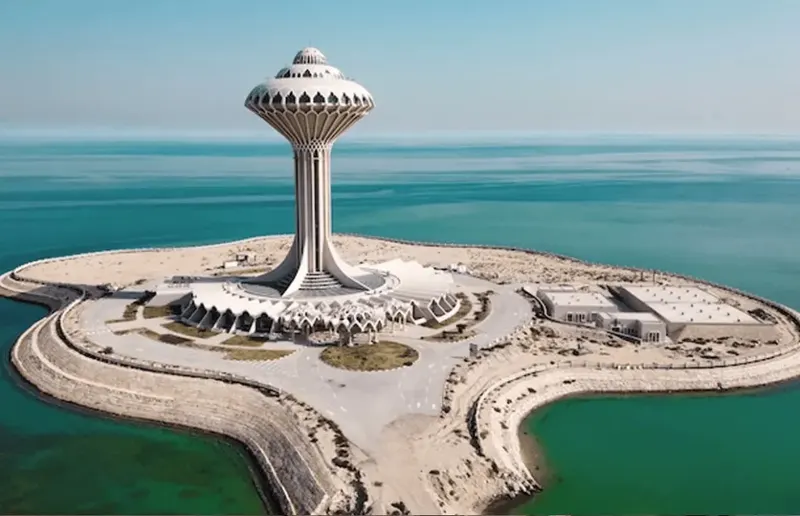
Dammam anchors Saudi Arabia's oil-rich Eastern Province, a low-slung Gulf city that spreads into a tri-city sprawl with neighbouring Al Khobar and Dhahran. This is the kingdom at its most coastal and outward-looking: long corniches on the Arabian Gulf, a causeway running to Bahrain, and the culture centre that Saudi Aramco built. It rewards travellers curious about the Saudi east rather than its holy cities or capital.
Dammam is a quieter alternative. It's ready to explore in the Nuvoha app: set your budget and see complete Dammam trips.
Why visit Dammam
The Eastern Province is Saudi Arabia's Gulf face, and Dammam is its hub. The city's long Corniche and King Abdullah Park give the waterfront its evening life, while neighbouring Al Khobar adds a busier seafront promenade of cafes and restaurants. In Dhahran, the King Abdulaziz Center for World Culture, known as Ithra, is a landmark of contemporary architecture with galleries, a library and a museum built by the national oil company. The King Fahd Causeway strikes out across the water towards Bahrain, and inland lies the vast Al Ahsa oasis, a UNESCO-listed sea of date palms and springs. Half Moon Bay curves south for beach days on the Gulf.
Coast, culture and causeway
- Dammam Corniche: A long Gulf-front promenade of lawns, playgrounds and King Abdullah Park, at its liveliest on cool evenings.
- King Abdulaziz Center for World Culture (Ithra): A landmark cultural complex in Dhahran, with a museum, galleries, library and cinema under a striking steel skin.
- Al Khobar Corniche: The neighbouring city's busy seafront strip of cafes, restaurants and family promenades facing the Gulf.
- King Fahd Causeway: The road bridge striding across the water from Al Khobar to the island nation of Bahrain.
- Half Moon Bay: A curved sandy bay south of the tri-city area, a favourite for beach outings and watersports on the Gulf.
- Al Ahsa Oasis: A UNESCO-listed oasis of millions of date palms and natural springs, inland from the coast.
Across the tri-city
- Dammam city centre: The older commercial core and port near the fish market, the corniche and traditional markets.
- Al Khobar: The tri-city's most sociable coast, with the corniche, shopping streets and dense dining.
- Dhahran: Home to the national oil company, a leading university and the Ithra cultural centre.
- Al Faisaliyah: A modern Al Khobar district of malls, restaurants and residential towers.
- Ar Rakah: A coastal residential belt linking Dammam and Al Khobar along the Gulf.
- Aziziyah (Half Moon Bay): The southern beach zone of resorts and weekend chalets on the shore.
The Eastern Province table
The Eastern Province table is Gulf Arabian at heart, built on spiced rice and the sea. Kabsa and mandi pair long-grain rice with lamb, chicken or fish, while local specialities like muhammar, a sweet date rice, and fresh Gulf shrimp and hamour turn up on family menus. Decades of international workers mean excellent South Asian, Filipino and Levantine food too, and any meal may open with dates and cardamom-scented gahwa.
- Kabsa
- Mandi
- Muhammar (sweet rice)
- Gulf shrimp
- Grilled hamour
- Gahwa with dates
What Dammam feels like
Life in the Eastern Province is quieter and more industrial than in Riyadh or Jeddah, shaped by the oil economy and the nearness of the Gulf. Days are hot and often humid, so much of life moves between air-conditioned malls and the cooler corniche evenings, when families picnic on the grass and children cycle the promenades. This is a conservative region, and Saudi customs apply: modest dress, prayer-time pauses when shops briefly close, and no alcohol anywhere. The mood is practical and welcoming rather than showy, with a large international workforce and a growing appetite for cafes, seafood restaurants and weekend trips over the causeway to Bahrain.
Getting around
The Eastern Province is built for driving, with wide highways knitting Dammam, Al Khobar and Dhahran together. There is no metro, so ride-hailing apps and taxis are the simplest way around for visitors, and car hire is common. Distances between the three cities are real but quick by road outside the peaks. Summer heat and humidity make walking uncomfortable except on the corniches after dark. King Fahd International Airport (DMM) lies north-west of Dammam and is among the largest airports in the world by land area. It is a drive of around forty-five minutes from the tri-city centre, usually by taxi or ride-hailing app.
Practical pointers
- Dress modestly in public: loose clothing covering shoulders and knees for men and women, though the abaya is no longer legally required for visitors.
- Saudi Arabia is alcohol-free; none is sold or permitted anywhere in the country.
- Shops and restaurants may pause briefly at prayer times, so plan around the five daily calls.
- During Ramadan, do not eat, drink or smoke in public in daylight, and expect a slower daytime pace.
- The cooler months from November to March are far more comfortable than the humid summer.
- Use ride-hailing apps to move between Dammam, Al Khobar and Dhahran without fare haggling.
- The King Fahd Causeway to Bahrain needs a passport and, for many nationalities, the right visa, so check requirements first.
- Ithra in Dhahran rewards a half day between its museum, galleries and exhibitions.
- Al Ahsa oasis makes a rewarding day trip inland for palm groves, springs and heritage.
- Evenings are for the corniche, when families gather and the heat finally eases.
Best for
- City breaks
- Quieter travel
Key facts
| Country | Saudi Arabia |
|---|---|
| Region | Middle East & North Africa |
| Airports | DMM |
| Trip length fit | Short-trip friendly |
Dammam essentials
| Currency | Saudi Riyal (SAR) |
|---|---|
| Language | Arabic; English is widely spoken in cities, hotels and restaurants |
| Time zone | Arabia Standard Time, UTC+3, no daylight saving |
| Emergency number | 911 |
| Driving side | Right |
| Tap water | Desalinated and generally safe in cities, though most residents and visitors drink bottled water |
Climate & seasons
| Month | Typical range | Season |
|---|---|---|
| January | 10°C to 22°C | Mild winter |
| April | 21°C to 35°C | Hot spring |
| July | 30°C to 43°C | Very hot summer |
| October | 24°C to 36°C | Hot autumn |
Typical stay
- Weekend-friendly
- Short break (2–5 days)
Dammam works as a weekend break just as well as a longer stay.
Getting there
Dammam is served via DMM.
- DMM
Is it your kind of trip?
Ideal if…
- you like walkable city energy
- you like places before everyone else finds them
Maybe not if…
- a beach-first holiday is the priority
Pairs well with
Compare with
More in Middle East & North Africa
Near Dammam
Travel style
- Short-trip friendly
- City
Frequently asked questions
Which airports serve Dammam?
Dammam is served via DMM.
Is Dammam good for a weekend trip?
Yes, Dammam works for a weekend as well as a longer stay.
What kind of trip is Dammam best for?
Dammam is best for city trips.
Which destinations pair well with Dammam?
Within multi-city range: Doha (222 km), Riyadh (353 km), Kuwait City (355 km).
Where is Dammam, and what is it known for?
Dammam is the capital of Saudi Arabia's Eastern Province, on the Arabian Gulf. It anchors a tri-city area with Al Khobar and Dhahran, sits at the centre of the country's oil industry, and serves as the mainland gateway to Bahrain.
How do you get from Dammam to Bahrain?
The King Fahd Causeway links Al Khobar to Bahrain by road across the Gulf. You will need a passport and, depending on nationality, a visa, and the crossing can be busy at weekends and on holidays.
Do I need to wear an abaya in Dammam?
Visitors are no longer legally required to wear the abaya, but modest dress remains expected: loose clothing covering the shoulders and knees for both men and women. Many women still carry a light abaya or scarf for comfort and respect.
When is the best time to visit?
Between November and March the weather is pleasant for the corniche and day trips. Summers on the Gulf coast are extremely hot and humid, keeping most activity indoors until the evening.