
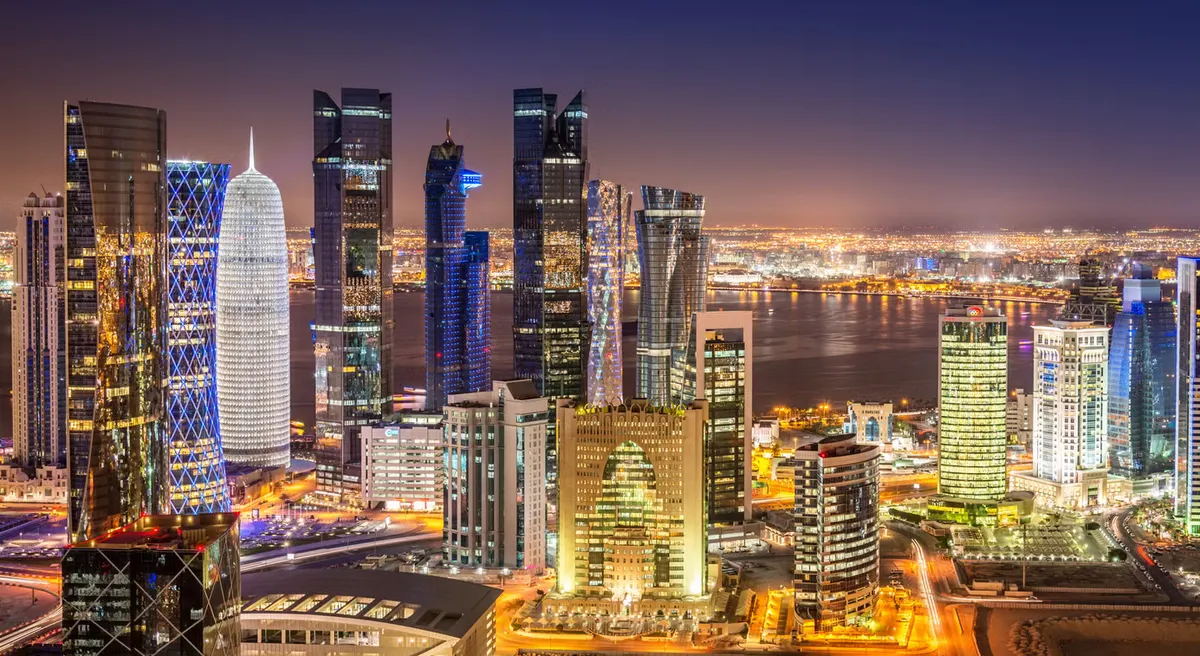
By early evening the lamps are lit in Souq Waqif and the alleys smell of oud smoke, karak and grilling meat, while hooded falcons doze in a souq of their own next door. Across the bay, West Bay's towers rise in a tidy crescent. Doha keeps its old and new faces a corniche stroll apart.
Doha is a quieter alternative. It's ready to explore in the Nuvoha app: set your budget and see complete Doha trips.
Why visit Doha
Doha has spent two decades turning itself into the Gulf's most walkable cultural stop, and it shows. I. M. Pei came out of retirement to build the Museum of Islamic Art on its own island; Jean Nouvel answered with the National Museum's interlocking desert-rose discs. Between them run seven kilometres of bayfront promenade, a restored souq that still trades in spices and falcons, and the limestone lanes of Msheireb, one of the world's most ambitious downtown regenerations. It is compact, easy and quietly confident.
Doha's essential stops
- Museum of Islamic Art: I. M. Pei's geometric landmark on a reclaimed island holds manuscripts, ceramics and metalwork spanning three continents and thirteen centuries.
- Souq Waqif: A restored market of mud-rendered alleys selling spices, textiles, perfume and falcons, at its liveliest after sunset.
- National Museum of Qatar: Jean Nouvel's interlocking discs echo the desert-rose crystal and wrap galleries telling Qatar's story from geology to gas.
- Katara Cultural Village: An open-air amphitheatre, galleries, ornate mosques and a public beach share one seafront campus.
- Doha Corniche: The seven-kilometre bayside promenade runs from the dhow harbour past museum lawns to the foot of West Bay.
- The Pearl-Qatar: A man-made island of marinas and arcaded promenades with views back across the water to the skyline.
Finding your bearings
- West Bay: The business and diplomatic quarter, a crescent of glass towers rising directly behind the Corniche.
- Msheireb Downtown: A regenerated quarter of limestone-clad contemporary architecture, heritage-house museums and its own tram loop.
- Old Doha around Souq Waqif: The historic core, where the souq, the Falcon Souq and Al Koot Fort cluster within a few lamplit blocks.
- Katara: The cultural village between West Bay and The Pearl, built around an amphitheatre and a swimmable beach.
- The Pearl-Qatar: Marina-side towers and Mediterranean-styled promenades on reclaimed land north of the centre.
What's cooking in Doha
Qatari cooking is home cooking (slow rice and meat dishes, wheat porridge for Ramadan evenings, cardamom-heavy tea) and the souq is the easiest place to meet it, alongside Levantine grills, Yemeni ovens and South Indian canteens. Karak, the sweet spiced milk tea, is the national habit; a cup from a roadside window is a rite of passage.
- Machboos
- Harees
- Luqaimat
- Karak
- Balaleet
What Doha feels like
Daytime Doha is hushed: heat presses the streets quiet and life migrates indoors. Then the sun drops and the city switches on: families promenade the Corniche, dhows string lights along the harbour, the souq fills with shisha smoke and conversation in Arabic, Hindi, Tagalog and English. The overall register is calm rather than frenetic; even West Bay's towers feel orderly.
Transport made simple
The driverless Doha Metro runs three lines (Red, Green and Gold) with a rechargeable travel card covering all of them, and the Msheireb tram loops the regenerated downtown. Karwa taxis are metered and app-summonable. In the cooler months the Corniche links the museums and souq on foot; in summer, treat the metro's chilled stations as your allies. Hamad International Airport connects to the centre on the metro's Red Line, reaching the Msheireb interchange in around twenty minutes; taxis are quick outside rush hour.
A few things worth knowing
- Dress modestly in public: covered shoulders and knees are the norm for both sexes.
- Ask before photographing people, particularly women and families.
- During Ramadan, eat and drink away from public view in daylight hours.
- Tipping is not obligatory; rounding up in restaurants and taxis is a courteous habit.
- November to March offers genuinely pleasant outdoor weather; the Corniche walk is best then.
- Buy a metro travel card at any station: the network covers most visitor sights.
- Visit Souq Waqif after dark, when the alleys are at their liveliest and coolest.
- Cards are accepted almost everywhere, so heavy cash is unnecessary.
- Alcohol is served only in licensed hotel venues, never in public spaces.
- Friday mornings are quiet, with much of the city opening after midday prayers.
Best for
- City breaks
- Quieter travel
Key facts
| Country | Qatar |
|---|---|
| Region | Middle East & North Africa |
| Airports | DOH |
| Trip length fit | Short-trip friendly |
Doha essentials
| Currency | Qatari Riyal (QAR) |
|---|---|
| Language | Arabic; English is widely spoken |
| Time zone | Arabia Standard Time (UTC+3), no daylight saving |
| Emergency number | 999 (all emergencies) |
| Driving side | Right |
| Tap water | A safe desalinated supply; bottled water is the common choice |
Climate & seasons
| Month | Typical range | Season |
|---|---|---|
| January | 14°C to 23°C | Mild winter |
| April | 22°C to 33°C | Hot spring |
| July | 31°C to 41°C | Very hot summer |
| October | 26°C to 36°C | Hot autumn |
Typical stay
- Weekend-friendly
- Short break (2–5 days)
Doha works as a weekend break just as well as a longer stay.
Getting there
Doha is served via DOH.
- DOH
Is it your kind of trip?
Ideal if…
- you like walkable city energy
- you like places before everyone else finds them
Maybe not if…
- a beach-first holiday is the priority
Pairs well with
Compare with
More in Middle East & North Africa
Near Doha
Travel style
- Short-trip friendly
- City
Frequently asked questions
Which airports serve Doha?
Doha is served via DOH.
Is Doha good for a weekend trip?
Yes, Doha works for a weekend as well as a longer stay.
What kind of trip is Doha best for?
Doha is best for city trips.
Which destinations pair well with Doha?
Within multi-city range: Dammam (222 km), Abu Dhabi (325 km), Dubai (382 km).
Can you walk between Doha's main sights?
In winter, yes. The Corniche links the Museum of Islamic Art, the dhow harbour and Souq Waqif in one flat, scenic stroll. From May to September the heat makes the metro the wiser link.
Do I need cash in Doha?
Rarely. Cards and phone payments are accepted almost everywhere, including taxis and the souq's larger shops, though a little cash helps for karak stands and small stallholders.
What are the alcohol rules in Qatar?
Alcohol is legal only in licensed venues, which in practice means hotel restaurants and bars. Drinking in public places is against the law, and nothing is sold in ordinary shops.