
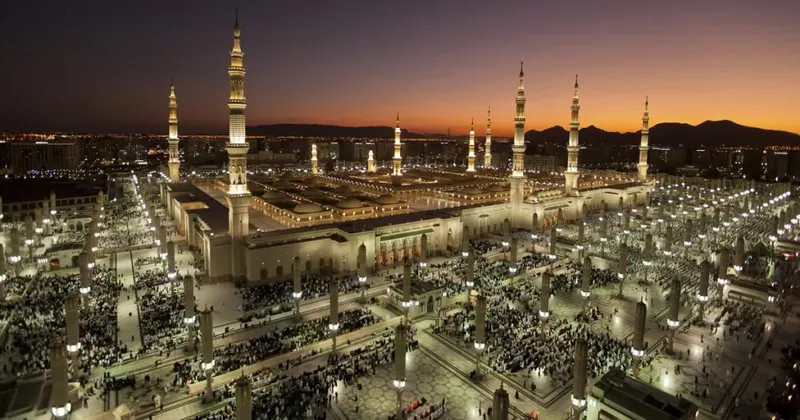
Medina, or Al Madinah, is the second-holiest city in Islam and the place to which the Prophet Muhammad migrated from Mecca. At its heart stands the Prophet's Mosque, its green dome and vast courtyards drawing many millions of Muslim visitors each year. Set on an inland plateau ringed by dark volcanic hills and date-palm groves, the city carries a calm, devotional atmosphere shaped by centuries of pilgrimage. Its history reaches back to the earliest days of Islam.
Medina is a quieter alternative. It's ready to explore in the Nuvoha app: set your budget and see complete Medina trips.
Why visit Medina
For Muslims, Medina holds a place unlike almost anywhere else. The Prophet's Mosque shelters the Prophet Muhammad's tomb beneath its green dome, alongside the Rawdah and the resting places of the first caliphs. Around the city lie foundational sites: Quba, the first mosque of Islam; the Mosque of the Two Qiblas, where the direction of prayer was turned toward Mecca; and Mount Uhud, with the graves of those who fell in an early battle. The city is also renowned for its dates, above all the prized Ajwa. Please note that the central area around the mosque is open to Muslims only.
Sites to plan around
- The Prophet's Mosque: The spiritual heart of the city, sheltering the Prophet Muhammad's tomb beneath its green dome, with vast courtyards shaded by retractable canopies.
- Quba Mosque: The first mosque built in Islam, on the southern edge of the city, long associated with special reward for those who pray there.
- Mosque of the Two Qiblas: The mosque commemorating the moment the direction of prayer was turned from Jerusalem toward Mecca.
- Mount Uhud: A volcanic ridge north of the city, the site of an early battle and the burial place of its martyrs, including the Prophet's uncle Hamza.
- Jannat al-Baqi: The historic cemetery beside the Prophet's Mosque, resting place of many of the Prophet's companions and family.
- Hejaz Railway Museum: The restored terminus of the old Damascus-to-Medina railway, now a museum recalling the early twentieth-century line through the desert.
The city's quarters
- The central sanctuary: The area enclosing the Prophet's Mosque, ringed by hotels and plazas and, at its core, open to Muslims only.
- Quba: A southern quarter built around the first mosque of Islam, set among date farms and quieter residential streets.
- Uhud: The northern approach toward Mount Uhud, taking in the battlefield site, the martyrs' cemetery and open ground below the hills.
- Al Anbariyah: The district around the historic Hejaz Railway station, where Ottoman-era buildings and old city gates survive.
- The date farms: The belt of date plantations south and east of the city, source of Medina's celebrated Ajwa and other varieties.
The Hejazi table
Medina sits in the Hejaz, and its table reflects the western region's cooking as much as the wider kingdom's. Dates are everywhere, the celebrated Ajwa most of all, sold fresh from farms on the city's edge. Around the mosque, cooks feed a constant flow of visitors from across the Muslim world, so alongside Hejazi staples you will find Turkish, Egyptian, South Asian and Indonesian kitchens. Meals often begin, as ever in Arabia, with dates and gahwa (lightly spiced Arabic coffee).
- Ajwa dates
- Saleeg
- Mandi
- Mutabbaq
- Gahwa with dates
What Medina feels like
Medina's mood is devotional and unhurried. Life orbits the Prophet's Mosque, which never truly empties: the faithful arrive for each of the five daily prayers, and the marble plazas fill and settle in slow tides through the day and night. The retractable canopies open against the sun, calligraphy and lamplight soften the interiors, and the feeling is one of quiet reverence rather than spectacle. Beyond the central sanctuary, the city spreads into markets, date farms and residential districts against a backdrop of stark volcanic hills. Even at its busiest, Medina keeps a gentleness that visitors remember.
Getting around
Within the central area, most visitors walk, as the hotels cluster around the Prophet's Mosque and the plazas are made for foot traffic. Taxis and ride-hailing apps reach the outer sites such as Quba, the Mosque of the Two Qiblas and Mount Uhud. For longer journeys, the Haramain High Speed Railway connects Medina with Jeddah and Mecca, and buses serve the pilgrimage routes. Note that some central roads are reserved for Muslim travellers. Prince Mohammad bin Abdulaziz International Airport lies north of the city, handling both pilgrimage traffic and regular flights. Taxis, buses and arranged transfers connect it with the hotels around the mosque, a drive of around twenty to thirty minutes.
Practical pointers
- The central area around the Prophet's Mosque is open to Muslims only; the roads are signposted, and other visitors keep to the outer parts of the city.
- Dress is modest and, near the mosque, conservative: loose clothing covering arms and legs, with women also covering their hair.
- Photography inside the Prophet's Mosque is restricted; follow the posted rules and the guidance of staff.
- Alcohol is prohibited throughout Saudi Arabia.
- Keep a calm, patient and quiet manner in and around the sanctuary, especially at the crowded prayer times.
- During Ramadan the city is at its busiest; avoid eating or drinking in public during daylight hours.
- The cooler months from November to March are the most comfortable for time spent outdoors and walking between sites.
- Fridays and the nights around them are the busiest at the mosque, so arriving well before prayer times helps with space and access.
- Quba, the Mosque of the Two Qiblas and Mount Uhud combine easily into a single outing by taxi.
- Medina's dates, especially Ajwa, make the city's most characteristic purchase; the farm shops south of the centre sell them fresh.
- Non-Muslim visitors can see the outer city and its hills but should plan around the central restricted area.
- Bottled water is widely available; carry some, as the desert air is dry even in winter.
Best for
- City breaks
- Quieter travel
Key facts
| Country | Saudi Arabia |
|---|---|
| Region | Middle East & North Africa |
| Airports | MED |
| Trip length fit | Short-trip friendly |
Medina essentials
| Currency | Saudi Riyal (SAR) |
|---|---|
| Language | Arabic; English is widely spoken in cities, hotels and restaurants |
| Time zone | Arabia Standard Time, UTC+3, no daylight saving |
| Emergency number | 911 |
| Driving side | Right |
| Tap water | Desalinated and generally safe in cities, though most residents and visitors drink bottled water |
Climate & seasons
| Month | Typical range | Season |
|---|---|---|
| January | 12°C to 25°C | Mild winter |
| April | 22°C to 36°C | Hot spring |
| July | 30°C to 43°C | Very hot dry summer |
| October | 22°C to 36°C | Hot autumn |
Typical stay
- Weekend-friendly
- Short break (2–5 days)
Medina works as a weekend break just as well as a longer stay.
Getting there
Medina is served via MED.
- MED
Is it your kind of trip?
Ideal if…
- you like walkable city energy
- you like places before everyone else finds them
Maybe not if…
- a beach-first holiday is the priority
Pairs well with
Compare with
More in Middle East & North Africa
Near Medina
Travel style
- Short-trip friendly
- City
Frequently asked questions
Which airports serve Medina?
Medina is served via MED.
Is Medina good for a weekend trip?
Yes, Medina works for a weekend as well as a longer stay.
What kind of trip is Medina best for?
Medina is best for city trips.
Which destinations pair well with Medina?
Within multi-city range: AlUla (293 km), Jeddah (326 km), Sharm El Sheikh (652 km).
Can non-Muslims visit Medina?
Non-Muslims may visit the outer parts of Medina but not the central area around the Prophet's Mosque, which is reserved for Muslims. The roads approaching the sanctuary are clearly signposted. This differs from Mecca, which is closed to non-Muslims entirely.
What is Medina best known for?
Medina is the second-holiest city in Islam and home to the Prophet's Mosque, which shelters the Prophet Muhammad's tomb. It is also known for foundational sites such as Quba and for its dates, above all the prized Ajwa variety.
Is Medina part of the Hajj or Umrah?
Visiting Medina is not one of the formal rites of Hajj or Umrah, which take place in and around Mecca. Even so, many pilgrims travel on to Medina to pray at the Prophet's Mosque, and the two cities are linked by high-speed rail.
When is the best time to visit Medina?
The cooler months from roughly November to March bring the most comfortable weather. The city is busiest during Ramadan and the Hajj season, when pilgrim numbers peak and accommodation near the mosque fills.