
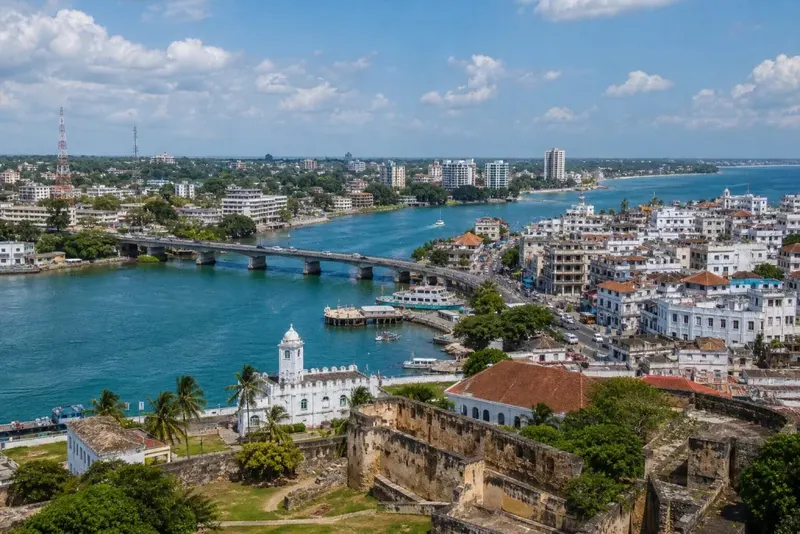
Mombasa is Kenya's ocean city, an ancient Swahili port strung along an island and the mainland coast either side. For centuries traders from Arabia, India, Persia and Portugal came for its harbour, and the mix still shows in its coral-stone lanes, carved doors and the great bulk of Fort Jesus. Today it is also the gateway to Kenya's beaches, the white sands of the north and south coasts unrolling under palms on the warm Indian Ocean.
Mombasa is made for unwinding. It's ready to explore in the Nuvoha app: set your budget and see complete Mombasa trips.
Why visit Mombasa
Mombasa pairs deep history with easy beach days. At its core stands Fort Jesus, the mighty Portuguese fortress above the old harbour, now a UNESCO site and museum, with the atmospheric Old Town of coral houses and Swahili doors at its feet. From the island, causeways and the Likoni ferry lead to the coast proper: the resort beaches of Nyali, Bamburi and Shanzu to the north, and the long white stretch of Diani to the south. Offshore lie coral reefs and marine parks for snorkelling and diving, while Haller Park turns an old quarry into a haven for giraffes, hippos and birds.
What Mombasa feels like
Mombasa runs at a slower, warmer, saltier tempo than Nairobi. This is the Swahili coast, tropical and humid, where the day starts early to beat the heat and life spills out again in the cool of the evening. The Old Town smells of cardamom, sea and frying mahamri; muezzins call across the rooftops of a mostly Muslim city; dhows still work the harbour under sail. On the beaches the pace turns to swimming, dhow trips and long lunches under casuarina trees. The heat is constant and the humidity high, easing when the ocean breeze picks up and during the cooler, drier months.
Highlights
- Fort Jesus: The sixteenth-century Portuguese fortress guarding the old harbour, a UNESCO World Heritage Site and museum.
- Old Town: A maze of Swahili coral-stone houses, carved wooden doors, balconies and small shops behind the fort.
- Diani Beach: A long ribbon of white sand and palms on the south coast, reached across the Likoni ferry.
- North Coast beaches: The resort sands of Nyali, Bamburi and Shanzu, close to the island and lined with hotels.
- Haller Park: A rehabilitated limestone quarry turned wildlife sanctuary, with giraffes, hippos, antelope and birdlife.
- Marine parks and reefs: Protected offshore reefs off the north and south coasts for snorkelling, diving and glass-bottom boat trips.
Areas to know
- Old Town: The historic Swahili quarter of coral houses and carved doors, gathered below Fort Jesus by the old harbour.
- Mombasa Island centre: The commercial heart on Moi Avenue, marked by the landmark tusk arches, markets and the port.
- Nyali: An affluent North Coast suburb of beaches, malls and gardens, just over the creek from the island.
- Bamburi and Shanzu: The North Coast resort belt of beach hotels, close to Haller Park and the marine park.
- Diani and the South Coast: The headline beach strip across the Likoni ferry, in Kwale County, known for white sand and reefs.
- Likoni and the mainland south: The busy ferry crossing and mainland approach that link the island to the south coast.
Food & drink
Mombasa's kitchen is Swahili to the core, built on coconut, seafood and the spices of old trade routes. Rice is cooked in coconut milk as wali wa nazi, or simmered with cloves and cinnamon into fragrant pilau and biryani. Fish and prawns come in coconut sauces such as samaki wa kupaka, and the streets fry cardamom-scented mahamri doughnuts and grill mishkaki skewers. It is a coast for spice, sweetness and the ever-present taste of the sea, washed down with fresh coconut water.
- Wali wa nazi (coconut rice)
- Pilau
- Samaki wa kupaka (fish in coconut sauce)
- Mahamri
- Mishkaki (grilled skewers)
Getting around
Mombasa moves by road and water. On the island, tuk-tuks and taxis are the easy way around, with matatus and boda-boda motorbikes filling in, and ride-hailing apps operating in the main areas. The Likoni ferry, free for foot passengers, carries the crowds across to the south coast and Diani, while bridges and causeways link the island to the north. Distances along the coast are longer than they look, so plan beach trips with the ferry queues in mind. Moi International Airport lies on the mainland west of the island and handles domestic and some international flights. The Standard Gauge Railway from Nairobi arrives at Mombasa Terminus at Miritini, on the mainland, a scenic alternative to flying that passes through Tsavo.
Good to know
- The coast is largely Muslim, so dress modestly away from the resort beaches, covering shoulders and knees in the Old Town and towns.
- Keep beachwear for the beach; cover up when walking through villages, markets and the Old Town.
- Ask before photographing people, homes or dhows, and expect a friendly greeting to come before any exchange.
- Be mindful during Ramadan, when many eat and drink discreetly by day and life shifts to the evenings.
- Time south-coast trips to avoid the busiest Likoni ferry crossings, especially at the start and end of the day.
- Protect the reefs by choosing reef-safe sunscreen and never standing on or touching coral when snorkelling.
- The Standard Gauge Railway from Nairobi is a relaxed way to arrive, threading through Tsavo's game country.
- Hydrate and slow down in the heat and humidity, saving sightseeing for the cooler morning and evening hours.
- Agree tuk-tuk and taxi fares before setting off, or use a ride-hailing app where it operates.
- Watch the beaches at low tide, when the reef flats are exposed and swimming can be limited.
Best for
- Beach time
- Unwinding
Key facts
| Country | Kenya |
|---|---|
| Region | Africa |
| Airports | MBA |
| Trip length fit | Short-trip friendly |
Mombasa essentials
| Currency | Kenyan Shilling (KES) |
|---|---|
| Language | Swahili and English, both official |
| Time zone | UTC+3, observed year-round |
| Emergency number | 999 (112 also works) |
| Driving side | Left |
| Tap water | Not recommended; choose bottled, filtered or boiled water |
Climate & seasons
| Month | Typical range | Season |
|---|---|---|
| January | 24°C to 32°C | Hot humid season |
| April | 24°C to 31°C | Long rains |
| July | 21°C to 29°C | Cooler dry season |
| October | 23°C to 31°C | Warm short rains |
Mombasa is one of Nuvoha's winter-sun picks.
Typical stay
- Weekend-friendly
- Short break (2–5 days)
Mombasa works as a weekend break just as well as a longer stay.
Getting there
Mombasa is served via MBA.
- MBA
Is it your kind of trip?
Ideal if…
- time on the coast is the point of the trip
- you want to slow down and reset
Maybe not if…
- you want big-city energy around the clock
Pairs well with
Compare with
More in Africa
Near Mombasa
Travel style
- Winter sun
- Short-trip friendly
- Beach
Frequently asked questions
Which airports serve Mombasa?
Mombasa is served via MBA.
Is Mombasa good for a weekend trip?
Yes, Mombasa works for a weekend as well as a longer stay.
What kind of trip is Mombasa best for?
Mombasa is best for beach trips, popular for unwinding.
Which destinations pair well with Mombasa?
Within multi-city range: Zanzibar (247 km), Dar es Salaam (319 km), Nairobi (423 km).
Which beach should I choose near Mombasa?
The North Coast beaches of Nyali, Bamburi and Shanzu are closest to the island and airport. Diani, on the South Coast across the Likoni ferry, is famed for its long white sand. Your choice often comes down to whether you want to be near the city or further from it.
Is the Old Town worth visiting?
Yes. Fort Jesus and the surrounding Old Town are the cultural heart of Mombasa, with centuries of Swahili, Arab, Indian and Portuguese heritage written into the coral streets, carved doors and old harbour. A guided walk brings the history to life.
How do I get between Mombasa and the South Coast?
The Likoni ferry links the island to the south coast and Diani, carrying pedestrians and vehicles across the harbour mouth. It can be busy, so allow time, especially at peak hours, and factor the crossing into any day trip.
Can I combine a safari with the Mombasa coast?
Easily. Tsavo East and West lie inland on the road and railway towards Nairobi, so many visitors pair a few days on safari with time on the coast. The Standard Gauge Railway makes the journey between the two straightforward.