
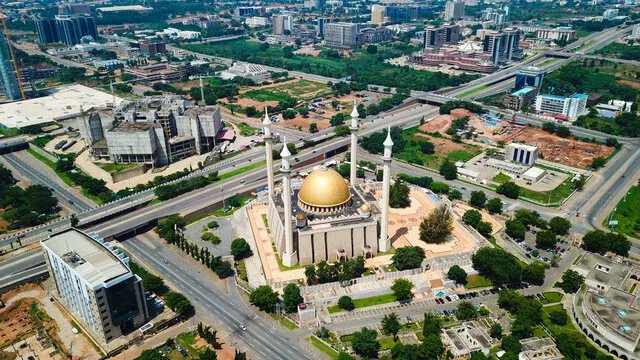
Purpose-built in the geographic heart of Nigeria, Abuja is the orderly, green counterpoint to Lagos: a planned capital of wide boulevards, low hills and open space. The giant granite dome of Aso Rock rises behind the government quarter, while the golden National Mosque and the soaring National Christian Centre face each other across the city. Calmer and more spacious than Nigeria's commercial powerhouse, Abuja shows the country's civic, diplomatic side.
Abuja is a quieter alternative. It's ready to explore in the Nuvoha app: set your budget and see complete Abuja trips.
Why visit Abuja
Abuja is Nigeria at its most planned and poised. Its defining sight is Aso Rock, a vast monolith on the city's edge, with the Presidential Villa and government complex gathered at its base. Two landmarks capture the country's faith and balance: the gold-domed National Mosque and the tent-like National Christian Centre, which face one another across the central district. Millennium Park, the largest in the city, offers green lawns beneath the hills, and Jabi Lake draws walkers and diners to its shore. Beyond the boundary rises Zuma Rock, the towering monolith pictured on the naira, guarding the road north. It is a capital built for calm rather than chaos.
Rock, dome and green space
- Aso Rock: The giant granite monolith on the city's edge, rising behind the Presidential Villa and government complex.
- Nigerian National Mosque: A landmark of gold domes and slender minarets on Independence Avenue, open to visitors outside prayer times.
- National Christian Centre: The vast, tent-roofed national church facing the mosque, a symbol of the country's religious balance.
- Millennium Park: The city's largest public park, a stretch of lawns, fountains and shaded walks near Maitama.
- Jabi Lake: A reservoir with a waterfront promenade, boat rides and a lakeside mall, made for an evening out.
- Zuma Rock: A colossal monolith on the road north towards Kaduna, pictured on the national currency and known as the gateway to Abuja.
Across the capital
- Central Business District: The planned heart of government and commerce, holding the National Mosque, the national church and ministries.
- Maitama: An affluent, leafy district of embassies, upmarket homes and Millennium Park.
- Asokoro: The most exclusive quarter, home to the Presidential Villa and many government residences.
- Wuse: A busy commercial and nightlife zone, with Wuse Market, shops and restaurants.
- Garki: One of the oldest districts, a mix of markets, offices and hotels south of the centre.
- Jabi: A lakeside district of offices and apartments around the Jabi Lake mall and promenade.
The Nigerian table
Abuja gathers Nigeria's regional kitchens in one capital. Jollof rice, the celebrated one-pot of tomato and pepper, is the centrepiece, served with fried plantain and chicken, while pounded yam, eba and amala come with rich soups like egusi, ogbono and efo riro. The city has a special love of suya, skewers of spiced grilled beef sold smoking from roadside stands after dark, a northern speciality. Pepper soup, moi moi, akara and grilled catfish round out a table that is generous, fiery and deeply social.
- Jollof rice
- Pounded yam with egusi soup
- Suya (spiced beef skewers)
- Pepper soup
- Moi moi
- Grilled catfish
What Abuja feels like
Abuja feels unlike the rest of Nigeria: measured, spacious and green, with wide roads, roundabouts and hills rather than the crush of Lagos. As the seat of government and the diplomatic corps, it carries a certain formality, its central districts filling by day with officials and quieting at night, while nightlife and dining cluster in Wuse and Maitama. The population is a national mix of every region and faith, and mosque and church stand comfortably side by side. Rains sweep in green and dramatic through the middle of the year; the dry season brings warm days and, at its peak, the hazy harmattan wind off the Sahara. The overall mood is relaxed and safety-conscious.
Getting around
Abuja is well laid out and less congested than Lagos, but it is still a driving city. Ride-hailing apps are the standard, safe way for visitors to get around, alongside metered and negotiated taxis. The Abuja light-rail line links the city centre to the airport and outer districts, though services can be limited. Distances between districts are real, and the wide, well-signed roads make car travel straightforward. Agree fares before any informal taxi ride. Nnamdi Azikiwe International Airport (ABV) lies west of the city, around a forty-minute drive from the centre. Ride-hailing apps, hotel transfers and taxis are the usual links, and the light rail also connects the airport to town.
Good to know
- Nigeria is deeply religious and courteous; exchange warm greetings and a little small talk before business.
- Dress smartly and modestly, particularly at the mosque, the national church and government areas.
- Always ask before taking photographs, and avoid photographing government buildings, the airport or security forces.
- Accept and offer things with the right hand, and use titles and a respectful tone with elders and officials.
- The dry season from November to March is the easiest time to visit, though harmattan haze can dull the views.
- Use ride-hailing apps rather than flagging cars, and agree any informal fare before setting off.
- Dress up a little: Abuja leans smart, and neat clothing is expected in many venues.
- Zuma Rock makes a striking photo stop on the road towards Kaduna, just outside the city.
- Carry water and sun cover for the warm days, and check current travel advice before wider trips.
- Evenings are for suya stands and the Jabi Lake waterfront, when the heat eases.
Best for
- City breaks
- Quieter travel
Key facts
| Country | Nigeria |
|---|---|
| Region | Africa |
| Airports | ABV |
| Trip length fit | Short-trip friendly |
Abuja essentials
| Currency | Nigerian Naira (NGN) |
|---|---|
| Language | English is the official language; Hausa, Yoruba and Igbo are the largest of some 500 languages spoken across the country |
| Time zone | West Africa Time (UTC+1), no daylight saving |
| Emergency number | 112 (national emergency line) |
| Driving side | Right |
| Tap water | Not safe from the tap; bottled water and filtered water are widely sold |
Climate & seasons
| Month | Typical range | Season |
|---|---|---|
| January | 19°C to 34°C | Dry Harmattan season |
| April | 23°C to 34°C | Hot pre-rains |
| July | 22°C to 29°C | Rainy season |
| October | 22°C to 31°C | Humid late rains |
Typical stay
- Weekend-friendly
- Short break (2–5 days)
Abuja works as a weekend break just as well as a longer stay.
Getting there
Abuja is served via ABV.
- ABV
Is it your kind of trip?
Ideal if…
- you like walkable city energy
- you like places before everyone else finds them
Maybe not if…
- a beach-first holiday is the priority
Compare with
More in Africa
Near Abuja
Travel style
- Short-trip friendly
- City
Frequently asked questions
Which airports serve Abuja?
Abuja is served via ABV.
Is Abuja good for a weekend trip?
Yes, Abuja works for a weekend as well as a longer stay.
What kind of trip is Abuja best for?
Abuja is best for city trips.
Is Abuja the capital of Nigeria?
Yes. Abuja became the capital in 1991, replacing Lagos, and was purpose-built in the centre of the country as a neutral, planned city for government. Lagos remains the largest city and commercial hub on the coast.
How is Abuja different from Lagos?
Abuja is planned, green and relatively calm, built around government, embassies and wide boulevards. Lagos is vast, coastal, crowded and commercial, the country's cultural and business engine. Abuja feels more orderly and spacious by comparison.
Is Abuja safe to visit?
Abuja is generally more orderly and secure than many parts of Nigeria, but standard precautions apply: use ride-hailing or trusted drivers, stay aware after dark, avoid photographing security sites, and check your government's current travel advice before you go.
When is the best time to visit Abuja?
The dry season, roughly November to March, is the most comfortable for getting around, though the harmattan wind can bring dusty haze around December to February. The rains fall heavily between about April and October, turning the city lush and green.