
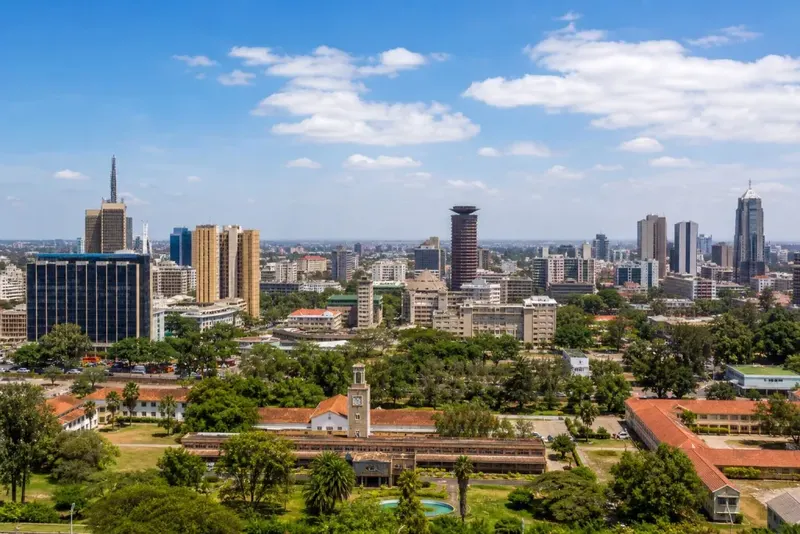
Nairobi is that rare capital with lions on its doorstep. Kenya's high, fast-growing hub sits at around 1,800 metres, cool and green, its skyline rising a short drive from open savannah where rhino and giraffe graze. Founded barely more than a century ago as a railway depot, it has become East Africa's business and travel crossroads, and the launch point for nearly every Kenyan safari. It is a city of contrasts, energetic, congested and surrounded by wild country.
Nairobi is a quieter alternative. It's ready to explore in the Nuvoha app: set your budget and see complete Nairobi trips.
Why visit Nairobi
Nairobi is where most Kenyan journeys begin, but it deserves a day or two of its own. On its southern edge, Nairobi National Park protects lions, rhinos, giraffes and zebra against a backdrop of city towers, the only park of its kind bordering a capital. Nearby, the Sheldrick elephant orphanage raises rescued calves, and the Giraffe Centre lets you meet endangered Rothschild's giraffes at eye level. In the leafy suburb of Karen, the farmhouse of Out of Africa author Karen Blixen is now a museum. Add the national museum, spirited markets and a lively dining and music scene, and the city earns its stop.
Highlights
- Nairobi National Park: Savannah wildlife, from lions to rhinos and giraffes, roaming within sight of the skyline on the city's southern edge.
- Sheldrick Wildlife Trust: A renowned elephant orphanage where rescued calves are hand-reared, open to visitors for a short window each day.
- Giraffe Centre: A conservation centre in Langata where you can hand-feed and photograph endangered Rothschild's giraffes.
- Karen Blixen Museum: The colonial farmhouse of the Out of Africa author, preserved with its gardens below the Ngong Hills.
- Nairobi National Museum: The country's flagship museum of natural history, culture and prehistory, with an adjoining snake park.
- Bomas of Kenya: A cultural centre presenting traditional homesteads and dances from communities across the country.
Areas to know
- Central Business District: The high-rise core around the landmark Kenyatta International Convention Centre, with government buildings and city markets.
- Westlands: A lively district of restaurants, malls, offices and nightlife, north-west of the centre.
- Karen: A leafy, spacious suburb of gardens and horse country, named after Karen Blixen, near the Giraffe Centre.
- Langata: A green residential area bordering the national park, home to the Giraffe Centre and the Sheldrick orphanage.
- Gigiri: The diplomatic quarter around the United Nations complex, quiet and heavily wooded.
- Kilimani: A fast-changing inner suburb of apartments, cafes and offices south-west of the centre.
Food & drink
Nairobi eats well and eats sociably. The city's signature is nyama choma, meat, often goat or beef, slow-grilled over charcoal and shared straight from the board with kachumbari, a fresh tomato and onion relish. The everyday staple is ugali, a firm maize porridge eaten with greens like sukuma wiki and a stew or grill. Coastal and South Asian influences bring pilau, biryani, samosas and chapati, while roadside stalls fry sweet mandazi. Kenyan coffee and tea, grown in the highlands nearby, are a point of pride.
- Nyama choma
- Ugali with sukuma wiki
- Pilau
- Chapati
- Mandazi
What Nairobi feels like
Nairobi is fast, loud and full of enterprise, softened by its altitude and its greenery. The traffic is famous and the energy relentless, yet the climate stays mild all year, and jacaranda trees wash whole avenues in purple when they bloom. Days move to matatus blaring music, roadside coffee and the buzz of a young, ambitious population; nights belong to nyama choma grills and live bands in Westlands and beyond. Beyond the towers the mood shifts quickly, from the diplomatic calm of Gigiri to the horse paddocks of Karen and the open plains of the national park, all within the city's reach.
Getting around
Nairobi runs on the road, and traffic is heavy, so allow generous time between places. The colourful matatu minibuses are the local backbone but can be daunting for newcomers, and most visitors rely on ride-hailing apps, which are widespread and remove fare haggling. The tolled Nairobi Expressway now speeds journeys between the airport, the centre and Westlands. Boda-boda motorbike taxis are quick through jams, though they carry more risk. Jomo Kenyatta International Airport, the country's main gateway, lies south-east of the centre and links to town via the Nairobi Expressway. Smaller Wilson Airport, closer in, handles light aircraft and most flights to the safari parks and the coast.
Good to know
- Kenyans are warm and courteous; a handshake and an unhurried greeting go a long way before getting to business.
- Always ask before photographing people, and be especially respectful around Maasai and other communities in traditional dress.
- Dress is generally smart-casual and fairly modest in the city; the coast and mosques call for more cover.
- Tipping for good service is appreciated in restaurants and to safari guides and drivers, and is part of how many are paid.
- Leave the centre early for a game drive in the national park, when the animals are most active and the light is soft.
- Arrange the Sheldrick orphanage visit ahead, as it opens to the public for only a short period in the middle of the day.
- Give yourself a buffer for traffic, especially heading to the airport in the morning and evening peaks.
- Nairobi sits at altitude and can be cool and wet, so pack a warm layer and a light waterproof.
- Use ride-hailing apps rather than flagging cabs, and agree any safari or tour details in writing first.
- Ask about malaria precautions for onward safari areas, even though the city itself is high and lower risk.
Best for
- City breaks
- Quieter travel
Key facts
| Country | Kenya |
|---|---|
| Region | Africa |
| Airports | NBO |
| Trip length fit | Short-trip friendly |
Nairobi essentials
| Currency | Kenyan Shilling (KES) |
|---|---|
| Language | Swahili and English, both official |
| Time zone | UTC+3, observed year-round |
| Emergency number | 999 (112 also works) |
| Driving side | Left |
| Tap water | Not recommended; choose bottled, filtered or boiled water |
Climate & seasons
| Month | Typical range | Season |
|---|---|---|
| January | 12°C to 26°C | Warm dry season |
| April | 13°C to 24°C | Long rains |
| July | 10°C to 22°C | Cool dry season |
| October | 12°C to 25°C | Short rains |
Typical stay
- Weekend-friendly
- Short break (2–5 days)
Nairobi works as a weekend break just as well as a longer stay.
Getting there
Nairobi is served via NBO.
- NBO
Is it your kind of trip?
Ideal if…
- you like walkable city energy
- you like places before everyone else finds them
Maybe not if…
- a beach-first holiday is the priority
Pairs well with
Compare with
More in Africa
Near Nairobi
Travel style
- Short-trip friendly
- City
Frequently asked questions
Which airports serve Nairobi?
Nairobi is served via NBO.
Is Nairobi good for a weekend trip?
Yes, Nairobi works for a weekend as well as a longer stay.
What kind of trip is Nairobi best for?
Nairobi is best for city trips.
Which destinations pair well with Nairobi?
Within multi-city range: Mombasa (423 km), Zanzibar (602 km), Dar es Salaam (668 km).
Is Nairobi worth spending time in, or just a transit stop?
It is worth a day or two. Between the national park, the elephant orphanage, the Giraffe Centre and the Karen Blixen Museum, you can combine wildlife and history without leaving the city, which also eases you into the altitude before a safari.
Can you really see wildlife inside the city?
Yes. Nairobi National Park, on the southern edge of the city, is home to lions, rhinos, giraffes, buffalo and plains game, famously photographed against the distant skyline. It is the only national park bordering a capital.
How do I get around Nairobi?
Most visitors use ride-hailing apps, which are reliable and avoid fare negotiation. Traffic is heavy, so plan extra time, particularly for airport runs, and use the Nairobi Expressway where it helps.
Is Nairobi a malaria area?
The city sits at high altitude and is generally considered low risk, but many safari destinations are not. Seek current medical advice on antimalarials and vaccinations for your whole trip before you travel.