
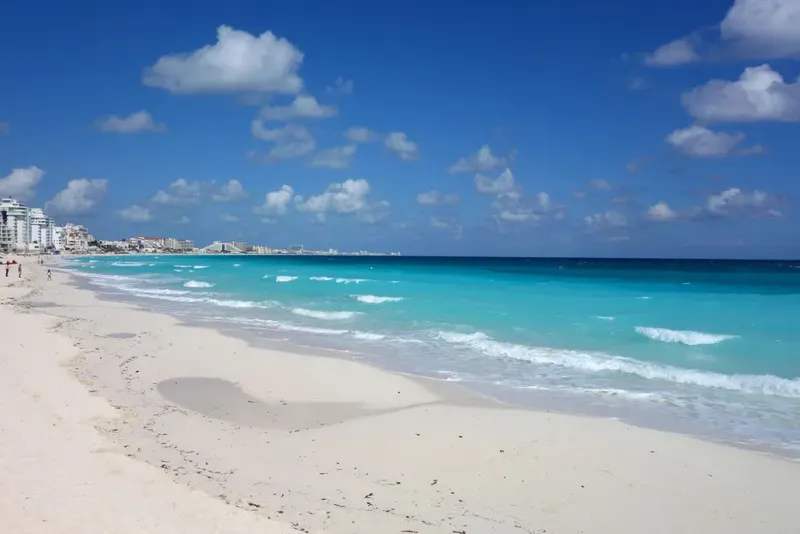
Cancun runs along a narrow ribbon of white sand between the turquoise Caribbean and a calm inland lagoon, on the northern tip of Mexico's Yucatan Peninsula. The powdery, limestone-fine beach stays cool underfoot even at midday, and the sea glows in bands of jade and sapphire. Beyond the resort strip lie ancient Maya cities, freshwater sinkholes and islands, making this as much a gateway to the Yucatan as a place to lie in the sun.
Cancún is made for unwinding. It's ready to explore in the Nuvoha app: set your budget and see complete Cancún trips.
Why visit Cancún
Cancun pairs dependable Caribbean beach weather with some of the richest sightseeing in the Americas. The long Hotel Zone strings hotels and public beaches along the coast, with the calm lagoon behind and warm, swimmable sea in front for much of the year. Ferries reach the laid-back isle of Isla Mujeres and, further off, the reefs of Cozumel. Inland, the Yucatan hides cenotes, freshwater caverns clear enough to swim in, and the great Maya sites of Chichen Itza, Tulum and Coba. Add fresh regional cooking and the buzz of Playa del Carmen down the coast, and there is far more here than sand.
What Cancún feels like
The rhythm here is set by the sea and the sun. Days drift between the beach, the warm shallows and the poolside, picking up in the evening when the Hotel Zone's restaurants and bars come alive. The strip itself is modern and geared to visitors, a world apart from the workaday downtown on the mainland, where locals shop and eat at taco counters far from the beach. Away from the towers, the mood turns wonderfully languid on Isla Mujeres or the sleepier southern beaches. The light is dazzling, the water bath-warm, and the Caribbean colours barely look real.
Coast and sights to plan around
- Playa Delfines: The best-known public beach on the strip, backed by dunes and the giant, multicoloured Cancun letters, with wide Caribbean views.
- Isla Mujeres: A slender, laid-back island a short ferry from the mainland, ringed by calm swimming coves and reached along quiet, golf-cart lanes.
- Chichen Itza: One of the New Seven Wonders of the World, this great Maya city inland is crowned by the stepped pyramid of Kukulcan.
- Tulum: A walled Maya port set dramatically on a cliff above a Caribbean beach, a few hours down the Riviera Maya.
- Cenotes of the Yucatan: Natural freshwater sinkholes in the limestone, some open pools and some hidden in caverns, wonderful for a cool, clear swim.
- Cozumel and the reef: An island off the coast fringed by part of the Mesoamerican Reef, among the finest diving and snorkelling in the Caribbean.
Along the coast
- Zona Hotelera (Hotel Zone): The barrier-island strip shaped like a number seven, lined with beaches, resorts, malls and marinas between sea and lagoon.
- El Centro (downtown): The everyday city on the mainland, where residents live, shop and eat, centred on Avenida Tulum and the Mercado 28 market.
- Puerto Juarez and the ferries: The northern departure point for the quick crossing to Isla Mujeres, at the top of the coast.
- Playa del Carmen: A busy, walkable beach town down the coast, built around the pedestrian Quinta Avenida, and the ferry port for Cozumel.
- Riviera Maya: The stretch of coast running south towards Tulum, dotted with beaches, cenotes, eco-parks and smaller resort villages.
- Isla Mujeres: The low-key island across the water, where the pace slows and Playa Norte offers some of the calmest swimming around.
The Yucatecan table
The food of the Yucatan is unlike the rest of Mexico, shaped by Maya traditions and mild, earthy spicing. Look for cochinita pibil, pork slow-roasted in achiote and sour orange, sopa de lima, and antojitos such as panuchos and salbutes topped with turkey and pickled onion. The Caribbean supplies ceviche and fish grilled Tikin xic style in achiote, while street stalls sell marquesitas, crisp rolled wafers filled with cheese and caramel. Beyond the strip, the downtown taco counters and markets serve the most authentic cooking.
- Cochinita pibil
- Sopa de lima
- Panuchos
- Ceviche
- Tikin xic fish
- Marquesitas
Getting from A to B
The Hotel Zone is one long boulevard, easily covered by the frequent public buses that shuttle between the strip and downtown for a small, fixed fare. Taxis are plentiful, though it is wise to agree the fare before setting off, as meters are rare. For trips down the coast to Playa del Carmen and Tulum, the comfortable ADO coaches and shared vans are inexpensive and reliable. Ferries to the islands leave from marked terminals along the shore. Cancun International Airport lies a short drive south of the Hotel Zone and is one of the busiest gateways in the Americas. Pre-paid airport taxis and vans are the usual transfer, while frequent ADO coaches run to the downtown bus station and on down the coast.
Practical pointers
- Save swimwear for the beach and pool, and cover up for the town, shops and restaurants.
- Tipping of around ten to fifteen per cent is expected in restaurants, and appreciated by guides and drivers.
- Protect the fragile reefs and cenotes by wearing reef-safe sunscreen, or none at all in the freshwater.
- Treat the Maya sites with respect, keeping to the paths and, where asked, no longer climbing the ancient pyramids.
- The dry season, from November to April, brings the calmest, sunniest beach weather; the Atlantic hurricane season runs from June to November.
- Drifts of sargassum seaweed can reach the Caribbean beaches in some months, most often in spring and summer.
- Drink bottled or filtered water rather than from the tap.
- Hire a car or take a coach to explore the cenotes and Maya ruins inland at your own pace.
- Carry pesos in small notes for buses, tips and market stalls, even though cards are widely taken.
- Bring reef-safe sunscreen, which is required at many cenotes and eco-parks to protect the water.
Best for
- Beach time
- Unwinding
Key facts
| Country | Mexico |
|---|---|
| Region | Americas |
| Airports | CUN |
| Trip length fit | Suited to longer trips |
Cancún essentials
| Currency | Mexican Peso (MXN) |
|---|---|
| Language | Spanish; English is spoken in tourist areas and larger cities, alongside dozens of Indigenous languages |
| Time zone | Mostly Central Time (UTC-6), with Mountain (UTC-7) in the northwest and Pacific (UTC-8) in Baja California; most of the country no longer observes daylight saving |
| Emergency number | 911 (all emergencies) |
| Driving side | Right |
| Tap water | Not for drinking from the tap; stick to bottled or filtered water, which is available everywhere |
Climate & seasons
| Month | Typical range | Season |
|---|---|---|
| January | 22°C to 29°C | Sunny dry season |
| April | 24°C to 32°C | Warm shoulder season |
| July | 25°C to 33°C | Hot humid summer |
| October | 24°C to 31°C | Late wet season |
Cancún is one of Nuvoha's winter-sun picks.
Typical stay
- A week or more
Cancún is a long-haul trip for most travellers: it rewards a longer stay over a quick break.
Getting there
Cancún is served via CUN.
- CUN
Is it your kind of trip?
Ideal if…
- time on the coast is the point of the trip
- you want to slow down and reset
Maybe not if…
- you only have a weekend: the distance suits a longer stay
- you want big-city energy around the clock
Pairs well with
Compare with
| Cancún | Miami | Mexico City | |
|---|---|---|---|
| Country | Mexico | United States | Mexico |
| Region | Americas | Americas | Americas |
| Styles | Beach | Beach, City | City |
| Trip length fit | Longer stays | Longer stays | Longer stays |
| Airports | 1 | 1 | 1 |
More in Americas
Near Cancún
Travel style
- Winter sun
- Beach
Frequently asked questions
Which airports serve Cancún?
Cancún is served via CUN.
Is Cancún good for a weekend trip?
Cancún is a long-haul trip, so it suits a week or more rather than a weekend.
What kind of trip is Cancún best for?
Cancún is best for beach trips, popular for unwinding.
Which destinations pair well with Cancún?
Within multi-city range: Miami (845 km), Mexico City (1,288 km).
When is the best time to visit Cancun?
November to April is the peak, dry season, with warm sunshine and calmer seas. The summer and autumn are hotter and more humid, and coincide with the Atlantic hurricane season, though many days stay bright.
What is there to do beyond the beach?
Quite a lot. Ferries reach Isla Mujeres and Cozumel, the inland cenotes offer freshwater swimming, and the Maya cities of Chichen Itza, Tulum and Coba are within a day trip. Playa del Carmen and the wider Riviera Maya stretch down the coast.
Is the sea warm enough to swim year-round?
Yes. The Caribbean here stays warm and swimmable throughout the year, warmest in the summer months. Do watch for occasional seaweed and always heed any beach warning flags.
Is Cancun just for resorts?
Not at all. The Hotel Zone is resort territory, but downtown Cancun is an ordinary Mexican city with local markets and taco counters, and the islands, ruins and cenotes nearby reward anyone who ventures out.