
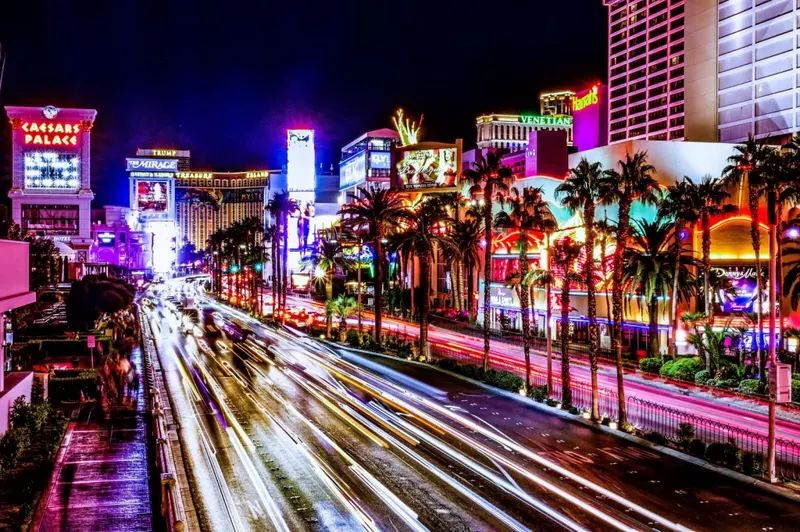
Las Vegas rises from the Mojave Desert as a single, improbable boulevard of light. The Strip lines up its casino resorts like a theme park of the world, with a half-scale Eiffel Tower, a Venetian canal, a glass pyramid and a giant illuminated sphere within a few blocks of one another. Built for entertainment and open around the clock, it is less a city than a purpose-made resort, ringed by raw desert and red-rock mountains.
Las Vegas is a quieter alternative. It's ready to explore in the Nuvoha app: set your budget and see complete Las Vegas trips.
Why visit Las Vegas
Las Vegas is built to entertain, and it does so at a scale found nowhere else. The themed resorts of the Strip are attractions in themselves, packed with casinos, shopping, pools and some of the country's most ambitious restaurants and stage shows, from residencies by global stars to long-running spectaculars. Beyond the gaming floors, the Fremont Street Experience recalls the neon of old downtown, the Neon Museum preserves the signs that built the myth, and the newest arenas and the Sphere push live entertainment further still. Then there is the desert itself: Red Rock Canyon, Hoover Dam and the Grand Canyon all lie within reach of a city that never really sleeps.
What to see and do
- The Strip: The four-mile boulevard of themed mega-resorts, casinos and replicas that is the reason most visitors come, at its best on foot after dark.
- Bellagio Fountains: Choreographed jets dance to music on the resort's lake through the day and evening, one of the Strip's free set-pieces.
- Fremont Street Experience: The covered pedestrian mall of old downtown, roofed by a vast LED canopy above vintage neon and street performers.
- The Sphere: A giant spherical venue whose wraparound interior screen and glowing exterior have become a landmark of the modern Strip.
- Neon Museum: An outdoor boneyard of rescued vintage casino signs, telling the city's story through the neon that made it famous.
- Red Rock Canyon: A desert conservation area of red sandstone cliffs and hiking trails a short drive west, a reminder of the wilderness at the city's edge.
The city laid out
- The Strip: The main event, a stretch of Las Vegas Boulevard lined with themed resorts, technically just south of the city in Paradise.
- Downtown and Fremont Street: The original casino district, older and smaller in scale, centred on the neon canopy of Fremont Street.
- The Arts District (18b): A revived downtown quarter of galleries, vintage shops, breweries and murals, the city's independent, creative side.
- Chinatown: A long commercial strip along Spring Mountain Road with some of the city's best and most varied Asian dining.
- Summerlin and Henderson: Master-planned suburbs on the western and southern edges, greener and quieter, with Red Rock and Lake Mead nearby.
- Paradise and the Convention Corridor: East of the Strip, home to the convention centre, the university and much of the city's everyday life away from the resorts.
Eating in Las Vegas
Las Vegas has become one of the country's great dining cities, drawing celebrated chefs to open flagship rooms along the Strip. The old-school Vegas of prime rib specials, shrimp cocktails and all-you-can-eat buffets still has its devotees, but alongside it now sit tasting menus, steakhouses and restaurants from famous names worldwide. Off the Strip, Spring Mountain Road's Chinatown serves outstanding noodles, dim sum and Korean barbecue at all hours, and around-the-clock dining remains part of the city's character.
- Shrimp cocktail
- Prime rib
- All-you-can-eat buffets
- Steakhouse cuts
- Spring Mountain noodles
- Chef's tasting menus
What Las Vegas feels like
Inside the resorts it is perpetual evening: no clocks, no windows, cool air and the electronic chatter of the gaming floor at any hour. Step outside and the desert asserts itself at once, in dry heat, hard light and mountains on every horizon. The Strip is a slow river of visitors day and night, a spectacle of fountains, screens and replicas meant to be walked, gawped at and photographed. It is unapologetically artificial and knows it, playing its excess for fun. Away from the neon, real neighbourhoods, an arts district and a serious dining scene have grown up, and the surrounding wilderness is closer than the crowds ever suggest.
Getting around the Strip and beyond
The Strip is walkable in principle but longer than it looks, with resorts set far back from the road and pedestrian bridges routing you over the traffic. A monorail runs along the east side of the Strip, trams link some neighbouring resorts, and buses, taxis and ride-hailing cover the rest; a small underground loop shuttles visitors beneath the convention centre. To reach the desert parks, Hoover Dam or the Grand Canyon, you will want a car or an organised tour. Harry Reid International (LAS) sits just southeast of the Strip, one of the closest major airports to its city centre anywhere. Most resorts are minutes away by taxi, ride-hailing or shuttle; the airport was renamed from McCarran in 2021 and handles heavy leisure traffic, so allow time at busy periods.
Know before you go
- Tipping is woven into the city: dealers, cocktail servers, bartenders, valets and housekeeping all expect it, on top of fifteen to twenty per cent in restaurants.
- Gambling and drinking are for over-twenty-ones only, and you may be asked for identification; alcohol can be carried on the Strip but not in a glass container.
- What happens on the gaming floor is social; watch the etiquette at table games or start with the machines while you learn.
- The desert sun is fierce even on a short walk between resorts, so carry water and do not underestimate the heat.
- Spring and autumn are the most comfortable seasons; summer is fiercely hot and winter nights can be genuinely cold in the desert.
- The Strip is a marathon, not a stroll, so wear proper shoes and use the monorail, trams and pedestrian bridges.
- Most resorts add a nightly resort fee on top of the room rate, so check the full cost when you book.
- Many of the best free spectacles, the Bellagio fountains, the Fremont canopy, the resort interiors, cost nothing to enjoy on a walk.
- Reserve big-name shows and sought-after restaurants ahead, as the headline residencies and rooms fill quickly.
- Hire a car if you want the desert; Red Rock Canyon, Valley of Fire and Hoover Dam are all easy half-day trips.
Best for
- City breaks
- Quieter travel
Key facts
| Country | United States |
|---|---|
| Region | Americas |
| Airports | LAS |
| Trip length fit | Suited to longer trips |
Las Vegas essentials
| Currency | US Dollar (USD) |
|---|---|
| Language | English; Spanish is widely spoken in many regions |
| Time zone | Six main zones from Eastern (UTC-5) to Hawaii (UTC-10); most states observe daylight saving from March to November |
| Emergency number | 911 |
| Driving side | Right |
| Tap water | Safe to drink virtually everywhere; restaurants serve it by default |
Climate & seasons
| Month | Typical range | Season |
|---|---|---|
| January | 3°C to 14°C | Cool desert winter |
| April | 13°C to 27°C | Warm desert spring |
| July | 27°C to 41°C | Very hot desert summer |
| October | 14°C to 28°C | Warm autumn |
Typical stay
- A week or more
Las Vegas is a long-haul trip for most travellers: it rewards a longer stay over a quick break.
Getting there
Las Vegas is served via LAS.
- LAS
Is it your kind of trip?
Ideal if…
- you like walkable city energy
- you like places before everyone else finds them
Maybe not if…
- you only have a weekend: the distance suits a longer stay
- a beach-first holiday is the priority
Pairs well with
Compare with
| Las Vegas | Los Angeles | San Francisco | |
|---|---|---|---|
| Country | United States | United States | United States |
| Region | Americas | Americas | Americas |
| Styles | City | City | City |
| Trip length fit | Longer stays | Longer stays | Longer stays |
| Airports | 1 | 1 | 1 |
More in Americas
Near Las Vegas
Travel style
- City
Frequently asked questions
Which airports serve Las Vegas?
Las Vegas is served via LAS.
Is Las Vegas good for a weekend trip?
Las Vegas is a long-haul trip, so it suits a week or more rather than a weekend.
What kind of trip is Las Vegas best for?
Las Vegas is best for city trips.
Which destinations pair well with Las Vegas?
Within multi-city range: Los Angeles (380 km), San Francisco (665 km).
Do you have to gamble in Las Vegas?
Not at all. Plenty of visitors come for the shows, restaurants, pools, shopping and free spectacles without placing a bet. The casinos are hard to avoid walking through, but there is far more to the city than the gaming floors.
When is the best time to visit Las Vegas?
Spring and autumn bring the most comfortable weather for walking the Strip. Summer is extremely hot, regularly topping the low forties Celsius, while winter days are mild and evenings can be cold. Weekends and big events are always the busiest.
Is Las Vegas suitable for families?
Increasingly, yes. Alongside the casinos there are shows, pools, arcades, roller coasters and day trips to the desert parks, though gaming areas are strictly adults-only and the Strip's late-night side is best navigated with that in mind.
How many days do you need in Las Vegas?
Two or three nights is enough for most, taking in the Strip, a show or two and old downtown. Add a day if you want to get out to Red Rock Canyon, Hoover Dam or further afield to the Grand Canyon.