
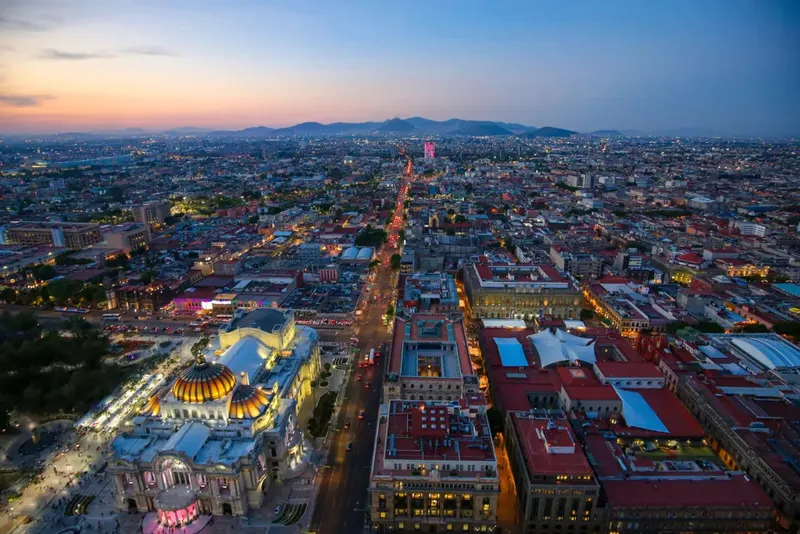
Set in a mountain-ringed valley more than two thousand metres up, Mexico City is one of the world's great capitals, layered over the Aztec island-city of Tenochtitlan. Around the vast Zocalo square, colonial palaces and a baroque cathedral rise beside excavated temple ruins, while leafy avenues, sprawling parks and world-class museums stretch out in every direction. It is a high, thin-aired megacity of extraordinary history, art and, above all, food.
Mexico City is a quieter alternative. It's ready to explore in the Nuvoha app: set your budget and see complete Mexico City trips.
Why visit Mexico City
Mexico City packs in more history and culture than almost anywhere in the Americas. The ceremonial heart, from the Zocalo and Metropolitan Cathedral to the unearthed Templo Mayor, sits within walking distance of the marble Palacio de Bellas Artes and the tree-lined Paseo de la Reforma. The National Museum of Anthropology holds the Aztec Sun Stone and treasures from across ancient Mexico, Frida Kahlo's Blue House draws pilgrims to Coyoacan, and the pyramids of Teotihuacan rise an hour away. Then there is the food, from taco stalls to celebrated dining rooms, in a city that treats eating as an art.
Sights to plan around
- Zocalo and the Metropolitan Cathedral: One of the world's largest city squares, framed by the National Palace and a vast cathedral built over centuries on the ruins of Tenochtitlan.
- Templo Mayor: The excavated main temple of the Aztec capital, unearthed beside the cathedral, with an adjoining museum of its recovered treasures.
- National Museum of Anthropology: A landmark museum in Chapultepec Park displaying the Aztec Sun Stone and the finest collection of pre-Hispanic art in the country.
- Palacio de Bellas Artes: A white-marble concert hall and art museum topped with a stained-glass dome, hung with murals by Rivera, Orozco and Siqueiros.
- Frida Kahlo Museum: The cobalt-blue Casa Azul in Coyoacan where the artist was born, lived and worked, now devoted to her life and paintings.
- Xochimilco: A surviving network of Aztec canals in the south, where painted trajinera boats drift among floating gardens.
Neighbourhood by neighbourhood
- Centro Historico: The monumental old core around the Zocalo, dense with colonial palaces, churches, murals and the ruins of the Aztec city beneath.
- Roma and Condesa: Adjoining early-twentieth-century quarters of Art Nouveau and Art Deco houses, tree-lined streets, parks, cafes and restaurants.
- Polanco: The polished district along Chapultepec's edge, known for its museums, designer boutiques and celebrated dining rooms.
- Coyoacan: A colonial village swallowed by the city, with cobbled plazas, markets and the Frida Kahlo house, still with a bohemian air.
- Chapultepec: A huge wooded park and its hilltop castle, holding several major museums and the city's green lungs.
- San Angel: A cobblestoned southern enclave of colonial mansions and gardens, at its liveliest during the Saturday art bazaar.
The Mexico City table
Mexican cooking is recognised by UNESCO as a cultural treasure, and the capital is its greatest showcase. Street stalls turn out tacos al pastor shaved from the spit, blue-corn quesadillas, tamales and tlacoyos, while formal kitchens reinterpret mole and pre-Hispanic ingredients to global acclaim. Great markets such as San Juan and La Merced overflow with chillies, herbs and exotic produce. To drink, there is mezcal and tequila, fresh fruit waters and the ancient, milky pulque. Few cities anywhere eat this well, from street corner to tasting menu.
- Tacos al pastor
- Tamales
- Mole
- Tlacoyos
- Chiles en nogada
- Churros
What Mexico City feels like
For all its size, Mexico City surprises visitors with how gracious and green it feels. Mornings are crisp and clear at altitude; afternoons in the rainy months bring a sharp shower before the sky clears again. Life spills onto the street, where organ grinders, taco carts and mariachi bands share the pavement, and the historic centre buzzes while the leafy Roma and Condesa quarters keep a slower, cafe-terrace pace. Chilangos, as residents are known, are famously warm and proud of their city's art, music and endless appetite. The altitude is real, so most people take their first day gently.
Getting around the city
The Metro is vast, busy and inexpensive, and the surface Metrobus fills in the main avenues, both paid with a rechargeable card. Ride-hailing apps are affordable and widely used, and often the easiest way across town, while the historic centre and the Roma and Condesa quarters are a pleasure on foot. Bear the altitude and the sheer scale of the place in mind, and allow time for the traffic. Benito Juarez International Airport sits just east of the centre. Authorised airport taxis, bought from a booth inside the terminal, are the simplest way in, and a Metrobus line also runs from the airport towards the historic centre.
Practical pointers
- A little Spanish is appreciated; greet people with buenos dias or buenas tardes before getting to business.
- Tipping of around ten to fifteen per cent is expected in restaurants, and small tips for attendants and baggers are customary.
- Dress smartly for the evening; Mexico City residents take pride in their appearance.
- Treat the great archaeological sites and churches with respect, keeping to marked paths and quiet inside.
- The dry season, from November to April, brings the clearest skies; the rains from May to October usually fall in short afternoon bursts.
- Ease into the altitude on your first day, drink plenty of water and go easy on alcohol.
- Ride-hailing apps and the Metrobus are the least stressful ways to cross the city.
- Many major museums, including Anthropology, close on Mondays, so plan around it.
- Visit Teotihuacan early to beat the heat and the tour buses to the pyramids.
- Carry some cash in small notes for markets, street food and tips.
Best for
- City breaks
- Quieter travel
Key facts
| Country | Mexico |
|---|---|
| Region | Americas |
| Airports | MEX |
| Trip length fit | Suited to longer trips |
Mexico City essentials
| Currency | Mexican Peso (MXN) |
|---|---|
| Language | Spanish; English is spoken in tourist areas and larger cities, alongside dozens of Indigenous languages |
| Time zone | Mostly Central Time (UTC-6), with Mountain (UTC-7) in the northwest and Pacific (UTC-8) in Baja California; most of the country no longer observes daylight saving |
| Emergency number | 911 (all emergencies) |
| Driving side | Right |
| Tap water | Not for drinking from the tap; stick to bottled or filtered water, which is available everywhere |
Climate & seasons
| Month | Typical range | Season |
|---|---|---|
| January | 6°C to 22°C | Dry mild winter |
| April | 11°C to 27°C | Warm dry spring |
| July | 12°C to 24°C | Rainy season |
| October | 10°C to 23°C | Mild late rains |
Typical stay
- A week or more
Mexico City is a long-haul trip for most travellers: it rewards a longer stay over a quick break.
Getting there
Mexico City is served via MEX.
- MEX
Is it your kind of trip?
Ideal if…
- you like walkable city energy
- you like places before everyone else finds them
Maybe not if…
- you only have a weekend: the distance suits a longer stay
- a beach-first holiday is the priority
Pairs well with
Compare with
More in Americas
Near Mexico City
Travel style
- City
Frequently asked questions
Which airports serve Mexico City?
Mexico City is served via MEX.
Is Mexico City good for a weekend trip?
Mexico City is a long-haul trip, so it suits a week or more rather than a weekend.
What kind of trip is Mexico City best for?
Mexico City is best for city trips.
Which destinations pair well with Mexico City?
Within multi-city range: Cancún (1,288 km).
Is Mexico City safe for visitors?
Millions visit without incident, and the central and well-touristed neighbourhoods such as the historic centre, Roma, Condesa, Polanco and Coyoacan are generally comfortable by day and evening. Take normal city precautions, use authorised or app-based taxis, and keep valuables discreet.
Does the altitude affect visitors?
It can. At over two thousand metres, some people feel short of breath or tired at first. Take your first day slowly, stay hydrated and moderate alcohol, and most adjust within a day or two.
When is the best time to visit Mexico City?
The dry season from November to April offers the most reliable sunshine and comfortable days. The rainy season from May to October is still pleasant, with showers usually confined to the late afternoon.
How many days do you need in Mexico City?
Three or four days covers the historic centre, the major museums, Coyoacan and a day trip to Teotihuacan. The city rewards longer stays, with endless neighbourhoods, markets and restaurants to explore.