
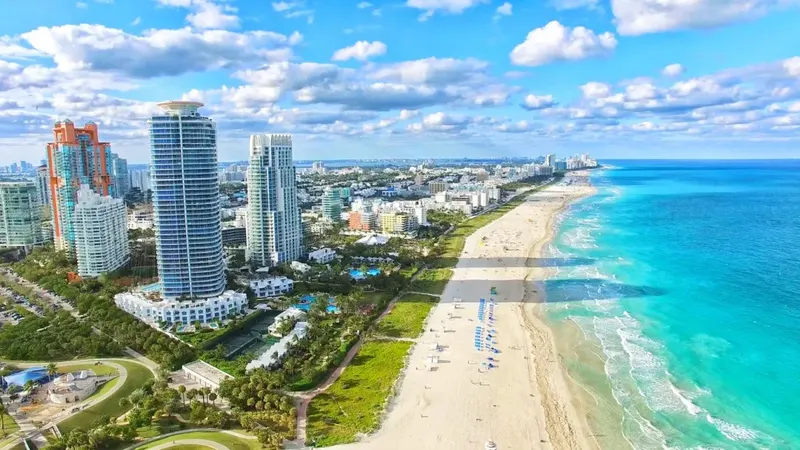
Miami sits where the Florida peninsula slips into the tropics, a low, bright city strung along Biscayne Bay and the Atlantic. Its identity is as much Latin American and Caribbean as it is North American: Spanish is heard as often as English, cafecito fuels the afternoons, and the pastel geometry of South Beach glows under a subtropical sun. Beaches, nightlife and heat define the days here.
Miami is made for unwinding. It's ready to explore in the Nuvoha app: set your budget and see complete Miami trips.
Why visit Miami
Miami offers a beach holiday and a Latin American city in one. South Beach pairs miles of Atlantic sand with the largest concentration of Art Deco architecture anywhere, its pastel hotels lining Ocean Drive. Inland, Little Havana serves Cuban coffee and dominoes on Calle Ocho, Wynwood turns whole blocks into open-air murals, and the Design District and Vizcaya supply the polish. The nightlife runs late and the music is everywhere, from salsa to reggaeton. Add warm winters that draw sun-seekers from colder climates, and food that spans the whole Caribbean and Latin world, and Miami rewards those who come to be outdoors and up late.
Miami's landmarks
- Ocean Drive and the Art Deco District: The pastel heart of South Beach, where hundreds of 1930s Art Deco hotels line the beachfront, best seen on the walking tour or lit up at night.
- Little Havana and Calle Ocho: The centre of Miami's Cuban community, with cigar rollers, the domino players of Maximo Gomez Park and cafecito windows along Eighth Street.
- Wynwood Walls: An outdoor museum of large-scale murals that turned a warehouse district into one of the country's landmark street-art destinations.
- Vizcaya Museum and Gardens: An Italianate bayfront villa from the 1910s with formal gardens, a lavish relic of Miami's early Gilded Age winters.
- South Beach: Miami Beach's famous stretch of white Atlantic sand, lifeguard towers and clear warm water across the causeway from the mainland.
- Bayside and Bayfront Park: A downtown waterfront of marinas, open-air stalls and green space looking out over Biscayne Bay.
What Miami feels like
Miami runs on heat, colour and rhythm. Days are bright and humid, broken by sudden afternoon downpours that pass as quickly as they arrive, and life organises itself around air-conditioning, shade and the water. The soundtrack is bilingual and bass-heavy, spilling from car windows, cafe counters and beachfront terraces. There is a real glamour to the place, in the sports cars along Ocean Drive and the rooftop bars of Brickell, but also an unpretentious street life of Cuban lunch counters, Haitian markets and families grilling in the bayfront parks. Style matters here, and the city stays up long after others have gone to bed.
Around the neighbourhoods
- South Beach: The southern tip of Miami Beach, packed with Art Deco hotels, beach clubs and nightlife between Ocean Drive and Collins Avenue.
- Little Havana: The Cuban and Central American heart of the mainland, centred on the cafes, cigar shops and music of Calle Ocho.
- Wynwood: A former warehouse quarter reborn around murals, breweries, galleries and independent shops just north of downtown.
- Brickell: Miami's high-rise financial district on the bay, dense with towers, rooftop bars and waterfront dining.
- Coconut Grove and Coral Gables: Leafy, older neighbourhoods south of the centre, one bohemian and bayside, the other a planned Mediterranean-style city of boulevards.
- Design District and Midtown: Upmarket blocks of fashion, galleries and restaurants north of downtown, a short hop from Wynwood.
The Miami table
Miami eats across the whole Caribbean and Latin America. Cuban cooking leads, from the pressed sandwich and slow-roast pork to the cafecito that punctuates the day, but Haitian griot, Nicaraguan grills, Colombian arepas and Venezuelan snacks all have their counters. The Atlantic supplies stone crab in season and ceviche year-round, while the beachfront and Brickell handle the glossier, cheffed end of things. A Cuban lunch counter and a rooftop tasting menu are equally at home here.
- Cuban sandwich
- Croquetas
- Cafecito
- Stone crab claws
- Ropa vieja
- Pastelitos
Getting about
Miami is spread out and largely built for driving, so many visitors hire a car or lean on ride-hailing. Downtown and Brickell are stitched together by the free, elevated Metromover, and the Metrorail runs to the airport and southern suburbs, but neither reaches the beaches. South Beach itself is walkable and flat, ideal for cycling, while a causeway or a short drive separates it from the mainland. The Brightline train links Miami to Fort Lauderdale, West Palm Beach and Orlando. Miami International (MIA) lies just west of downtown and is a major gateway to Latin America and the Caribbean. Metrorail's Orange Line and the MIA Mover connect it to the city and the rental-car centre, with taxis and ride-hailing on hand; the beaches are a further drive across the causeways.
Good to know
- Tipping is expected for table service and taxis, with fifteen to twenty per cent the usual range; some restaurants add a service charge, so check the bill.
- Spanish is genuinely useful, and a friendly hola or gracias is always welcomed.
- Beachwear belongs on the beach; cover up for restaurants, shops and anywhere away from the sand.
- Summer afternoons bring heavy rain and lightning, so heed local warnings and clear the beach when storms roll in.
- The dry, more comfortable season runs roughly November to April; summers are hot, humid and stormy, and the Atlantic hurricane season spans June to November.
- A car makes the wider city easy, but for a South Beach stay you may barely need one.
- Sunscreen, a hat and water are essentials; the subtropical sun is stronger than it feels off the ocean breeze.
- Little Havana is at its liveliest on the last Friday of the month, when Calle Ocho hosts its street party, Viernes Culturales.
- Stone crab is a seasonal treat, generally on menus from mid-autumn into spring.
- Passing storms clear quickly in the afternoon, so build in shade and a plan B rather than writing off the day.
Best for
- Beach time
- City breaks
- Unwinding
Key facts
| Country | United States |
|---|---|
| Region | Americas |
| Airports | MIA |
| Trip length fit | Suited to longer trips |
Miami essentials
| Currency | US Dollar (USD) |
|---|---|
| Language | English; Spanish is widely spoken in many regions |
| Time zone | Six main zones from Eastern (UTC-5) to Hawaii (UTC-10); most states observe daylight saving from March to November |
| Emergency number | 911 |
| Driving side | Right |
| Tap water | Safe to drink virtually everywhere; restaurants serve it by default |
Climate & seasons
| Month | Typical range | Season |
|---|---|---|
| January | 18°C to 25°C | Warm dry winter |
| April | 22°C to 29°C | Warm spring |
| July | 26°C to 32°C | Hot humid summer |
| October | 24°C to 30°C | Humid autumn |
Miami is one of Nuvoha's winter-sun picks.
Typical stay
- A week or more
Miami is a long-haul trip for most travellers: it rewards a longer stay over a quick break.
Getting there
Miami is served via MIA.
- MIA
Is it your kind of trip?
Ideal if…
- time on the coast is the point of the trip
- you like walkable city energy
- you want to slow down and reset
Maybe not if…
- you only have a weekend: the distance suits a longer stay
Pairs well with
Compare with
More in Americas
Near Miami
Travel style
- Winter sun
- Beach
- City
Frequently asked questions
Which airports serve Miami?
Miami is served via MIA.
Is Miami good for a weekend trip?
Miami is a long-haul trip, so it suits a week or more rather than a weekend.
What kind of trip is Miami best for?
Miami is best for beach and city trips, popular for unwinding.
Which destinations pair well with Miami?
Within multi-city range: Cancún (845 km).
Is Miami Beach the same as Miami?
Not quite. Miami and Miami Beach are separate cities linked by causeways across Biscayne Bay. South Beach and the Art Deco district sit in Miami Beach, while Little Havana, Wynwood, Brickell and the airport are on the Miami mainland.
When is the best time to visit Miami?
The most comfortable weather runs from late autumn through spring, when the air is warm and drier. Summer is hot and humid with daily storms, and the hurricane season lasts from June to November, though many days remain fine.
Do you need a car in Miami?
It helps for exploring the wider city, since public transport does not reach the beaches. If you are staying on South Beach, though, you can walk, cycle and use ride-hailing for the occasional trip across the bay.
Is Spanish widely spoken in Miami?
Very much so. Spanish is spoken as a first language across large parts of the city, and many businesses operate bilingually. English is understood almost everywhere, but a few Spanish phrases go a long way.