
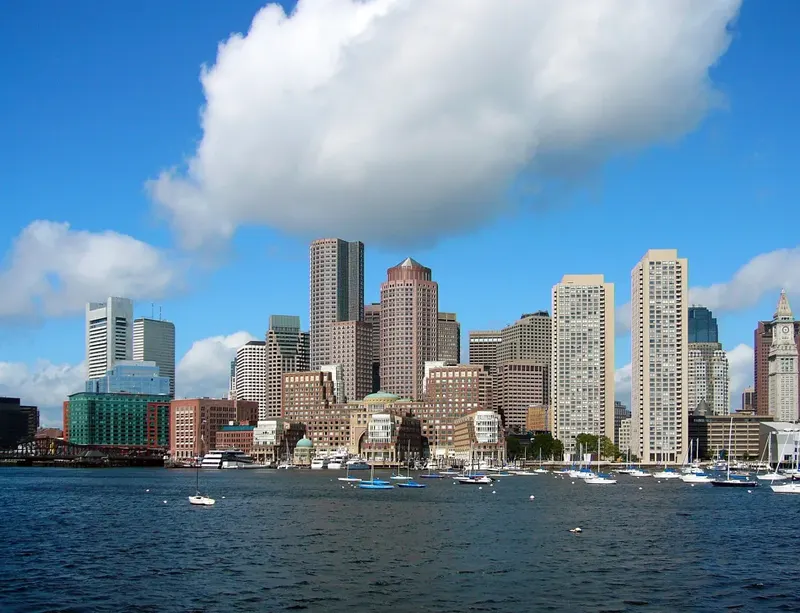
Boston wears its history on the surface, a compact, red-brick city where the American Revolution began and the past is never far from the present. Cobbled Beacon Hill, the Freedom Trail and the colonial burying grounds sit among glass towers and a great harbour, and the Charles River separates the city from the college powerhouses of Cambridge. Walkable, tightly knit and shaped by its universities, it feels older and more European than most of the United States.
Boston is a quieter alternative. It's ready to explore in the Nuvoha app: set your budget and see complete Boston trips.
Why visit Boston
Boston packs an outsized amount of history and culture into a walkable centre. The Freedom Trail links sixteen Revolutionary sites in a single red-brick line, from Boston Common to the USS Constitution, and few cities let you cover so much on foot. Beacon Hill's gas-lit lanes, the market stalls of Faneuil Hall, and the swan boats of the Public Garden lie minutes apart. World-class museums, the Fenway ballpark and a serious music and theatre scene fill the calendar, while the universities of Boston and Cambridge lend youthful energy and ideas. Add fresh New England seafood and the harbour at the doorstep, and it is among the most rewarding cities in the country to explore slowly.
Landmarks worth your time
- The Freedom Trail: A two-and-a-half-mile red-brick line through sixteen Revolutionary landmarks, from Boston Common and the Old State House to Paul Revere's house and the USS Constitution.
- Faneuil Hall and Quincy Market: The colonial meeting house and its bustling market halls, now a warren of food stalls, shops and street performers.
- Boston Common and the Public Garden: The oldest public park in the country beside America's first botanical garden, where swan boats glide on the lagoon in warm weather.
- Beacon Hill: The city's most photographed quarter, all gas lamps, brick row houses and the flower-lined cobbles of Acorn Street.
- Fenway Park: The intimate 1912 home of the Red Sox and its towering Green Monster wall, the oldest ballpark in Major League Baseball.
- USS Constitution: The world's oldest commissioned warship still afloat, Old Ironsides, berthed in the Charlestown Navy Yard.
How the city fits together
- Beacon Hill: The historic residential hill behind the gold-domed State House, a maze of gas-lit cobbled lanes and Federal-era townhouses.
- Back Bay: An elegant grid of Victorian brownstones, the shops of Newbury Street and the towers of Copley Square, built on filled tidal flats.
- North End: Boston's Little Italy, a tight tangle of streets packed with old-country restaurants, cafes and bakeries, and two Freedom Trail sites.
- Downtown and the Waterfront: The financial core and harbour's edge, taking in Faneuil Hall, the aquarium and ferries out to the Harbor Islands.
- Seaport: A gleaming, recently built district of glass towers, restaurants and the contemporary art museum on the South Boston waterfront.
- Cambridge: Across the Charles River, home to Harvard and MIT, with the bookshops and cafes of Harvard Square at its heart.
The Boston table
Boston's kitchen is built on the cold North Atlantic. Clam chowder, thick and creamy, lobster rolls, fried clams and just-shucked oysters are the staples, best eaten near the water, while the historic Union Oyster House has served them since 1826. The large Italian community of the North End keeps the city in fresh pasta, cannoli and espresso, and Boston baked beans and the cream-filled Boston cream pie carry the city's name. Add a strong Irish pub tradition and a growing modern scene, and you eat very well here.
- Clam chowder
- Lobster roll
- Fried clams
- Boston cream pie
- Oysters
- North End cannoli
What Boston feels like
Boston feels compact, historic and a touch patrician, softened by the energy of tens of thousands of students. The centre is a walker's city of crooked colonial lanes, brick townhouses and leafy commons, hemmed by the harbour and the river rather than freeways. Seasons run to extremes, from humid summers and glorious autumn colour to hard, snowy winters and the raw grey of a coastal spring. Locals are famously plain-spoken and fiercely loyal to their sports teams, above all the Red Sox at Fenway. There is old money and Ivy League polish here, but also a strong Irish and Italian working-class grain, and a distinctive accent to match.
Getting around on foot and the T
Boston is famously a walking city, and its historic core is best explored on foot. The MBTA, universally called the T, runs the oldest subway in the country on four colour-coded lines, backed by buses, ferries and commuter rail, all paid with a CharlieCard. The compact, tangled street plan, laid over old cow paths and colonial lanes, can baffle drivers, and parking is scarce and dear, so most visitors leave the car behind. Cambridge and the waterfront are an easy hop by T or on foot. Logan International (BOS) sits just across the water in East Boston, remarkably close to downtown. The Silver Line bus runs from the terminals to South Station free of charge, the Blue Line is a short shuttle ride away, and a water taxi crosses the harbour to the waterfront; taxis and ride-hailing are quick outside peak traffic.
Good to know before you go
- Tipping is expected, with fifteen to twenty per cent standard in restaurants and for bartenders, taxis and ride-hailing.
- Sports are close to religion here, and the Red Sox especially; enthusiasm is welcome, but do not praise New York's teams.
- Locals walk quickly and speak plainly; a brisk, direct manner is friendliness here, not rudeness.
- Jaywalking is something of a local sport, but traffic can be aggressive, so cross with your eyes open.
- Late spring through October is the loveliest stretch, with autumn foliage a highlight; winters are cold and snowy, and nor'easters can snarl travel.
- Wear comfortable shoes, as the Freedom Trail and the historic centre are best done on foot over cobbles and brick.
- The T is the easy way around, and a CharlieCard or contactless tap covers the subway, buses and ferries.
- Skip the hire car for a city stay; the streets confound newcomers and parking is scarce and expensive.
- Reserve Fenway Park tours or Red Sox tickets ahead in season, as home games sell out and fill the neighbourhood.
- Day trips are easy by train, from Salem and Concord to the beaches of Cape Cod in summer.
Best for
- City breaks
- Quieter travel
Key facts
| Country | United States |
|---|---|
| Region | Americas |
| Airports | BOS |
| Trip length fit | Suited to longer trips |
Boston essentials
| Currency | US Dollar (USD) |
|---|---|
| Language | English; Spanish is widely spoken in many regions |
| Time zone | Six main zones from Eastern (UTC-5) to Hawaii (UTC-10); most states observe daylight saving from March to November |
| Emergency number | 911 |
| Driving side | Right |
| Tap water | Safe to drink virtually everywhere; restaurants serve it by default |
Climate & seasons
| Month | Typical range | Season |
|---|---|---|
| January | -6°C to 3°C | Cold winter |
| April | 4°C to 14°C | Fresh spring |
| July | 19°C to 28°C | Warm summer |
| October | 8°C to 17°C | Crisp autumn |
Typical stay
- A week or more
Boston is a long-haul trip for most travellers: it rewards a longer stay over a quick break.
Getting there
Boston is served via BOS.
- BOS
Is it your kind of trip?
Ideal if…
- you like walkable city energy
- you like places before everyone else finds them
Maybe not if…
- you only have a weekend: the distance suits a longer stay
- a beach-first holiday is the priority
Pairs well with
Compare with
More in Americas
Near Boston
Travel style
- City
Frequently asked questions
Which airports serve Boston?
Boston is served via BOS.
Is Boston good for a weekend trip?
Boston is a long-haul trip, so it suits a week or more rather than a weekend.
What kind of trip is Boston best for?
Boston is best for city trips.
Which destinations pair well with Boston?
Within multi-city range: New York (300 km), Montreal (409 km), Toronto (715 km).
Is Boston walkable?
Very. The historic centre, Beacon Hill, Back Bay, the North End and the waterfront are all close together and best seen on foot, linked by the T when you want to cover more ground. Most visitors never need a car.
When is the best time to visit Boston?
Late spring, summer and especially autumn, when the foliage turns, are the prime seasons. Winters are cold and snowy, and while the city handles it well, storms can disrupt travel. Spring can be grey and raw before it warms.
How many days do you need in Boston?
Two or three days covers the Freedom Trail, the main neighbourhoods and a museum or ball game at a comfortable pace. A little longer allows for Cambridge, the harbour and a day trip to Salem, Concord or the coast.
Is Boston a good base for exploring New England?
Excellent. Trains and buses reach Salem, Concord, Providence and the coast, and with a car the mountains, beaches and autumn drives of the wider region open up, making Boston a natural starting point for New England.