
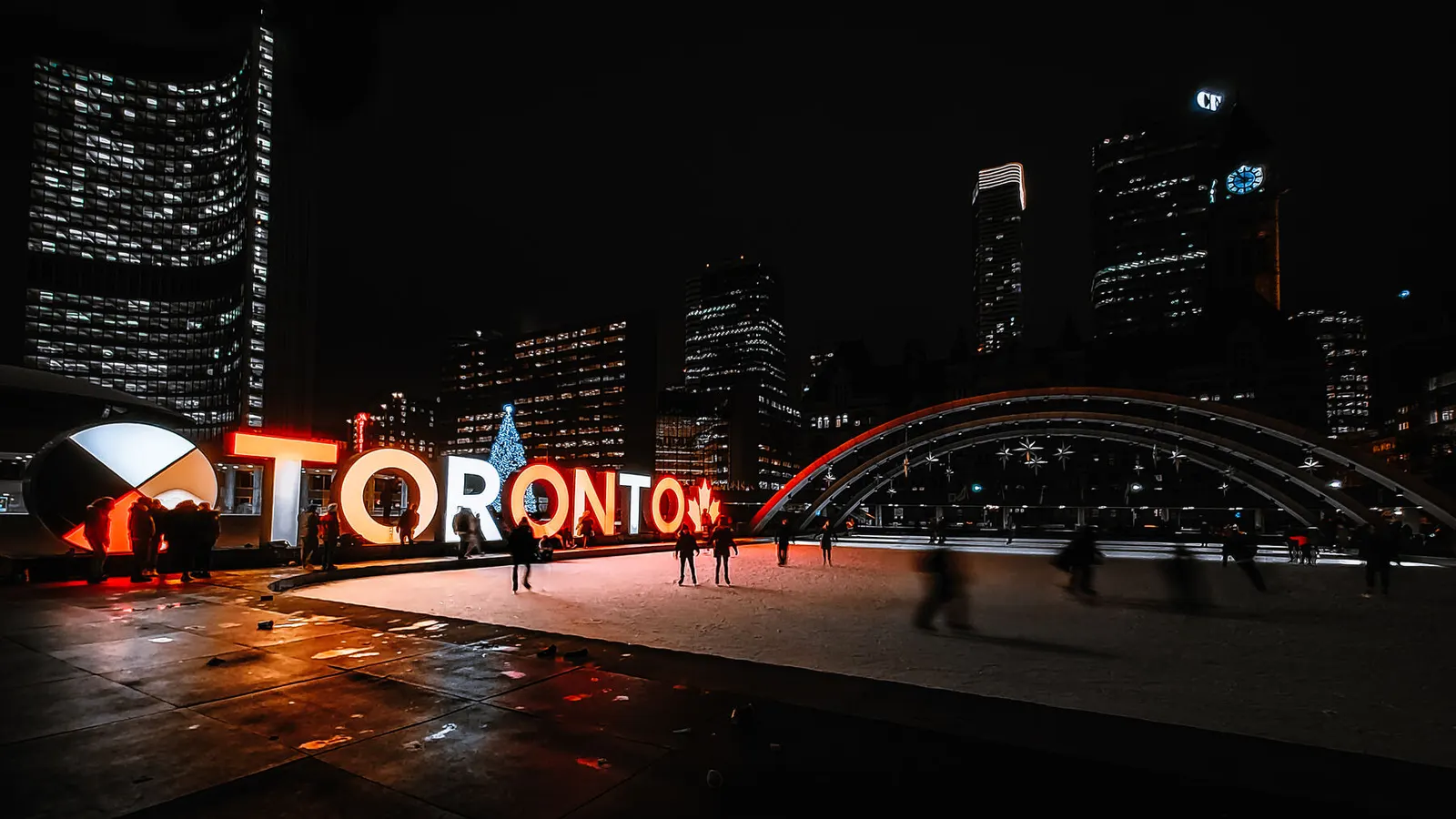
Streetcars rumble down King and Queen Streets past Victorian storefronts, and at the foot of the grid Lake Ontario stretches to the horizon like an inland sea, freckled with the sails of the Toronto Islands ferries. More than half the people who call this city home were born outside Canada, and you can hear it, taste it and read it on the shop signs of every block.
Toronto is a quieter alternative. It's ready to explore in the Nuvoha app: set your budget and see complete Toronto trips.
Why visit Toronto
Toronto is best understood as a federation of neighbourhoods. In one afternoon you can browse vintage shops and taco counters in Kensington Market, eat dim sum on Spadina, walk the Victorian lanes of the Distillery District and watch the sun drop behind the skyline from a ferry deck. The museums are serious: the ROM and the Art Gallery of Ontario lead the pack. The food scene may be the most genuinely multicultural on the continent, and a surprising wilderness of wooded ravines threads beneath the streets, waiting for anyone who wants a trail run between coffees.
Toronto's headline attractions
- CN Tower: The 553-metre tower that defines the skyline, with observation levels, a glass floor and views across Lake Ontario on clear days.
- Toronto Islands: A car-free chain of islands a short ferry ride from downtown, offering beaches, bike paths and the classic skyline panorama.
- St. Lawrence Market: A nineteenth-century market hall whose vendors are best known for the peameal bacon sandwich, a Toronto original.
- Distillery District: A pedestrianised quarter of Victorian industrial buildings, now filled with galleries, studios and cafés on cobbled lanes.
- Royal Ontario Museum: Canada's largest museum, spanning dinosaurs to world cultures behind its angular crystal entrance on Bloor Street.
- High Park: The city's biggest public park, with wooded trails, a small zoo and cherry trees that draw crowds each spring.
Corners of the city
- Kensington Market: A compact bohemian grid of vintage shops, spice merchants, murals and global snack counters beside Chinatown.
- Queen West: A long strip of independent boutiques, galleries and street art stretching from downtown out past Trinity Bellwoods Park.
- The Annex: A leafy Victorian district beside the University of Toronto, all turreted houses, bookshops and student cafés.
- Leslieville: An east-end stretch of Queen Street known for brunch spots, design shops and a relaxed, residential pace.
- Chinatown: One of North America's largest Chinatowns, centred on Spadina Avenue's grocers, barbecue windows and dumpling houses.
A city of many kitchens
Toronto's kitchen is the world's, arranged by streetcar line: hand-pulled noodles and dim sum on Spadina, Caribbean jerk along Eglinton West, Greek grills on the Danforth, Little Italy and Little Portugal along College and Dundas. The one dish the city claims outright is the peameal bacon sandwich at St. Lawrence Market, and no Ontario bakery case is complete without a butter tart. Quebec's poutine has long since colonised the late-night menus too.
- Peameal bacon sandwich
- Butter tart
- Jerk chicken
- Dim sum
- Poutine
What Toronto feels like
The city is polite, unhurried and quietly confident, with a big-city skyline but a habit of saying sorry when you bump into it. Summers are warm and social (patios, island picnics, open-air concerts) while winters are long and properly cold, driving life into the PATH, the underground network of walkways beneath the financial district. Hockey and basketball loyalties run deep, and small talk about the Leafs or Raptors opens doors.
Subways, streetcars and ferries
The TTC's subway lines, streetcars and buses cover the city, and a PRESTO card (or a simple contactless tap of your own bank card) works across all of them, with free two-hour transfers. Streetcars are the scenic way to cross downtown; the subway is faster for longer hops. Ferries from the foot of Bay Street serve the Toronto Islands, and the UP Express train links Pearson Airport to Union Station in about twenty-five minutes. Toronto Pearson International is the main gateway, connected to downtown's Union Station by the UP Express train in about twenty-five minutes. Billy Bishop City Airport sits on an island minutes from downtown and handles mainly regional flights.
Pointers from the locals
- Tipping is a firm expectation at restaurants, bars, cafés with table service and in taxis: card machines will prompt you.
- Stand to the right on escalators and let passengers off the subway before boarding.
- Hold doors and expect profuse mutual apologies for minor collisions; it is the local dialect of politeness.
- Queues form neatly at streetcar stops and bakery counters alike: join the end, not the middle.
- In winter, learn the PATH: the underground walkway network connects Union Station, the financial district and major shopping without stepping outside.
- Take the ferry to the Islands late in the afternoon and ride back after sunset for the skyline at its best.
- Streetcar doors open into traffic lanes: by law cars must stop behind them, but look before stepping off.
- Niagara Falls is a straightforward day trip, about ninety minutes away by train, bus or car.
- Summer weekends fill the Islands ferries quickly; buy tickets online and go early.
- March and November are the city's dreariest months; June to September and the crisp weeks of early autumn show Toronto at its best.
Best for
- City breaks
- Quieter travel
Key facts
| Country | Canada |
|---|---|
| Region | Americas |
| Airports | YYZ, YTZ |
| Trip length fit | Suited to longer trips |
Toronto essentials
| Currency | Canadian Dollar (CAD) |
|---|---|
| Language | English and French are official; French predominates in Québec, English almost everywhere else |
| Time zone | Six zones from Newfoundland (UTC-3:30) to Pacific (UTC-8); daylight saving observed in most provinces from March to November |
| Emergency number | 911 |
| Driving side | Right |
| Tap water | Safe to drink across the country |
Climate & seasons
| Month | Typical range | Season |
|---|---|---|
| January | -8°C to 0°C | Cold winter |
| April | 4°C to 14°C | Fresh spring |
| July | 18°C to 27°C | Warm summer |
| October | 7°C to 15°C | Cool autumn |
Typical stay
- A week or more
Toronto is a long-haul trip for most travellers: it rewards a longer stay over a quick break.
Getting there
Toronto is served by 2 airports, and Nuvoha covers all of them when building your trip.
- Pearson (YYZ)
- Billy Bishop (YTZ)
Is it your kind of trip?
Ideal if…
- you like walkable city energy
- you like places before everyone else finds them
Maybe not if…
- you only have a weekend: the distance suits a longer stay
- a beach-first holiday is the priority
Pairs well with
Compare with
More in Americas
Near Toronto
Travel style
- City
Frequently asked questions
Which airports serve Toronto?
Toronto is served by 2 airports, and Nuvoha covers all of them when building your trip. Pearson (YYZ), Billy Bishop (YTZ).
Is Toronto good for a weekend trip?
Toronto is a long-haul trip, so it suits a week or more rather than a weekend.
What kind of trip is Toronto best for?
Toronto is best for city trips.
Which destinations pair well with Toronto?
Within multi-city range: Montreal (507 km), New York (588 km), Chicago (701 km).
How harsh are Toronto winters for a visitor?
Cold, often well below freezing from December to March, with wind chill off the lake. The city functions normally, and the PATH network lets you cross much of downtown indoors. Pack a serious coat, hat and waterproof boots.
Can I do Niagara Falls as a day trip from Toronto?
Easily. The falls are about ninety minutes away, with direct trains and buses as well as countless guided coach tours. A morning departure leaves time for the boat cruise beneath the falls and a return by evening.
Do I need cash in Toronto?
Rarely. Contactless card and phone payments are accepted almost universally, including on the TTC. A little cash is only useful for the odd market stall or as tips for hotel staff.