
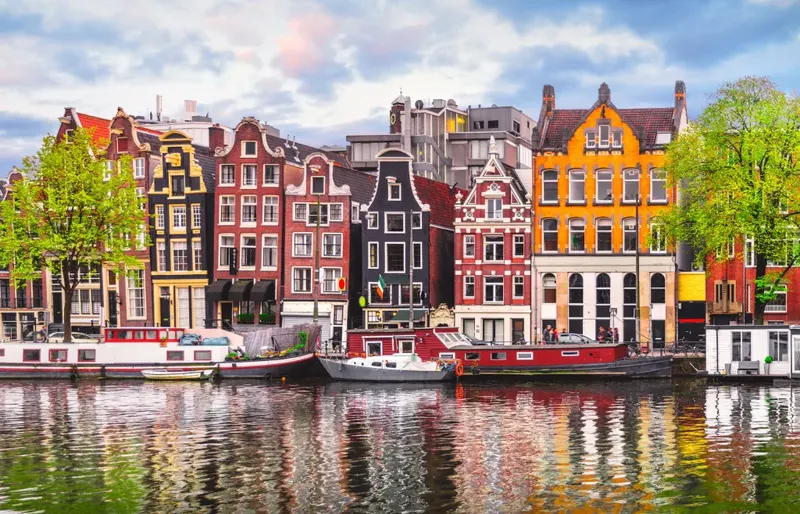
The Dutch reclaimed much of their country from the sea, and it shows: nearly a third of the Netherlands sits below sea level, kept dry by dykes, pumps and a famous calm about the water. Distances are short and the land is flat, which is why the bicycle rules and a train ride across the country takes only a couple of hours. Amsterdam's canal ring draws the crowds, but Rotterdam answers with bold modern architecture, The Hague with government and Vermeers, and Utrecht with quieter waterways. Beyond the cities lie windmills at Kinderdijk, cheese markets, the Wadden Islands and, for a few spring weeks, tulip fields in full colour. English is spoken almost everywhere.
Amsterdam is the Netherlands destination on Nuvoha today. Set your budget and Nuvoha builds the complete trip: flights and hotels together.
Why visit Netherlands
- Cities you can explore on foot, from headline sights to quiet neighbourhoods
- Quieter alternatives beyond the obvious stops
Best known for
- Amsterdam's canal ring
- Tulip fields and the Keukenhof
- Cycling everywhere
- Dutch Golden Age painting
- Windmills at Kinderdijk
- Dutch cheese
Around the Netherlands
- Amsterdam: The capital's concentric canal ring, a UNESCO site, alongside the Rijksmuseum, Van Gogh Museum and Anne Frank House. Small enough to cross by bike, and the country's main gateway.
- North Holland: Beyond Amsterdam lie the windmills of Zaanse Schans, the cheese market at Alkmaar, historic Haarlem and, out in the Wadden Sea, the dune-and-beach island of Texel.
- South Holland: Rotterdam's daring modern architecture, The Hague's seat of government and Mauritshuis gallery, the blue-and-white porcelain town of Delft and the Kinderdijk windmills.
- The bulb region and North Sea coast: The dune-backed strip between Haarlem and Leiden, where tulip, daffodil and hyacinth fields blaze each spring and the Keukenhof gardens open from late March to mid-May, with wide beaches just beyond.
- Utrecht and the Veluwe: Central Netherlands: canal-ringed Utrecht, plus the woods and heath of the Hoge Veluwe National Park, home to the Kroller-Muller Museum and its Van Gogh collection.
- Friesland and the north: The Frisian-speaking north, with a watery lake district for sailing and a chain of Wadden Islands, such as Terschelling and Ameland, facing the tidal mudflats of the Wadden Sea.
Where to go
Netherlands essentials
| Currency | Euro (EUR) |
|---|---|
| Language | Dutch; Frisian is co-official in Friesland, and English is spoken almost universally |
| Time zone | Central European Time (UTC+1, UTC+2 in summer) |
| Emergency number | 112 (all emergencies) |
| Driving side | Right |
| Tap water | Safe to drink, and among the best regarded in Europe |
Seasons at a glance in Amsterdam
| Month | Typical range | Season |
|---|---|---|
| January | 1°C to 7°C | Cold damp winter |
| April | 6°C to 14°C | Changeable spring |
| July | 14°C to 22°C | Mild summer |
| October | 8°C to 15°C | Cool autumn |
Seasons vary across Netherlands. Each destination page has its own climate table.
More in Europe
More Europe country guides
Frequently asked questions
Which Netherlands destinations can I book with Nuvoha?
Amsterdam, with complete flight and hotel trips built around your budget.
What kind of trips suit Netherlands?
Netherlands works for city breaks.
How do you get around the Netherlands?
Mostly by train: the national rail network is dense and frequent, linking Amsterdam, Rotterdam, The Hague and Utrecht in well under an hour each, and reaching almost every town. In the cities, trams, metros and hire bikes take over, and the whole country is famously flat for cycling.
When can you see the tulips?
The bulb fields around Lisse bloom for a few weeks each spring, roughly mid-April, weather depending. The Keukenhof gardens nearby open from late March to mid-May, and King's Day on 27 April turns the whole country orange.
Cash or card in the Netherlands?
Card and contactless payment are close to universal, and some shops and cafes no longer take cash at all. It is worth carrying a contactless card, plus a little cash for street markets and the odd small vendor.
What plug type does the Netherlands use?
Types C and F, the round two-pin European sockets, at 230 volts. Visitors from the UK, Ireland and North America need an adapter.