
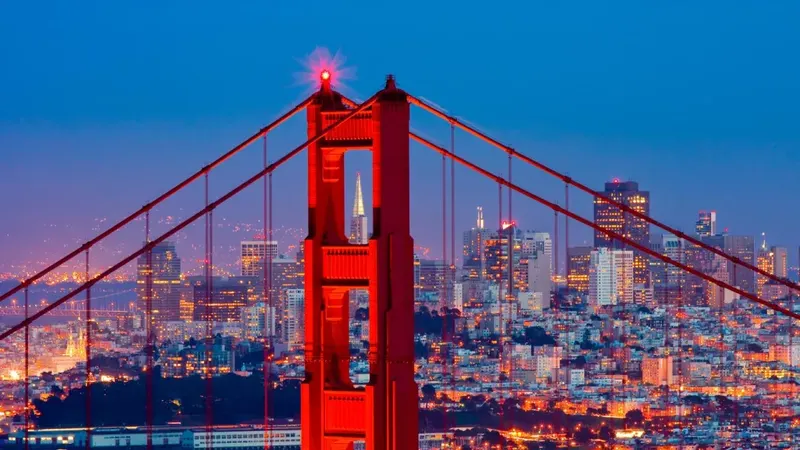
San Francisco occupies the tip of a hilly peninsula where the Pacific meets the bay, a compact city of about seven square miles that could hardly be less like the sprawl of Los Angeles to the south. Fog pours over the hills on summer afternoons, cable cars haul up impossible gradients, and the Golden Gate Bridge stands rust-red against the water. Walkable, expensive and endlessly photogenic, it packs an enormous amount into a small frame.
San Francisco is a quieter alternative. It's ready to explore in the Nuvoha app: set your budget and see complete San Francisco trips.
Why visit San Francisco
San Francisco concentrates an extraordinary amount into a walkable few square miles. You can ride a cable car over Nob Hill, walk or cycle across the Golden Gate Bridge, and take a boat to Alcatraz all in a day. The neighbourhoods have strong, distinct characters, from the oldest Chinatown in North America to the Italian cafes of North Beach and the murals of the Mission. Golden Gate Park rivals any city green space, the food and coffee are world-class, and the bay views appear at the top of nearly every hill. Unlike car-bound Los Angeles, this is a city best seen on foot and by transit, fog and all.
Sights not to miss
- Golden Gate Bridge: The rust-red suspension bridge across the strait, walked, cycled or simply admired from Fort Point, the Marin headlands or Baker Beach.
- Alcatraz Island: The former federal prison on its rock in the bay, reached by ferry and toured with a vivid audio guide voiced by ex-inmates and guards.
- Cable cars: The last manually operated cable cars in the world still haul passengers over Nob Hill and Russian Hill on three heritage lines.
- Fisherman's Wharf and Pier 39: A busy waterfront of seafood stalls, sourdough bakeries and a colony of sea lions barking on the docks.
- Golden Gate Park: A vast rectangle of gardens, lakes and museums stretching to the ocean, home to the de Young and the California Academy of Sciences.
- Painted Ladies at Alamo Square: The row of preserved Victorian houses framed against the downtown skyline, one of the city's signature views.
Neighbourhood by neighbourhood
- Chinatown: The oldest and one of the largest Chinatowns outside Asia, a dense grid of temples, herbalists, bakeries and dim sum below its dragon gate.
- North Beach: The historic Italian quarter at the foot of Telegraph Hill, known for its cafes, the Beat-era City Lights bookshop and Coit Tower above.
- The Mission: A sunny, largely Latino district of taquerias, muralled alleys and nightlife, and the city's oldest building at Mission Dolores.
- Haight-Ashbury: The birthplace of the 1960s counterculture, now lined with record shops, vintage clothing and Victorian houses beside Golden Gate Park.
- The Castro: The historic heart of LGBTQ San Francisco, centred on Castro Street beneath its landmark theatre and rainbow crossings.
- SoMa and the Embarcadero: South of Market and the eastern waterfront, home to museums, ballparks, the Ferry Building and much of the tech industry.
Eating in the city
San Francisco takes food seriously and helped shape modern American cooking. The city gave the world cioppino, the fisherman's tomato-and-shellfish stew, and its tangy sourdough, while the Gold Rush left one of the oldest and best Chinatowns in the country. The Mission is home to the overstuffed burrito that bears its name, the Ferry Building gathers the region's celebrated produce, cheese and coffee, and Dungeness crab comes into season each winter. Farm-to-table dining, third-wave coffee and dim sum all trace deep roots here.
- Cioppino
- Mission burrito
- Sourdough bread
- Dungeness crab
- Dim sum
- Hangtown fry
What San Francisco feels like
The weather sets the mood, and it is rarely what visitors expect: summers are cool and often grey, with fog, known locally as Karl, spilling through the Golden Gate by afternoon, while the warmest, clearest days tend to come in autumn. The city wears many identities at once, part old maritime port, part counterculture landmark, part global tech capital, and they rub along in the same steep streets. Microclimates mean one neighbourhood can be sunny while the next is socked in. There is a progressive, open-minded streak, a serious food and coffee culture, and, for all the wealth, a scrappy, hilly, walk-everywhere character that keeps it human in scale.
Getting around on foot and rail
This is a walking city, though the hills are real, and most of it is covered on foot backed by transit. Muni runs buses, the historic F-line streetcars and the underground Metro, while the three cable-car lines survive as much as heritage rides as transport. BART connects downtown to the airport, Oakland and the wider Bay Area, and ferries cross to Sausalito and beyond. Driving is more hindrance than help downtown, where parking is scarce and the gradients punishing. San Francisco International (SFO) sits about thirteen miles south of the city on the bay. BART links it directly to downtown in around half an hour, and an AirTrain connects the terminals; taxis and ride-hailing are readily available. The smaller Oakland airport across the bay is an alternative for some flights.
Practical pointers
- Tipping is expected, with fifteen to twenty per cent standard in restaurants and for taxis and bars.
- Layers are not optional; locals dress for a day that can swing from fog to sun and back, whatever the calendar says.
- Keep right on escalators so others can pass, and let cable-car riders board at the turntables.
- The city has a visible homelessness and inequality challenge; ordinary courtesy and awareness go further than comment.
- Dress in layers whatever the season; summer is the foggiest, coolest time, and autumn often brings the warmest, clearest days.
- Wear comfortable shoes with grip for the hills, and take the cable cars or buses uphill to save your legs.
- A Clipper card covers Muni, BART, ferries and most Bay Area transit on one tap.
- Reserve Alcatraz well ahead, as ferry tickets sell out days or weeks in advance, especially in summer.
- Fog is thickest in the mornings and evenings of high summer; if you want the Golden Gate clear, autumn is your best chance.
- Cross the bridge on foot or by bike for the finest views, but bring a windproof layer, as it is exposed and cold.
Best for
- City breaks
- Quieter travel
Key facts
| Country | United States |
|---|---|
| Region | Americas |
| Airports | SFO |
| Trip length fit | Suited to longer trips |
San Francisco essentials
| Currency | US Dollar (USD) |
|---|---|
| Language | English; Spanish is widely spoken in many regions |
| Time zone | Six main zones from Eastern (UTC-5) to Hawaii (UTC-10); most states observe daylight saving from March to November |
| Emergency number | 911 |
| Driving side | Right |
| Tap water | Safe to drink virtually everywhere; restaurants serve it by default |
Climate & seasons
| Month | Typical range | Season |
|---|---|---|
| January | 7°C to 15°C | Cool wet winter |
| April | 9°C to 18°C | Mild spring |
| July | 12°C to 20°C | Cool foggy summer |
| October | 12°C to 21°C | Mild autumn |
Typical stay
- A week or more
San Francisco is a long-haul trip for most travellers: it rewards a longer stay over a quick break.
Getting there
San Francisco is served via SFO.
- SFO
Is it your kind of trip?
Ideal if…
- you like walkable city energy
- you like places before everyone else finds them
Maybe not if…
- you only have a weekend: the distance suits a longer stay
- a beach-first holiday is the priority
Pairs well with
Compare with
| San Francisco | Los Angeles | Las Vegas | |
|---|---|---|---|
| Country | United States | United States | United States |
| Region | Americas | Americas | Americas |
| Styles | City | City | City |
| Trip length fit | Longer stays | Longer stays | Longer stays |
| Airports | 1 | 1 | 1 |
More in Americas
Near San Francisco
Travel style
- City
Frequently asked questions
Which airports serve San Francisco?
San Francisco is served via SFO.
Is San Francisco good for a weekend trip?
San Francisco is a long-haul trip, so it suits a week or more rather than a weekend.
What kind of trip is San Francisco best for?
San Francisco is best for city trips.
Which destinations pair well with San Francisco?
Within multi-city range: Los Angeles (544 km), Las Vegas (665 km), Vancouver (1,289 km).
Is San Francisco walkable?
Yes, though the hills are steep. The city is compact, and most neighbourhoods reward walking, backed by cable cars, streetcars, buses and the Metro. Unlike Los Angeles, you rarely need a car, and driving downtown is often more trouble than it is worth.
Why is it so cold and foggy in summer?
Cool ocean water and inland heat draw fog through the Golden Gate, most thickly from June to August. Summer days are often grey and breezy, while September and October tend to be the warmest and clearest of the year.
How many days do you need in San Francisco?
Three days covers the Golden Gate, Alcatraz, the cable cars and the main neighbourhoods at a steady pace. A fourth or fifth day leaves room for Golden Gate Park, the coast, or a trip to the wine country or Muir Woods.
Is San Francisco the same kind of city as Los Angeles?
Not at all. San Francisco is small, dense, hilly and walkable, wrapped in fog and built around transit, whereas Los Angeles is a vast, sunny, car-dependent sprawl. They share a state and little else in feel.