
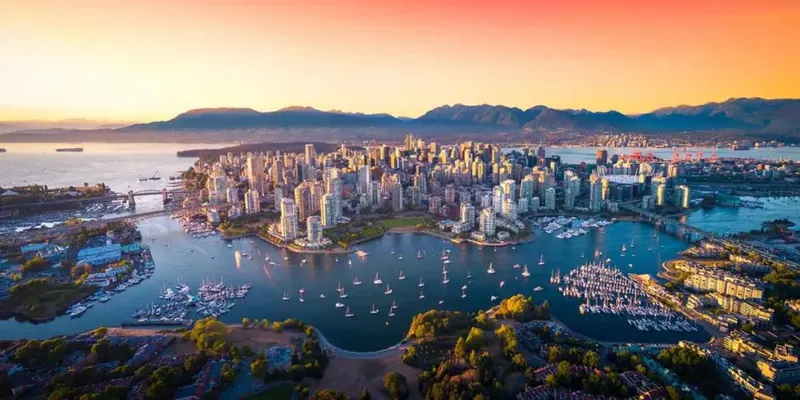
Vancouver sits where a working Pacific harbour laps against a wall of forested peaks, close enough that a morning on the water and an afternoon on the ski slopes fit into one day. Canada's westernmost metropolis wraps around inlets and beaches, hemmed by the Coast Mountains to the north and threaded with seawalls, rainforest parks and glass towers that catch the changing coastal light.
Vancouver is a quieter alternative. It's ready to explore in the Nuvoha app: set your budget and see complete Vancouver trips.
Why visit Vancouver
Few big cities keep the wilderness this close. Stanley Park rings the downtown peninsula with a seawall made for cycling past totem poles and beaches, while Grouse Mountain and the Capilano canyon are a short hop across the harbour on the North Shore. Granville Island packs a public market and artisan studios under a bridge, historic Gastown keeps its cobbles and steam clock, and the beaches of English Bay and Kitsilano fill on warm evenings. Add some of the finest Pacific seafood and Asian cooking in North America, plus Whistler and the Sea to Sky Highway within reach, and the outdoorsy appeal is obvious.
Experiences to plan around
- Stanley Park: A forested peninsula ringed by a seawall path, with totem poles at Brockton Point, beaches and rainforest trails minutes from downtown.
- Granville Island: A former industrial island under the Granville Bridge, now a covered public market, artisan workshops and theatres beside False Creek.
- Grouse Mountain: A North Shore peak reached by an aerial gondola, with alpine trails and views back over the city and harbour.
- Capilano Suspension Bridge: A swaying footbridge strung high above a rainforest gorge on the North Shore, alongside cliffside walkways among the treetops.
- Gastown: The city's oldest quarter, its cobbled streets lined with brick warehouses, boutiques and the landmark steam-powered clock.
- Museum of Anthropology: On the university campus at Point Grey, a striking gallery of Northwest Coast First Nations art, including work by Bill Reid.
Neighbourhood by neighbourhood
- Downtown and the West End: The high-rise core on the harbour peninsula, running from the business district to the beaches and leafy streets of the West End.
- Gastown and Chinatown: Neighbouring historic quarters east of downtown, one Victorian and cobbled, the other among the largest Chinatowns in North America.
- Yaletown: A converted warehouse district on False Creek, now full of loft conversions, waterfront patios and design shops.
- Kitsilano: A laid-back beachside neighbourhood south of English Bay, known for its sands, health-food cafes and views back to the mountains.
- Commercial Drive and Mount Pleasant: Independent-minded quarters east of the centre, home to Italian cafes, craft breweries and a lively arts scene.
- The North Shore: Across the harbour by bridge or SeaBus, where North and West Vancouver climb into mountains, canyons and trailheads.
The Vancouver table
Vancouver eats with its back to the Pacific and its face to Asia. The waters supply wild salmon, spot prawns, Dungeness crab and oysters, while some of the best Chinese, Japanese and Korean food outside Asia fills Richmond and the city's east side. A confident West Coast style leans on local, seasonal produce, the sushi is exceptional, and the street-food hybrid Japadog has become a local institution. Craft beer and wines from the Okanagan Valley round out the table.
- Wild Pacific salmon
- Spot prawns
- Japadog
- Dungeness crab
- Dim sum
- Nanaimo bar
What Vancouver feels like
Vancouver takes the outdoors seriously and dresses accordingly, in fleece and waterproofs rather than finery. Runners and cyclists own the seawall at dawn, paddleboarders cross False Creek, and even in drizzle the parks stay busy. The mood is relaxed, health-minded and quietly diverse, shaped by large Chinese, South Asian and Filipino communities whose food and festivals run through the calendar. Winters are mild but genuinely wet, so locals treat grey skies as no reason to stay in; when the cloud lifts and the mountains reappear over the towers, the whole city seems to exhale and head for the water.
Getting from A to B
Downtown is compact and walkable, and the SkyTrain, an automated light-metro, links it to the airport, the suburbs and the eastern neighbourhoods. Buses fill in the gaps, the SeaBus ferry glides across to the North Shore, and small ferries hop around False Creek to Granville Island. A rechargeable Compass card covers the network. Cyclists have it good, with the Stanley Park seawall the finest ride of all. Vancouver International Airport sits on Sea Island in Richmond, south of the centre. The Canada Line branch of the SkyTrain runs straight from the terminals into downtown in around twenty-five minutes, with taxis and ride-hailing also on hand.
Practical pointers
- Canadians value politeness and orderly queues; a please and thank you go a long way.
- Tipping of around fifteen to twenty per cent is expected in restaurants, taxis and bars.
- Take rain in your stride as locals do, with layers and a waterproof rather than an umbrella.
- Respect the region's First Nations heritage; many parks and artworks sit on the traditional lands of the Musqueam, Squamish and Tsleil-Waututh peoples.
- July and August bring the warmest, driest weather; the rest of the year is mild but often wet.
- Rent bikes to ride the Stanley Park seawall, a flat and traffic-free loop with constant views.
- The North Shore mountains are close, so pack layers even in summer, as it is cooler up high.
- Buy a Compass card for seamless travel across SkyTrain, bus and SeaBus.
- Tap water, piped from mountain reservoirs, is excellent straight from the tap.
- Whistler is about two hours north on the scenic Sea to Sky Highway, an easy day trip or overnight.
Best for
- City breaks
- Quieter travel
Key facts
| Country | Canada |
|---|---|
| Region | Americas |
| Airports | YVR |
| Trip length fit | Suited to longer trips |
Vancouver essentials
| Currency | Canadian Dollar (CAD) |
|---|---|
| Language | English and French are official; French predominates in Québec, English almost everywhere else |
| Time zone | Six zones from Newfoundland (UTC-3:30) to Pacific (UTC-8); daylight saving observed in most provinces from March to November |
| Emergency number | 911 |
| Driving side | Right |
| Tap water | Safe to drink across the country |
Climate & seasons
| Month | Typical range | Season |
|---|---|---|
| January | 1°C to 7°C | Cool wet winter |
| April | 6°C to 14°C | Fresh spring |
| July | 13°C to 23°C | Mild dry summer |
| October | 7°C to 14°C | Cool wet autumn |
Typical stay
- A week or more
Vancouver is a long-haul trip for most travellers: it rewards a longer stay over a quick break.
Getting there
Vancouver is served via YVR.
- YVR
Is it your kind of trip?
Ideal if…
- you like walkable city energy
- you like places before everyone else finds them
Maybe not if…
- you only have a weekend: the distance suits a longer stay
- a beach-first holiday is the priority
Pairs well with
Compare with
More in Americas
Near Vancouver
Travel style
- City
Frequently asked questions
Which airports serve Vancouver?
Vancouver is served via YVR.
Is Vancouver good for a weekend trip?
Vancouver is a long-haul trip, so it suits a week or more rather than a weekend.
What kind of trip is Vancouver best for?
Vancouver is best for city trips.
Which destinations pair well with Vancouver?
Within multi-city range: San Francisco (1,289 km).
How many days do you need in Vancouver?
Three or four days covers Stanley Park, Granville Island, the main neighbourhoods and a trip up to the North Shore mountains. Add more time if you plan to fold in Whistler, Victoria or a longer stretch of the coast.
Is Vancouver a rainy city?
It is one of Canada's wettest, especially from late autumn to early spring, though the rain is usually mild rather than heavy. Summers are comparatively dry and sunny, which is why they are the busiest season.
Is Vancouver easy to explore without a car?
The central neighbourhoods are walkable and well linked by SkyTrain, bus and SeaBus, so a car is unnecessary in the city. You may want one for the mountains and coast beyond, though tours and buses reach Whistler and the North Shore.
How do you get to the ski mountains from the city?
Grouse, Cypress and Mount Seymour rise on the North Shore, roughly half an hour from downtown by car or shuttle. Whistler Blackcomb, a larger resort, lies about two hours north along the Sea to Sky Highway.