
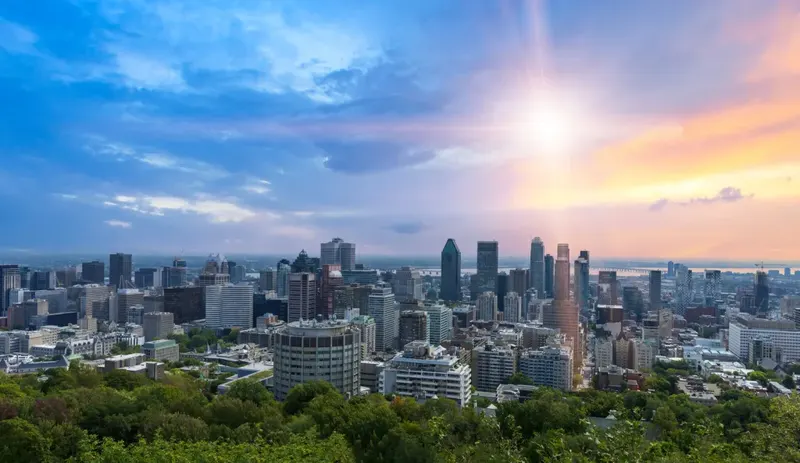
Montreal speaks French with a North American accent, an island city in the Saint Lawrence River where European habits meet New World scale. Cobbled Old Montreal runs down to the water below a downtown of glass towers, and everything centres on the green hump of Mount Royal. It is a place of long festival summers, bracing snow-lit winters and a bilingual, cafe-loving culture that feels closer to Europe than to anywhere else in Canada.
Montreal is a quieter alternative. It's ready to explore in the Nuvoha app: set your budget and see complete Montreal trips.
Why visit Montreal
Montreal rewards visitors with Old World texture and modern energy in equal measure. The lanes of Vieux-Montreal lead to the blue-lit splendour of Notre-Dame Basilica and the quays of the Old Port, while Mount Royal, landscaped by the designer of New York's Central Park, offers the city's best lookout. Museums, the vast underground city and the domed Saint Joseph's Oratory fill cooler days, and summer turns the streets over to jazz, comedy and food festivals that draw crowds from across the continent. The eating is superb, from bagels and smoked meat to French bistros, and the whole city carries an easy, unbuttoned charm.
Landmarks worth your time
- Notre-Dame Basilica: A Gothic Revival masterpiece in Old Montreal whose deep-blue, star-strewn sanctuary is among the most beautiful church interiors in North America.
- Old Montreal (Vieux-Montreal): The historic quarter of cobbled streets, eighteenth-century stone houses and the Old Port, running along the Saint Lawrence.
- Mount Royal Park: The forested hill at the city's heart, landscaped by Frederick Law Olmsted, with a lookout, the Belvedere, over downtown and the river.
- Saint Joseph's Oratory: Canada's largest church, its vast dome crowning the western flank of Mount Royal, reached by a long flight of pilgrim steps.
- Jean-Talon Market: One of North America's great open-air markets, in Little Italy, piled with Quebec produce, cheeses and maple goods.
- The Underground City: A sprawling network of climate-controlled walkways, known as RESO, linking metro stations, shops and offices beneath downtown.
Quarters of the city
- Vieux-Montreal (Old Montreal): The oldest quarter, its cobbled lanes and stone facades running from Place Jacques-Cartier down to the Old Port.
- Downtown (Ville-Marie): The modern core of towers, department stores and the Quartier des Spectacles, the festival district that lights up each summer.
- Plateau Mont-Royal: A colourful residential quarter famous for its spiral outdoor staircases, murals, cafes and independent shops.
- Mile End: A creative, cafe-dense neighbourhood known for its rival wood-fired bagel bakeries and studio culture.
- Le Village: One of the largest gay villages anywhere, lively with terraces and, in summer, a pedestrianised main street.
- Little Italy: Home to the Jean-Talon Market and a long-established Italian community, its cafes and trattorias clustered north of the centre.
The Montreal table
Montreal is one of the continent's finest eating cities, and proudly distinct. Its wood-fired bagels, boiled in honey water before baking, spark endless loyalty to one Mile End bakery or another, and its hand-carved smoked meat, piled into rye, is a rite of passage. Quebecois comfort food runs to poutine, tourtiere pie and everything maple, celebrated each spring at the sugar shacks. French bistros, Haitian and Portuguese kitchens and a serious wine culture complete a table that leans unmistakably European.
- Montreal-style bagels
- Smoked meat on rye
- Poutine
- Tourtiere
- Maple taffy
- Sugar pie
What Montreal feels like
Life here is lived outdoors whenever the weather allows and indoors with style when it does not. Summer is one long celebration of terrace dinners, street festivals and cyclists on the BIXI bikes; winter answers with skating rinks, snow-dusted stone and the warren of the underground city linking metro stations to malls. Conversation slips between French and English mid-sentence, coffee culture is taken seriously, and the tempo is noticeably more relaxed than in Toronto or New York. There is a bohemian, creative streak to the place, from Plateau murals to Mile End studios, and an unmistakable joie de vivre.
Moving around the city
The Metro, with its quiet rubber-tyred trains, is fast, clean and the easy way to cross the island, backed by an extensive bus network and paid for with an OPUS card. Old Montreal and downtown are eminently walkable, and in winter the underground city lets you cross the centre without a coat. In warmer months the BIXI bike-share and a growing web of cycle paths come into their own. Montreal-Trudeau International Airport lies west of the centre in Dorval. The round-the-clock 747 express bus runs directly to downtown and the central bus station, with taxis and ride-hailing the quicker door-to-door option.
Practical pointers
- Open with a bonjour and a little French; the effort is warmly received, even where English is widely spoken.
- Tipping of around fifteen per cent, before tax, is standard in restaurants and bars.
- Dress for the season in earnest, as winters are genuinely cold and summers hot and humid.
- Cover your shoulders and knees when visiting churches such as Notre-Dame and the Oratory.
- Summer is festival season, from the international jazz festival to comedy and fireworks; book accommodation early for July.
- Winters are cold but well organised; the underground city and Metro keep you moving whatever the weather.
- Buy an OPUS card or a weekly pass if you plan to use the Metro and buses more than a few times.
- The Mount Royal lookout is finest at sunset; walk up through the park or take the bus to the top.
- Autumn brings brilliant foliage on Mount Royal and in the Laurentians, an easy drive north.
- Many shops and menus lead in French, though staff readily switch to English when asked.
Best for
- City breaks
- Quieter travel
Key facts
| Country | Canada |
|---|---|
| Region | Americas |
| Airports | YUL |
| Trip length fit | Suited to longer trips |
Montreal essentials
| Currency | Canadian Dollar (CAD) |
|---|---|
| Language | English and French are official; French predominates in Québec, English almost everywhere else |
| Time zone | Six zones from Newfoundland (UTC-3:30) to Pacific (UTC-8); daylight saving observed in most provinces from March to November |
| Emergency number | 911 |
| Driving side | Right |
| Tap water | Safe to drink across the country |
Climate & seasons
| Month | Typical range | Season |
|---|---|---|
| January | -13°C to -5°C | Snowy winter |
| April | 3°C to 13°C | Late thaw |
| July | 17°C to 27°C | Warm summer |
| October | 6°C to 13°C | Cool autumn |
Typical stay
- A week or more
Montreal is a long-haul trip for most travellers: it rewards a longer stay over a quick break.
Getting there
Montreal is served via YUL.
- YUL
Is it your kind of trip?
Ideal if…
- you like walkable city energy
- you like places before everyone else finds them
Maybe not if…
- you only have a weekend: the distance suits a longer stay
- a beach-first holiday is the priority
Pairs well with
Compare with
More in Americas
Near Montreal
Travel style
- City
Frequently asked questions
Which airports serve Montreal?
Montreal is served via YUL.
Is Montreal good for a weekend trip?
Montreal is a long-haul trip, so it suits a week or more rather than a weekend.
What kind of trip is Montreal best for?
Montreal is best for city trips.
Which destinations pair well with Montreal?
Within multi-city range: Boston (409 km), Toronto (507 km), New York (537 km).
Do I need to speak French in Montreal?
No. French is the official language and greets you first on signs and menus, but Montreal is broadly bilingual and English is widely understood, especially downtown and in tourist areas. A few French phrases are appreciated all the same.
When is the best time to visit Montreal?
Late spring through early autumn is warmest and busiest, packed with outdoor festivals. Winter is cold and snowy but atmospheric, with skating and the sheltered underground city, while autumn brings spectacular foliage.
How many days do you need in Montreal?
Two or three days covers Old Montreal, Mount Royal, the main museums and a few neighbourhoods at a relaxed pace. Longer stays leave room for day trips to Quebec City or the Laurentian hills.
Is Montreal walkable?
The core is very walkable, particularly Old Montreal and downtown, and the Metro handles longer hops. In deep winter, the underground city links much of the centre so you can get around comfortably out of the cold.