
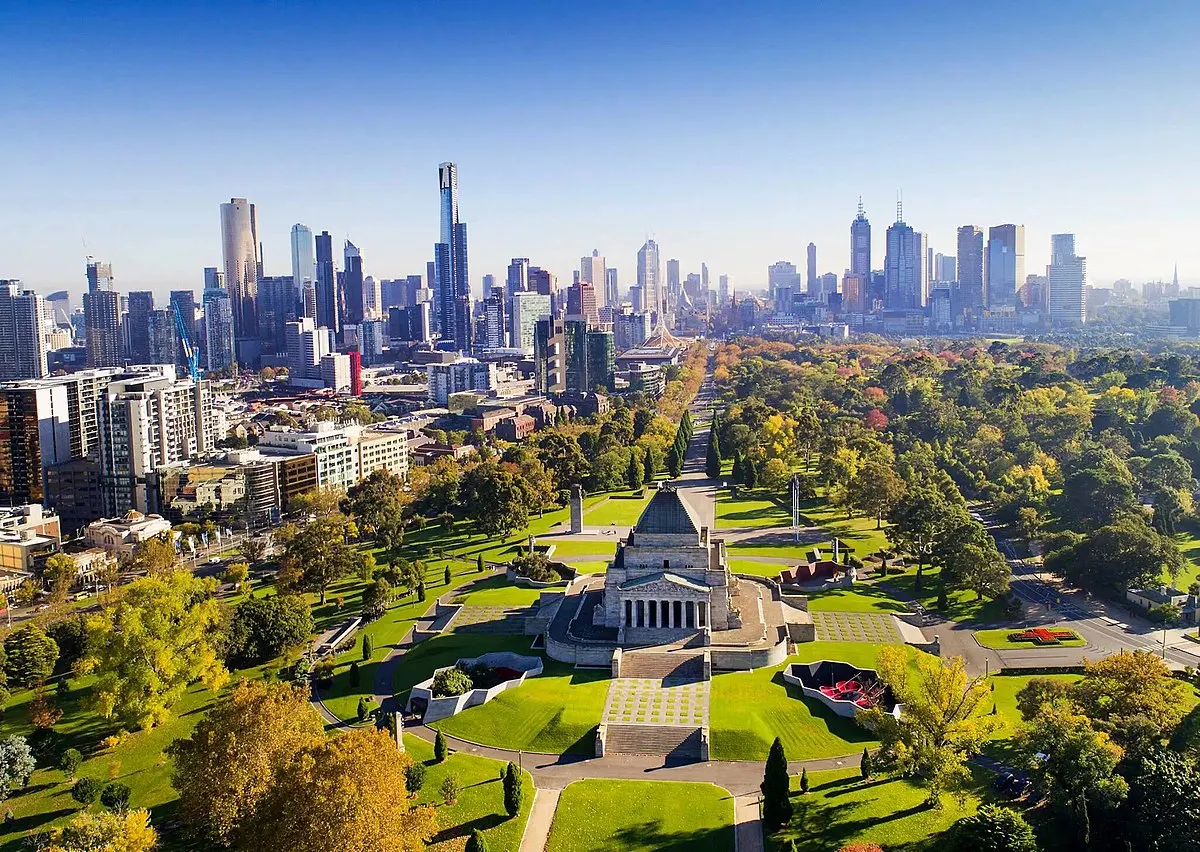
The hiss of an espresso machine carries down Degraves Street before the morning trams have filled, and by lunchtime the bluestone laneways off Flinders Lane are packed shoulder to shoulder under layers of street art. Melbourne organises itself around these narrow arteries (and around coffee, football and the Yarra) rather than any single postcard landmark.
Melbourne is a quieter alternative. It's ready to explore in the Nuvoha app: set your budget and see complete Melbourne trips.
Why visit Melbourne
Melbourne rewards travellers who like cities with texture. Its pleasures are cumulative: a flat white pulled by someone who takes it personally, a record shop found down an unmarked lane, ninety thousand voices rising at the MCG on a winter Saturday, an evening at the NGV or a small theatre in the Southbank arts precinct. The dining scene is Australia's most obsessive, spanning Lygon Street's Italian institutions, Victoria Street's pho houses and tasting menus hidden above laneways. It is a city built for wandering, watching and eating, ideally all three in one afternoon.
Laneways, galleries and grandstands
- Melbourne Cricket Ground: The 100,000-capacity 'G' in Yarra Park is the spiritual home of Australian Rules football and hosts the Boxing Day cricket Test.
- Hosier Lane: The city's most famous street-art laneway, its bluestone walls repainted so constantly that no two visits look the same.
- National Gallery of Victoria: Australia's oldest and most-visited public gallery, split between the moat-fronted St Kilda Road building and the Australian collection at Federation Square.
- Queen Victoria Market: A vast nineteenth-century open-air market trading in produce, deli goods and the famous hot jam doughnuts.
- Royal Botanic Gardens: Thirty-eight hectares of lakes and lawns beside the Yarra, ringed by the Tan running track that Melburnians treat as communal property.
- State Library Victoria: Home to the octagonal La Trobe Reading Room, whose domed galleries make it one of the world's most photographed libraries.
Inner suburbs to explore
- Fitzroy: Melbourne's original bohemian quarter along Brunswick and Gertrude Streets, dense with vintage shops, band venues and street art.
- Carlton: The city's Italian heartland around Lygon Street, where post-war migrants planted Australia's espresso culture.
- Southbank: The Yarra-side arts precinct holding the NGV, Arts Centre Melbourne's spire and a riverfront promenade facing the city towers.
- St Kilda: The bayside suburb of Luna Park's grinning gate, Acland Street's cake shops and a pier where little penguins roost at dusk.
- Collingwood: A former industrial strip along Smith Street turned into one of the city's liveliest runs of bars, galleries and record stores.
Coffee first, then everything else
Coffee is the city's love language (order a flat white, or a magic if you want to sound local) and the café benchmark is punishingly high. Beyond the beans, Melbourne eats globally: chicken parma in a corner pub, dumplings in Chinatown's laneways, souvlaki from Greek institutions (the city has one of the largest Greek populations outside Greece), and pho along Victoria Street in Richmond. Bakeries fight serious battles over lamingtons and vanilla slices.
- Chicken parma
- Dumplings
- Souvlaki
- Pho
- Lamington
What Melbourne feels like
Melburnians dress in black, argue about coffee and carry an umbrella they may not need: the weather's four-seasons-in-a-day reputation is earned, thanks to winds that swing between desert and Southern Ocean. The city hums rather than shouts: galleries and bookshops, band rooms in Fitzroy and Collingwood, tram bells, and an almost tribal devotion to Australian Rules football that peaks each September. Under it all runs a dry, self-deprecating humour and a fierce certainty that Melbourne, not Sydney, got the better deal.
Trams and how to ride them
Trams are the way: Melbourne runs the largest tram network on earth, and within the CBD's Free Tram Zone, including the burgundy heritage City Circle route, you ride at no charge. Beyond the zone, touch on with a myki card, which also covers trains from Flinders Street and Southern Cross and the bus network. The centre's grid is flat and easily walked, and the laneways are best found on foot anyway. Melbourne Airport at Tullamarine has no direct rail link; SkyBus coaches run frequently to Southern Cross Station in the city centre, taking roughly half an hour outside peak traffic.
Melbourne particulars
- Tipping is not expected anywhere (staff are paid properly) though rounding up for great service is a kind gesture.
- Stand on the left of escalators and let riders exit the tram before you board.
- Asking someone which AFL team they follow is a reliable ice-breaker; mocking their answer is a local sport in itself.
- If you only need to travel within the Free Tram Zone, don't touch on your myki: doing so can trigger a fare.
- Dress in layers whatever the forecast says; a 35-degree morning can end in a cold southerly change by evening.
- The best laneways (Degraves, Centre Place, Hosier, Hardware) branch off Flinders Lane and the Flinders Street end of the grid; wander without a plan.
- See an AFL match at the MCG between March and September; tickets to home-and-away games are easy to get and the crowd is half the show.
- Queen Victoria Market's hot jam doughnut van is a rite of passage worth the queue.
- The Great Ocean Road and the Yarra Valley wine region both work as day trips, though the coast road deserves an overnight.
- Free galleries stack up quickly: the NGV's permanent collections, the State Library and Federation Square's Australian galleries all cost nothing to enter.
Best for
- City breaks
- Quieter travel
Key facts
| Country | Australia |
|---|---|
| Region | Oceania |
| Airports | MEL |
| Trip length fit | Suited to longer trips |
Melbourne essentials
| Currency | Australian Dollar (AUD) |
|---|---|
| Language | English |
| Time zone | Three main zones: Sydney and Melbourne on UTC+10 (UTC+11 in summer), Adelaide on UTC+9:30, Perth on UTC+8; daylight saving varies by state |
| Emergency number | 000 (112 also works from mobiles) |
| Driving side | Left |
| Tap water | Safe to drink in all cities and towns |
Climate & seasons
| Month | Typical range | Season |
|---|---|---|
| January | 15°C to 26°C | Warm summer |
| April | 10°C to 20°C | Mild autumn |
| July | 6°C to 14°C | Cool winter |
| October | 9°C to 20°C | Changeable spring |
Typical stay
- A week or more
Melbourne is a long-haul trip for most travellers: it rewards a longer stay over a quick break.
Getting there
Melbourne is served via MEL.
- MEL
Is it your kind of trip?
Ideal if…
- you like walkable city energy
- you like places before everyone else finds them
Maybe not if…
- you only have a weekend: the distance suits a longer stay
- a beach-first holiday is the priority
Pairs well with
Compare with
More in Oceania
Near Melbourne
Travel style
- City
Frequently asked questions
Which airports serve Melbourne?
Melbourne is served via MEL.
Is Melbourne good for a weekend trip?
Melbourne is a long-haul trip, so it suits a week or more rather than a weekend.
What kind of trip is Melbourne best for?
Melbourne is best for city trips.
Which destinations pair well with Melbourne?
Within multi-city range: Sydney (706 km), Gold Coast (1,330 km).
How does the Free Tram Zone work?
All tram travel that starts and ends within the marked CBD zone (which includes the Queen Victoria Market and Docklands edges and the City Circle heritage route) is free. Cross the boundary and you must touch on with a myki.
Is Melbourne's weather really that changeable?
Yes. The four-seasons-in-a-day cliché is meteorological fact, driven by winds that flip between hot inland air and cold Southern Ocean fronts. Carry a layer and something rain-proof year-round, even in summer.
What should I order in a Melbourne café?
A flat white is the classic; a magic (a double ristretto with steamed milk in a smaller cup) marks you as someone who has done their homework. Filter and single-origin options are standard, and baristas welcome questions.