
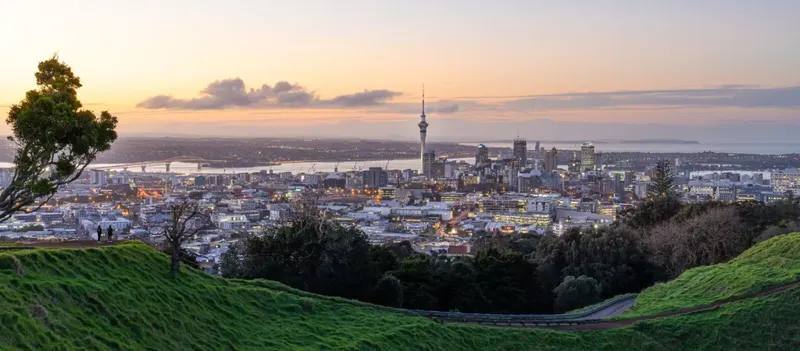
Auckland spreads across a narrow, hilly isthmus between two great harbours, sails scattered across the blue water that gives New Zealand's largest city its nickname. Extinct volcanic cones rise green among the suburbs, ferries fan out to islands in the Hauraki Gulf, and the Sky Tower needles above a compact, waterfront centre. Wrapped in coast and studded with parks, this is an outdoors-loving, Polynesian-flavoured city where beaches, vineyards and volcanoes all lie within easy reach of downtown.
Auckland is made for unwinding. It's ready to explore in the Nuvoha app: set your budget and see complete Auckland trips.
Why visit Auckland
Auckland puts an unusual amount of nature at a city's doorstep. From the waterfront you can ride a ferry to Waiheke Island for vineyards and beaches, or to Rangitoto, the youngest of the volcanoes, to climb its bare summit for a view back over the gulf. In the city itself, grassy craters such as Mount Eden give sweeping panoramas, the Sky Tower offers the highest view in the land, and the Auckland War Memorial Museum holds a moving collection of Maori and Pacific treasures. Add wild black-sand surf beaches on the west coast, a lively harbourside dining scene and a warm, multicultural spirit, and the city amply rewards a stay.
Experiences to plan around
- Sky Tower: The needle-like tower over the city centre, the tallest structure in the country, with observation decks and a glass-floored walk high above downtown.
- Waiheke Island: A gulf island of vineyards, olive groves and swimming beaches, an easy ferry from the city and a favourite day out.
- Rangitoto Island: The symmetrical volcanic cone guarding the harbour, the youngest of Auckland's volcanoes, with a lava-field walk to its summit.
- Mount Eden (Maungawhau): A grassy volcanic cone near the centre, its deep crater ringed by a path and its summit giving a full circle of city and sea.
- Auckland War Memorial Museum: A grand museum in the Domain, itself set on a volcano, renowned for its Maori and Pacific collections and daily cultural performance.
- Viaduct Harbour and Wynyard Quarter: The revitalised waterfront of marinas, restaurants and bars at the city's edge, built up around the America's Cup.
Neighbourhood by neighbourhood
- City Centre: The compact downtown of Queen Street, the Sky Tower, the Britomart precinct and the waterfront at the Viaduct and Wynyard Quarter.
- Ponsonby and Karangahape Road: A ridge of Victorian villas west of the centre, thick with cafes, boutiques and bars, running down to the eclectic strip of K Road.
- Parnell and Newmarket: Genteel eastern suburbs of galleries, gardens and shopping, close to the Domain and the museum.
- Devonport: A seaside village a short ferry across the harbour, with wooden villas, cafes and two volcanic hills looking back at the skyline.
- Mount Eden: A leafy inner suburb around its namesake volcano, with a village high street and some of the city's best crater views.
- The west coast and ranges: Beyond the suburbs lie the Waitakere Ranges and wild surf beaches such as Piha, with black sand and strong currents.
The Auckland table
Auckland's table draws on the sea, the land and the Pacific. The waters yield green-lipped mussels, snapper, oysters and crayfish, while New Zealand lamb and beef anchor the menus and the country's flat white fuels the cafes. Being the largest Polynesian city, it embraces the Maori hangi, cooked in an earth oven, along with Samoan and Tongan flavours and a strong Asian influence from its many communities. The vineyards of Waiheke and the wider region supply the wine, and weekend farmers markets brim with local produce.
- Green-lipped mussels
- New Zealand lamb
- Snapper
- Hangi
- Whitebait fritter
- Pavlova
What Auckland feels like
Auckland lives for the water and the weekend. Boats fill the harbour, the ferry to Devonport is part of the daily rhythm, and summer empties the city towards the beaches and the gulf islands. It is the largest Polynesian city in the world, and that shows in its food, its festivals and its easygoing warmth, alongside strong Maori and Asian communities. The vibe is relaxed and unshowy, more about the outdoors than the skyline, though downtown has sharpened up around the Viaduct and Britomart. The weather is famously changeable, delivering four seasons in a day, so locals simply carry a jacket and get on with it.
Getting around by ferry and rail
Downtown Auckland is walkable, and ferries from the central terminal are the joy of getting around, gliding to Devonport, Waiheke and Rangitoto. Buses and a small suburban rail network cover the rest, tapped on and off with an AT HOP card, and a new underground rail link is extending the network. Distances stretch out beyond the centre, so for the west-coast beaches and the ranges a car earns its place. Auckland Airport lies south of the city. The AirportLink and city bus services connect the terminals to the centre and to the rail network at Puhinui, and taxis and ride-hailing are on hand. Allow extra time in the rush hour, as the motorways in can be slow.
Practical pointers
- New Zealanders are friendly and informal; a relaxed, unpretentious manner goes down well.
- Tipping is not expected, as service is included, though it is welcome for something special.
- Respect Maori culture and language; you will hear kia ora as a greeting and see bilingual place names everywhere.
- Take off your shoes when entering someone's home, as many households do.
- Summer, from December to March, is warmest and driest, and the season for the gulf islands and beaches; winters are mild but wet.
- Pack layers and a light waterproof whatever the season, as the weather can change through the day.
- Give Waiheke Island a full day, combining a vineyard lunch with a swim at one of its beaches.
- Buy an AT HOP card to tap on and off the ferries, buses and trains.
- The wild west-coast beaches such as Piha are beautiful but have strong rips, so swim only where patrolled.
- Tap water is clean and safe to drink straight from the tap.
Best for
- City breaks
- Unwinding
Key facts
| Country | New Zealand |
|---|---|
| Region | Oceania |
| Airports | AKL |
| Trip length fit | Suited to longer trips |
Auckland essentials
| Currency | New Zealand Dollar (NZD) |
|---|---|
| Language | English, Maori and New Zealand Sign Language are official; English is used day to day |
| Time zone | New Zealand Standard Time (UTC+12, UTC+13 with daylight saving from late September to early April) |
| Emergency number | 111 (all emergencies) |
| Driving side | Left |
| Tap water | Safe to drink from the tap in towns and cities |
Climate & seasons
| Month | Typical range | Season |
|---|---|---|
| January | 17°C to 24°C | Warm summer |
| April | 13°C to 20°C | Mild autumn |
| July | 8°C to 15°C | Cool wet winter |
| October | 11°C to 18°C | Changeable spring |
Typical stay
- A week or more
Auckland is a long-haul trip for most travellers: it rewards a longer stay over a quick break.
Getting there
Auckland is served via AKL.
- AKL
Is it your kind of trip?
Ideal if…
- you like walkable city energy
- you want to slow down and reset
Maybe not if…
- you only have a weekend: the distance suits a longer stay
- a beach-first holiday is the priority
Compare with
More in Oceania
Near Auckland
Travel style
- City
Frequently asked questions
Which airports serve Auckland?
Auckland is served via AKL.
Is Auckland good for a weekend trip?
Auckland is a long-haul trip, so it suits a week or more rather than a weekend.
What kind of trip is Auckland best for?
Auckland is best for city trips, popular for unwinding.
How many days do you need in Auckland?
Three or four days covers the city, a volcano or two, the museum and a ferry trip to Waiheke or Rangitoto. Many travellers use Auckland as the start of a wider New Zealand trip and pass through more than once.
When is the best time to visit Auckland?
Summer and early autumn, from December to April, are warmest and best for the beaches and islands. Winters are mild but wet, and spring and autumn bring changeable but pleasant weather with fewer crowds.
Which islands can you visit from Auckland?
Ferries from downtown reach Waiheke, known for vineyards and beaches, Rangitoto with its volcanic summit walk, and quieter Motutapu and Tiritiri Matangi, a bird sanctuary. Devonport, just across the harbour, makes an easy short hop.
Is Auckland walkable?
The central city and waterfront are easily walked, and ferries handle the harbour. Beyond the centre the city sprawls, so buses, trains or a car help for the volcanoes, beaches and ranges further out.