
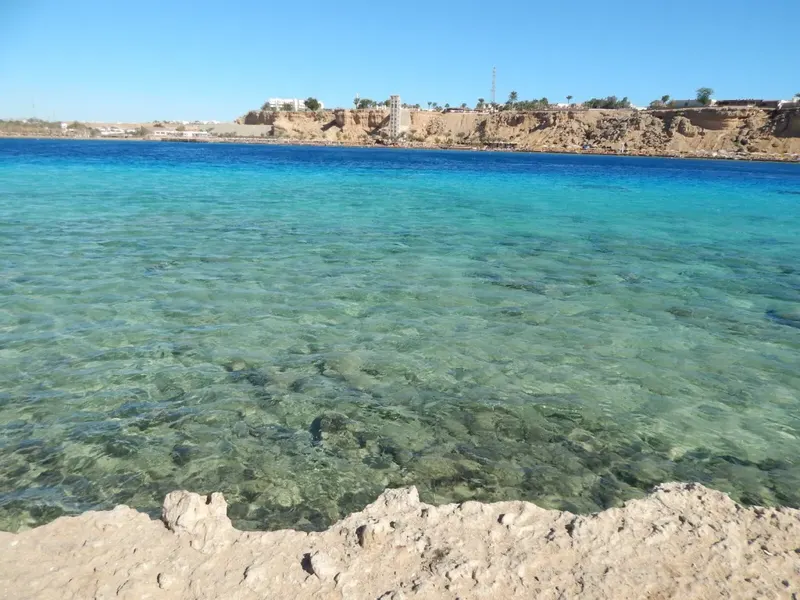
Sharm El Sheikh sits at the southern tip of Egypt's Sinai peninsula, where desert mountains meet the Red Sea. The resort gathers around a series of bays on the Gulf of Aqaba, with Naama Bay at its heart and the old market inland. What sets it apart is the coral: reefs fringe the shore with sudden drop-offs, and two of the Red Sea's best-known dive areas, Ras Mohammed and the Straits of Tiran, lie a short boat ride away.
Sharm El Sheikh is made for unwinding. It's ready to explore in the Nuvoha app: set your budget and see complete Sharm El Sheikh trips.
Why visit Sharm El Sheikh
Sharm is built for the water. Coral reefs start at the shoreline and fall away into deep blue, so even snorkellers see walls of fish, and divers have Ras Mohammed National Park and the four reefs of Tiran within reach. Beyond the sea, the Sinai interior draws visitors inland: the pre-dawn climb of Mount Sinai and the ancient monastery of Saint Catherine, and the sandstone folds of the Coloured Canyon. The bays offer calm swimming and promenades, the old market keeps a local flavour, and the desert lays on Bedouin dinners and wide, clear night skies.
What Sharm El Sheikh feels like
The setting is stark and bright: bare Sinai mountains behind, coral sea in front, and resorts terraced along the bays between them. Naama Bay is the long-standing hub, a pedestrian strip of hotels, cafes and evening life along the water. The older Sharm El Maya and its market keep a plainer, more Egyptian feel, while Nabq and Shark's Bay spread north towards the airport. Sun is near-constant and the sea stays warm even in winter, so the year divides less by season than by heat. The resort has also hosted international summits, which lends it a secure, orderly air.
Reefs, bays and desert
- Ras Mohammed National Park: A protected headland at Sinai's tip where the reefs of Shark and Yolanda meet deep water, among the best-known dives in the Red Sea.
- The Straits of Tiran: Four reefs, Jackson, Woodhouse, Thomas and Gordon, strung across the channel between Sinai and Tiran Island, reached by day boat.
- Naama Bay: The resort's central bay, with a seafront promenade of hotels, restaurants and shops and calm water for swimming.
- The Old Market and Al Sahaba Mosque: The bazaar quarter of Sharm El Maya, with local shops and cafes beside a striking modern mosque.
- Mount Sinai and Saint Catherine's Monastery: An inland excursion to climb the mountain for sunrise and visit one of the oldest working monasteries in the world.
- The Coloured Canyon: A narrow sandstone gorge in the Sinai interior, banded with colour and explored on desert safaris.
Around the bays
- Naama Bay: The main tourist hub, a walkable bay of hotels, dining and nightlife along a seafront promenade.
- Sharm El Maya and the Old Market: The older quarter by the port, home to the bazaar and a more local, everyday atmosphere.
- Hadaba (Ras Um Sid): A plateau above the sea south of Naama, with clifftop hotels and the reef and lighthouse at Ras Um Sid below.
- Shark's Bay: A quieter bay to the north with its own reefs and resorts, on the way to the airport.
- Nabq Bay: A protected coastal strip further north with mangroves and spread-out resorts near the airport.
The Red Sea and Bedouin table
The table mixes Egyptian staples, Red Sea fish and Bedouin cooking. Grilled fish and seafood arrive simply done, or as sayadeya with spiced rice, while koshari and ful medames stand in for the everyday food of the mainland. Bedouin meals bring meat slow-cooked in a covered sand oven and bread baked over the fire, finished with sweet tea scented with herbs. Mezze of tahini and salads, warm baladi bread, and juices of mango and hibiscus fill out most meals along the bays.
- Sayadeya (spiced fish with rice)
- Grilled Red Sea seafood
- Bedouin sand-oven roast
- Koshari
- Ful medames
Getting between the bays
The bays are strung along the coastal Peace Road, so getting between Naama Bay, the Old Market and Nabq means a taxi or hotel shuttle rather than a walk. Agree taxi fares in advance, as meters are uncommon, and keep small cash to hand. Diving and snorkelling trips leave by boat from the ports, and Ras Mohammed can also be reached overland by four-wheel drive. Desert and Sinai excursions run in guided convoys. Sharm El Sheikh International Airport lies to the north of the resort, near Nabq. Transfers to Naama Bay and Sharm El Maya run down the Peace Road, a short to moderate drive depending on which bay you are staying in.
Practical pointers
- In the Old Market and away from the beach, dress modestly and cover shoulders and knees, and carry a scarf for mosques.
- Do not touch, stand on or remove coral and shells, as the reefs are a protected marine environment.
- Small tips, or baksheesh, are customary for many services, so keep coins and small notes handy.
- Ask before photographing people, particularly Bedouin hosts on desert trips.
- House reefs mean you can snorkel straight from many beaches, though currents can be strong where the reef drops away.
- Ras Mohammed and Tiran are boat day-trips, and Ras Mohammed can also be reached by four-wheel drive across the desert.
- The Mount Sinai climb starts in the small hours to reach the summit for sunrise, and it is cold at the top, so bring layers.
- The Old Market is the place to feel the local side of Sharm, away from the hotel strips.
- The sun is strong all year and the sea stays warm in winter, so sun protection matters even out of season.
- Keep small cash for taxis, tips and the market, where cards are rarely taken.
Best for
- Beach time
- Unwinding
Key facts
| Country | Egypt |
|---|---|
| Region | Middle East & North Africa |
| Airports | SSH |
| Trip length fit | Short-trip friendly |
Sharm El Sheikh essentials
| Currency | Egyptian Pound (EGP) |
|---|---|
| Language | Arabic; English is widely understood in tourism |
| Time zone | Eastern European Time (UTC+2), with daylight saving observed in summer (UTC+3) |
| Emergency number | 122 (police), 123 (ambulance), 180 (fire) |
| Driving side | Right |
| Tap water | Not for drinking: stick to bottled water, which is available everywhere |
Climate & seasons
| Month | Typical range | Season |
|---|---|---|
| January | 14°C to 23°C | Sunny winter |
| April | 21°C to 31°C | Warm spring |
| July | 29°C to 38°C | Very hot summer |
| October | 24°C to 33°C | Hot autumn |
Sharm El Sheikh is one of Nuvoha's winter-sun picks.
Typical stay
- Weekend-friendly
- Short break (2–5 days)
Sharm El Sheikh works as a weekend break just as well as a longer stay.
Getting there
Sharm El Sheikh is served via SSH.
- SSH
Is it your kind of trip?
Ideal if…
- time on the coast is the point of the trip
- you want to slow down and reset
Maybe not if…
- you want big-city energy around the clock
Pairs well with
Compare with
More in Middle East & North Africa
Near Sharm El Sheikh
Travel style
- Winter sun
- Short-trip friendly
- Beach
Frequently asked questions
Which airports serve Sharm El Sheikh?
Sharm El Sheikh is served via SSH.
Is Sharm El Sheikh good for a weekend trip?
Yes, Sharm El Sheikh works for a weekend as well as a longer stay.
What kind of trip is Sharm El Sheikh best for?
Sharm El Sheikh is best for beach trips, popular for unwinding.
Which destinations pair well with Sharm El Sheikh?
Within multi-city range: Hurghada (106 km), Aqaba (192 km), Cairo (376 km).
How is Sharm El Sheikh different from Hurghada?
Sharm sits on the Sinai peninsula, with the reefs of Ras Mohammed and Tiran and the bays around Naama at its centre. Hurghada is across the water on the mainland, more spread out and windier, and better known for island reef trips and for kite and windsurfing.
Is Sharm good for non-divers?
Yes. You can snorkel off house reefs, take glass-bottom boats, and fill days with desert safaris, Bedouin evenings and trips into the Sinai interior to Mount Sinai and Saint Catherine's.
Can I climb Mount Sinai and see Saint Catherine's Monastery?
Yes, on a guided excursion that usually starts before dawn so you reach the summit for sunrise, then visits the monastery below. Warm layers are needed for the cold, exposed top.
When is the best time to visit?
The climate is sunny and dry almost all year. Spring and autumn are ideal, summer is very hot, and winter stays mild and remains good for sun and diving.