
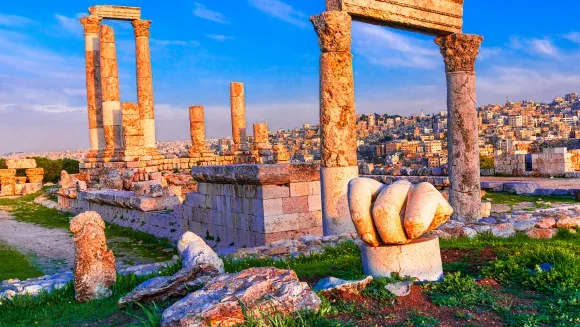
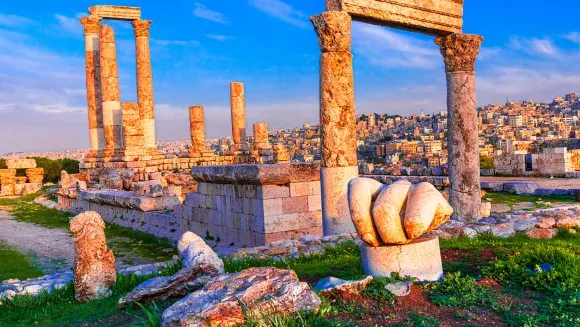
Jordan packs an extraordinary amount into a small, largely desert country at the heart of the Middle East. Its centrepiece is Petra, the rose-coloured Nabataean city carved into sandstone cliffs, but the wonders keep coming: the vast red desert of Wadi Rum, the Roman colonnades of Jerash, and the mineral-heavy Dead Sea, the lowest point on the planet, where bathers float rather than swim. Amman, the hilly capital, ties it together, while Aqaba opens onto the Red Sea and its reefs. Threaded by the ancient King's Highway and dotted with mosaics, crusader castles and biblical sites, Jordan is compact, welcoming and unusually easy to travel, with English widely spoken and a deep tradition of hospitality.
Jordan on Nuvoha spans 2 destinations: Amman, Aqaba. Set your budget and Nuvoha builds the complete trip: flights and hotels together.
Why visit Jordan
- Cities you can explore on foot, from headline sights to quiet neighbourhoods
- Coastline worth building a trip around
- Quieter alternatives beyond the obvious stops
- Easy to combine two cities in a single trip
Best known for
- Petra, the rock-cut Nabataean city
- The desert landscapes of Wadi Rum
- Floating in the Dead Sea
- The Roman ruins of Jerash
- Warm Bedouin hospitality
- Red Sea diving at Aqaba
Regions of Jordan
- Amman and the north: The capital's hills alongside the Roman ruins of Jerash, the castle at Ajloun and the views from Umm Qais.
- The Dead Sea and Jordan Valley: The deep rift below sea level, with mineral-rich shores, hot springs and the baptism site on the river.
- The King's Highway: The ancient road running south past Madaba's mosaics, Mount Nebo, Karak's crusader castle and the Dana reserve.
- Petra and the south: The Nabataean city and the surrounding sandstone country, Jordan's headline sight.
- Wadi Rum: A protected desert of red dunes, granite mountains and Bedouin camps, long a haunt of filmmakers.
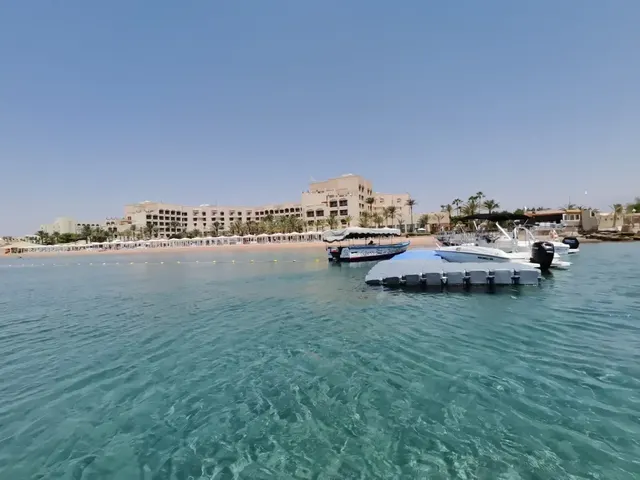
- Aqaba and the Red Sea: Jordan's coastal corner, with warm water, coral reefs and a resort town at the tip of the gulf.
Where to go
Jordan travel basics
| Currency | Jordanian Dinar (JOD) |
|---|---|
| Language | Arabic; English is widely spoken in tourism |
| Time zone | UTC+3, observed year-round |
| Emergency number | 911 |
| Driving side | Right |
| Tap water | Many visitors prefer bottled or filtered water |
Seasons at a glance in Amman
| Month | Typical range | Season |
|---|---|---|
| January | 4°C to 12°C | Cool winter |
| April | 10°C to 23°C | Mild spring |
| July | 19°C to 32°C | Hot dry summer |
| October | 14°C to 27°C | Warm autumn |
Seasons vary across Jordan. Each destination page has its own climate table.
How travellers explore Jordan
Amman and Aqaba sit about 253 km apart, an easy pairing in one trip.
More in Middle East & North Africa
More Middle East & North Africa country guides
Frequently asked questions
Which Jordan destinations can I book with Nuvoha?
Amman, Aqaba, each with complete flight and hotel trips built around your budget.
What kind of trips suit Jordan?
Jordan works for city breaks and beach holidays, and its cities pair well for multi-stop itineraries.
How many days do you need in Jordan?
A week lets you take in Amman, Jerash, the Dead Sea, Petra and Wadi Rum at a steady pace, with Aqaba added if you want the sea. Five days is enough for the highlights if you keep moving, while ten or more allows the King's Highway and the nature reserves.
What is the Jordan Pass?
The Jordan Pass is an official pass that bundles entry to Petra and many other sites with a waiver of the tourist visa fee, provided you stay a minimum number of nights. Many independent travellers arrange it online before arrival to simplify both entry and sightseeing.
When is the best time to visit Jordan?
Spring and autumn are ideal, with warm days and cool nights suited to Petra and the desert. Summer is very hot, especially in Wadi Rum and by the Dead Sea, while winter is cold on the highlands and can bring snow to Amman and Petra.
Is Jordan easy to travel around?
Yes. Distances are manageable, roads are generally good, and many visitors hire a car or driver to link the sights. English is widely spoken in tourism, and organised tours and airport transfers are easy to arrange. The main sights are well signposted and set up for visitors.