
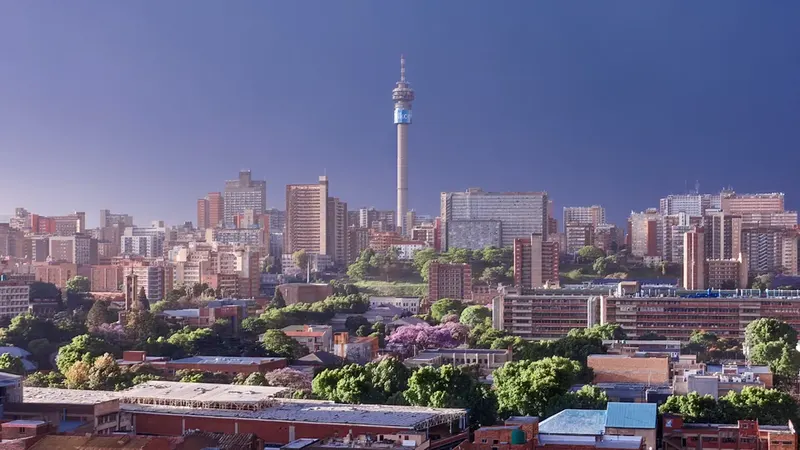
Born from an 1886 gold rush, Johannesburg is South Africa's restless economic engine, a high-altitude city of enterprise, reinvention and profound history. This is where the story of apartheid and its undoing is told most powerfully, in Soweto, at Constitution Hill and inside the Apartheid Museum. Around them a creative city stirs, from the regenerated warehouses of Maboneng to leafy northern suburbs, all under the wide, storm-washed skies of the Highveld.
Johannesburg is a quieter alternative. It's ready to explore in the Nuvoha app: set your budget and see complete Johannesburg trips.
Why visit Johannesburg
Johannesburg rewards travellers who want to understand modern South Africa. The Apartheid Museum traces the rise and fall of racial segregation with unflinching clarity, and in Soweto you can stand on Vilakazi Street, the only street to have housed two Nobel laureates, visit Nelson Mandela's former home and the Hector Pieterson Memorial to the 1976 uprising. Constitution Hill turns a former prison into a living seat of the Constitutional Court. Beyond the history, the city offers the art and markets of Maboneng and Braamfontein, the malls and galleries of Sandton and Rosebank, and easy access to the Cradle of Humankind, where fossil caves hold some of our earliest ancestors.
History, art and origins
- Apartheid Museum: A powerful, unflinching account of South Africa's era of racial segregation and the long struggle to end it.
- Soweto and Vilakazi Street: The historic township where Mandela's house, the Hector Pieterson Memorial and lively eateries sit within walking distance.
- Constitution Hill: A former prison and fort, now home to the Constitutional Court, telling the story of injustice and its overturning.
- Maboneng Precinct: A regenerated pocket of the inner east, with warehouse galleries, studios, cafes and a weekend market.
- Cradle of Humankind: A UNESCO site north-west of the city, where the Sterkfontein Caves have yielded famous early-hominin fossils.
- Nelson Mandela Square: A Sandton plaza dominated by a towering statue of Mandela, ringed by shops and restaurants.
Neighbourhood by neighbourhood
- Sandton: The affluent financial hub north of the centre, built around malls, offices and Nelson Mandela Square.
- Rosebank: A walkable northern district of galleries, malls and a lively Sunday rooftop market.
- Maboneng: A regenerated creative quarter in the inner east, known for art spaces, studios and cafes.
- Braamfontein: A student and arts district near the university, busy with markets, galleries and nightlife.
- Melville: A bohemian older suburb of tree-lined streets, bars and bookshops along 7th Street.
- Soweto: The vast, historic township south-west of the centre, central to the anti-apartheid story and full of life.
The Joburg table
Johannesburg eats across every one of South Africa's cultures. The braai, a social barbecue, is close to a national institution, turning out boerewors sausage, steaks and chops, while township kitchens serve shisanyama grills, pap and gravy, and the loaded street sandwich known as a kota. Look for chakalaka relish, biltong and dried sausage to snack on, and Sunday tables laden with the slow-cooked stews of many communities. The northern suburbs add polished dining from around the world, but the soul of the city's food is smoky, generous and shared.
- Braai (boerewors and chops)
- Pap and chakalaka
- Shisanyama
- Kota (township sandwich)
- Biltong
- Vetkoek
What Johannesburg feels like
Johannesburg is fast, entrepreneurial and endlessly reinventing itself, a city that lives at altitude and at speed. The old central business district has given way to new energy in the northern suburbs and pockets of inner-city regeneration, and the mood shifts sharply from block to block. Summers bring dramatic afternoon thunderstorms that clear as quickly as they arrive, then wide blue skies; winter days are dry, bright and crisp, cold once the sun drops. Locals are warm, direct and quick to talk, whether over a weekend braai or at a Sunday market. It pays to stay street-smart, use ride-hailing after dark and keep valuables out of sight.
Getting around
Johannesburg is a driving city, spread wide and built around freeways, so most visitors rely on ride-hailing apps, which are cheap, reliable and safer than walking unfamiliar streets. The Gautrain rapid-rail line is the standout for public transport, linking O.R. Tambo airport with Sandton, Rosebank and Pretoria quickly and comfortably. The Rea Vaya bus network covers some routes, but walking between districts is not advised, especially after dark. Hiring a car suits day trips to the Cradle of Humankind. O.R. Tambo International Airport (JNB), east of the city, is the busiest in Africa and the main gateway; the Gautrain runs from its terminal to Sandton in around fifteen minutes. Lanseria Airport (HLA), to the north-west, handles some domestic and regional flights.
Good to know
- South Africans are warm and direct; greet people properly before getting down to business.
- Stay aware of your surroundings, keep phones and valuables out of sight, and use ride-hailing rather than walking after dark.
- Ask before photographing people, particularly in townships, and consider a guided tour that supports the community.
- Tipping is customary: around ten percent in restaurants, and a little for car guards and petrol attendants.
- Use ride-hailing apps to get around; they are inexpensive and spare you unfamiliar roads and parking.
- Take the Gautrain from the airport to Sandton or Rosebank to skip the traffic on arrival.
- Give Soweto and the Apartheid Museum a full day, ideally with a knowledgeable local guide.
- Summers bring afternoon thunderstorms, so plan outdoor sightseeing for the morning.
- Winter days are sunny but nights are cold at altitude, so pack warm layers.
- Keep valuables out of sight in traffic and avoid walking alone in quiet areas, day or night.
Best for
- City breaks
- Quieter travel
Key facts
| Country | South Africa |
|---|---|
| Region | Africa |
| Airports | JNB |
| Trip length fit | Short-trip friendly |
Johannesburg essentials
| Currency | South African Rand (ZAR) |
|---|---|
| Language | Twelve official languages including English, isiZulu, isiXhosa and Afrikaans; English is spoken almost everywhere visitors go |
| Time zone | South African Standard Time, UTC+2, no daylight saving |
| Emergency number | 10111 (police); 112 from any mobile |
| Driving side | Left |
| Tap water | Safe to drink in Cape Town, Johannesburg and most major towns; ask locally in rural areas |
Climate & seasons
| Month | Typical range | Season |
|---|---|---|
| January | 15°C to 26°C | Warm rainy summer |
| April | 10°C to 22°C | Mild autumn |
| July | 4°C to 17°C | Dry cool winter |
| October | 11°C to 24°C | Warm spring |
Typical stay
- Weekend-friendly
- Short break (2–5 days)
Johannesburg works as a weekend break just as well as a longer stay.
Getting there
Johannesburg is served via JNB.
- JNB
Is it your kind of trip?
Ideal if…
- you like walkable city energy
- you like places before everyone else finds them
Maybe not if…
- a beach-first holiday is the priority
Pairs well with
Compare with
More in Africa
Near Johannesburg
Travel style
- Short-trip friendly
- City
Frequently asked questions
Which airports serve Johannesburg?
Johannesburg is served via JNB.
Is Johannesburg good for a weekend trip?
Yes, Johannesburg works for a weekend as well as a longer stay.
What kind of trip is Johannesburg best for?
Johannesburg is best for city trips.
Which destinations pair well with Johannesburg?
Within multi-city range: Durban (503 km), Cape Town (1,272 km).
Is Johannesburg safe for tourists?
Johannesburg has real crime challenges, so common sense matters: use ride-hailing apps rather than walking, keep valuables out of sight, avoid quiet streets after dark, and favour busy, well-known areas and guided tours. Many visitors spend time here without trouble by staying alert and taking local advice.
How many days do you need in Johannesburg?
Two to three days covers the essentials: a full day for Soweto and the Apartheid Museum, another for Constitution Hill, Maboneng and the northern suburbs, and time for a day trip to the Cradle of Humankind if the fossils appeal.
What is the best way to get around?
Ride-hailing apps for the city and the Gautrain for the airport, Sandton, Rosebank and Pretoria. Distances are large and walking is not recommended, so plan to travel by car or rail between sights.
How is Johannesburg different from Cape Town or Durban?
Johannesburg is the inland economic and historical heart, high on the Highveld with no coastline, focused on business, art and the story of apartheid. Cape Town is the scenic peninsula, and Durban the warm Indian Ocean beach city, so many travellers combine two of the three.