
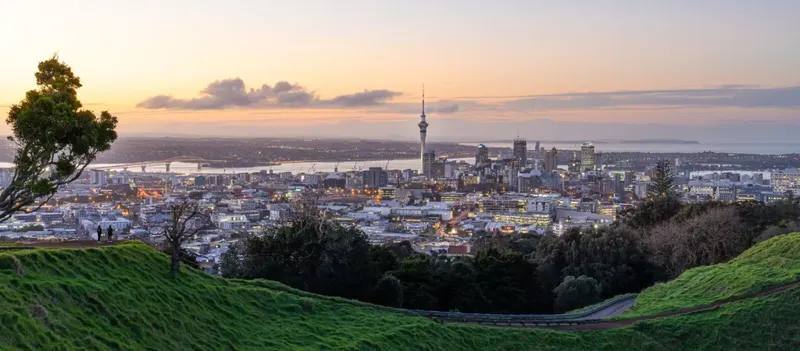
New Zealand sits far out in the South Pacific, two main islands (plus many smaller ones) that squeeze an improbable range of landscapes into a country roughly the size of the United Kingdom. The North Island runs from Auckland's harbours and the Bay of Islands down through Rotorua's steaming geysers and the volcanoes of the central plateau to the capital, Wellington. The South Island answers with the Southern Alps, the glaciers of the west coast and the mirror-still waters of Milford Sound in Fiordland. Maori culture is woven through daily life, from the haka to place names and the marae, and the welcome comes with a strong outdoor streak: hiking, skiing, kayaking and the bungy jumping that Queenstown made famous. Drive on the left and keep the camera handy.
Auckland is the New Zealand destination on Nuvoha today. Set your budget and Nuvoha builds the complete trip: flights and hotels together.
Why visit New Zealand
- Cities you can explore on foot, from headline sights to quiet neighbourhoods
Best known for
- Milford Sound and Fiordland
- Adventure sports in Queenstown
- Maori culture
- Film locations
- Geothermal Rotorua
- Rugby and the All Blacks
Two islands, region by region
- Auckland and Northland: The largest city sprawls between two harbours in the warm north, gateway to the subtropical Bay of Islands, the Waitangi treaty grounds and the long finger of land ending at Cape Reinga.
- Rotorua and the central plateau: The North Island's volcanic heart, with Rotorua's geysers, hot springs and Maori cultural villages, the great lake at Taupo and the peaks of Tongariro National Park.
- Wellington and the lower North Island: The compact capital packs a cafe and film scene and the national Te Papa museum onto a windy harbour, with the Martinborough vineyards a short hop away.
- Christchurch and Canterbury: The South Island's largest city, rebuilt with fresh energy since its earthquakes, sits on the Canterbury plains between the Southern Alps and the hills of Banks Peninsula.
- Queenstown and Fiordland: The adventure capital on Lake Wakatipu opens onto Central Otago's wine country and the deep, waterfall-hung sounds of Fiordland, including Milford and Doubtful Sounds.
- The West Coast and Southern Alps: A wild, rain-fed coast where the Franz Josef and Fox glaciers spill from the mountains, crowned inland by Aoraki (Mount Cook), the country's highest peak.
Where to go
New Zealand essentials
| Currency | New Zealand Dollar (NZD) |
|---|---|
| Language | English, Maori and New Zealand Sign Language are official; English is used day to day |
| Time zone | New Zealand Standard Time (UTC+12, UTC+13 with daylight saving from late September to early April) |
| Emergency number | 111 (all emergencies) |
| Driving side | Left |
| Tap water | Safe to drink from the tap in towns and cities |
Seasons at a glance in Auckland
| Month | Typical range | Season |
|---|---|---|
| January | 17°C to 24°C | Warm summer |
| April | 13°C to 20°C | Mild autumn |
| July | 8°C to 15°C | Cool wet winter |
| October | 11°C to 18°C | Changeable spring |
Seasons vary across New Zealand. Each destination page has its own climate table.
More in Oceania
More Oceania country guides
Frequently asked questions
Which New Zealand destinations can I book with Nuvoha?
Auckland, with complete flight and hotel trips built around your budget.
What kind of trips suit New Zealand?
New Zealand works for city breaks.
What is the best way to get around New Zealand?
Most visitors hire a car or campervan, since the highlights are spread along scenic roads and public transport between towns is limited. Domestic flights and the Cook Strait ferry connect the two islands, and the TranzAlpine is a memorable rail crossing of the Southern Alps.
Which side of the road do you drive on in New Zealand?
The left, as in the UK, Australia and Japan. Roads are often narrow and winding, so distances take longer than the map suggests; allow extra time and take regular breaks on longer drives.
When is the best time to visit New Zealand?
Seasons are reversed from the northern hemisphere: summer runs from December to February for beaches and hiking, while the ski fields around Queenstown and Ruapehu open from roughly June to September. Spring and autumn are quieter and mild.
What plug type does New Zealand use?
Type I, the angled flat-pin plug shared with Australia, at 230 volts. Visitors from the UK, Europe and North America all need an adapter.