
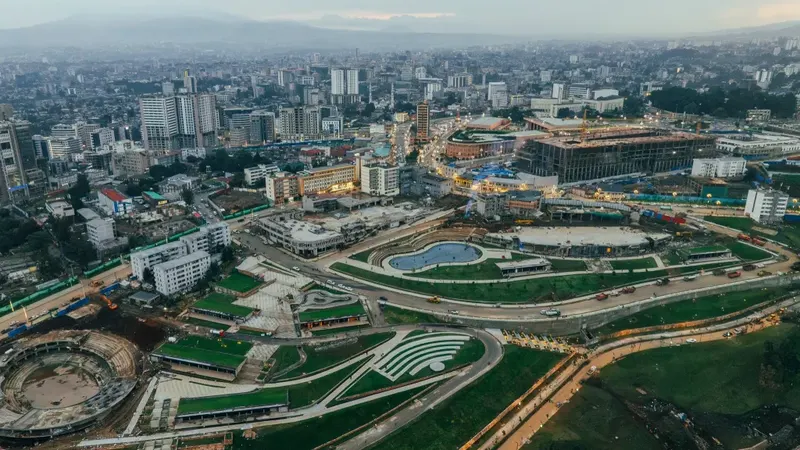
Ethiopia keeps its own calendar and its own clock, and counts itself among the few African nations never formally colonised, a history it wears with pride. The highlands rise green and cool around Addis Ababa, one of the highest capital cities on Earth at roughly 2,400 metres, and climb higher still to the jagged Simien Mountains, where gelada monkeys graze in troops thousands strong. To the north stand wonders of the medieval world: the rock-hewn churches of Lalibela, cut down into the ground some eight centuries ago, and the towering stone obelisks of Aksum. Drop east into the Danakil Depression and the land turns to bubbling sulphur and open lava. Coffee was first brewed here, and the ceremony that surrounds it is still a daily ritual of welcome.
Addis Ababa is the Ethiopia destination on Nuvoha today. Set your budget and Nuvoha builds the complete trip: flights and hotels together.
Why visit Ethiopia
- Cities you can explore on foot, from headline sights to quiet neighbourhoods
- Quieter alternatives beyond the obvious stops
Best known for
- The rock-hewn churches of Lalibela
- Gondar's royal castles
- The Simien Mountains and gelada monkeys
- The Danakil Depression's lava lake
- Coffee ceremonies in coffee's birthplace
- Injera and richly spiced stews
Highlands and beyond
- Addis Ababa and the Central Highlands: The lively capital, one of the highest cities in the world, holds the National Museum and the fossil skeleton of Lucy, with the Entoto hills and eucalyptus forests rising just above.
- Lalibela and the Historic North: The rock-hewn churches of Lalibela, still living places of worship carved from solid stone, alongside the royal castles of Gondar, Lake Tana with its island monasteries and the Blue Nile Falls at Bahir Dar.
- The Simien Mountains: A UNESCO-listed range of sheer escarpments and grassy summits, home to grazing gelada monkeys, the rare walia ibex and Ras Dashen, the highest peak in the country.
- Tigray and Aksum: The far north, where the obelisks and tombs of the ancient Aksumite kingdom stand near the sandstone temple of Yeha and dozens of churches carved into remote cliffs.
- Harar and the Danakil: The walled old town of Harar in the east, a maze of mosques and markets, and to its north the Danakil Depression, where the Erta Ale lava lake glows and the Dallol springs bubble in one of the hottest places on Earth.
- The Rift Valley and the South: The Great Rift Valley strings together lakes and the Bale Mountains, home of the rare Ethiopian wolf, while further south the Omo Valley holds a mosaic of distinct peoples and the terraced Konso landscape.
Where to go
Ethiopia essentials
| Currency | Ethiopian Birr (ETB) |
|---|---|
| Language | Amharic, written in its own Ge'ez script, is the federal working language; Oromo, Tigrinya, Somali and many others are widely spoken, and English is used in business and tourism |
| Time zone | East Africa Time (UTC+3), no daylight saving |
| Emergency number | 911 (police) and 907 (ambulance) in Addis Ababa; numbers can vary by city |
| Driving side | Right |
| Tap water | Not safe from the tap; bottled water is widely available |
Seasons at a glance in Addis Ababa
| Month | Typical range | Season |
|---|---|---|
| January | 8°C to 23°C | Dry mild season |
| April | 11°C to 24°C | Mild spring |
| July | 11°C to 21°C | Cool rainy season |
| October | 8°C to 22°C | Mild post-rains |
Seasons vary across Ethiopia. Each destination page has its own climate table.
More in Africa
More Africa country guides
Frequently asked questions
Which Ethiopia destinations can I book with Nuvoha?
Addis Ababa, with complete flight and hotel trips built around your budget.
What kind of trips suit Ethiopia?
Ethiopia works for city breaks.
Why are the date and time different in Ethiopia?
Ethiopia follows the Ge'ez calendar, which runs about seven to eight years behind the Gregorian one and has thirteen months: twelve of thirty days plus a short final month. Many people also count the hours from dawn, so what a local calls one o'clock in the morning can be seven by the Western clock. Agree which system you mean when booking.
Will the altitude affect me?
It can. Much of the country, including Addis Ababa and the Simien and Bale mountains, sits above 2,000 metres, and some trekking routes climb beyond 4,000. Allow a day or two to adjust after you arrive, take the first days gently, and expect cool nights even near the equator.
How do you get around Ethiopia?
Because the roads are long and mountainous, many visitors fly the historic northern circuit of Bahir Dar, Gondar, Lalibela and Aksum, linked by frequent domestic flights. Elsewhere, hired cars with drivers are the usual way to cover ground, and Addis Ababa has a light-rail line.
What plug type does Ethiopia use?
Mostly Types C and F, the round two-pin European sockets, with some Type E and L outlets too, at 220 volts. Bring a European-style adapter, and a power bank is handy in case of outages.